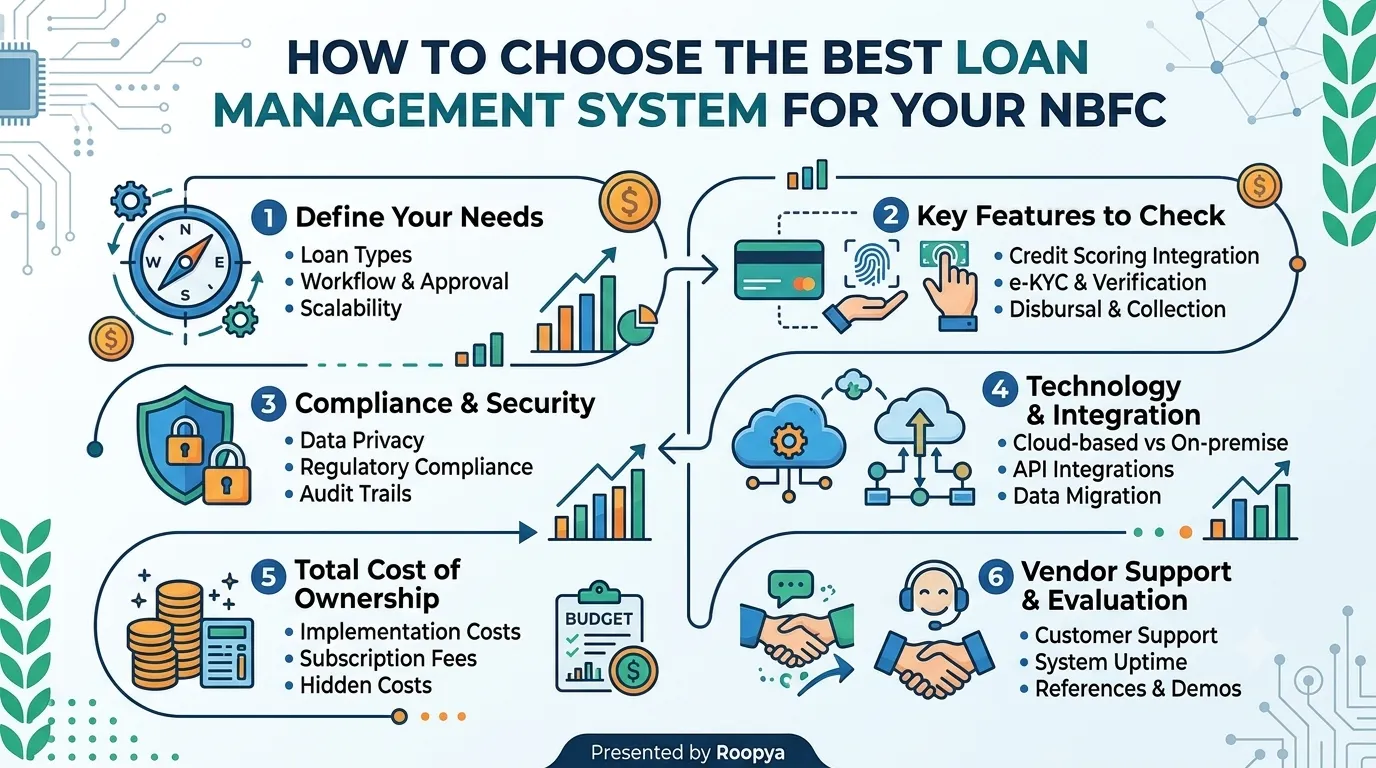

Running an NBFC in India has never been more demanding — or more exciting. The Reserve Bank of India's regulatory expectations are sharper than ever, borrower demand is growing faster than most lenders can service it manually, and the fintech ecosystem is raising the bar on what a great borrowing experience looks like. At the centre of every high-performing NBFC is one piece of technology that determines whether the business scales smoothly or collapses under its own operational weight: the Loan Management System (LMS).
Yet choosing the right LMS is not straightforward. The market is crowded with options ranging from legacy on-premise systems built in the 2000s to cloud-native, AI-powered platforms designed for the digital lending era. Features, pricing models, implementation timelines, and compliance capabilities vary wildly. A bad choice can cost your NBFC years of lost productivity, expensive re-implementations, and regulatory exposure. A good choice can be the single most valuable technology investment your organization makes.
This guide is designed to help NBFC founders, CFOs, COOs, and technology heads cut through the noise. We will explain exactly what a loan management system does, the ten critical criteria you must evaluate before making a decision, the common mistakes NBFCs make when choosing an LMS, and why platforms like Roopya represent the future of lending infrastructure in India.
1. What Is a Loan Management System and Why Does Your NBFC Need One?
A Loan Management System is the software platform that manages the complete lifecycle of a loan — from origination and disbursement through repayment, collections, and closure. Think of it as the operating system of your lending business. Every borrower interaction, every rupee disbursed, every EMI collected, every compliance report generated flows through your LMS.
For an NBFC operating without a dedicated LMS — or with a poorly chosen one — the consequences are severe. Loan officers juggle spreadsheets and WhatsApp messages to track repayments. Collections teams lack real-time visibility into delinquencies. Finance teams spend days every month reconciling disbursements manually. Compliance officers scramble to produce audit reports that should be generated in minutes. And borrowers experience delays, errors, and frustration that drives them to competitors.
A modern LMS eliminates all of this. It creates a single source of truth for your entire loan portfolio, automates routine processes that drain human resources, provides real-time analytics for sharper business decisions, and ensures every regulatory requirement is met consistently and without manual effort.
The question for NBFCs today is not whether to invest in an LMS — that decision has already been made for you by the competitive and regulatory environment. The question is which LMS to choose, and how to evaluate the options rigorously before committing.
2. The NBFC Lending Landscape in 2025: Why the Stakes Are Higher Than Ever
Before diving into evaluation criteria, it is worth understanding the environment in which your NBFC operates and why choosing the right LMS has become so consequential.
The RBI's scale-based regulation framework, introduced in 2022 and continually refined, has placed significantly higher compliance and reporting obligations on NBFCs at every tier. From mandatory Fair Practice Code adherence to stringent KYC norms under PMLA, from credit bureau reporting requirements to the growing expectations around digital record-keeping and audit trails — the regulatory burden on NBFCs has grown substantially. A loan management system that was adequate in 2019 may be genuinely non-compliant in 2025.
At the same time, the competitive environment has intensified. Fintech lenders backed by sophisticated technology stacks are encroaching on NBFC territory with faster approvals, lower processing costs, and superior borrower experiences. Traditional NBFCs that respond with better technology — including modern LMS platforms — are growing and winning market share. Those that do not are finding their customer acquisition costs rising and their portfolio quality declining.
Finally, the cost of switching systems mid-journey is enormous. Data migration, staff retraining, process redesign, and temporary productivity loss during transition make choosing the wrong LMS a very expensive mistake. Getting the decision right the first time is not just desirable — it is financially critical.
3. The Ten Critical Criteria for Choosing an LMS for Your NBFC
Criterion 1: End-to-End Loan Lifecycle Coverage
The first and most fundamental question to ask any LMS vendor is: does the platform cover the complete loan lifecycle, or does it only handle certain stages? A robust loan management system for an NBFC should manage the entire journey — loan origination and application processing, credit underwriting and bureau integration, sanction and documentation, disbursement, EMI scheduling and collection, delinquency management, foreclosure and pre-closure, and final loan closure.
Platforms that handle only part of this lifecycle force you to integrate multiple systems — an origination platform here, a collections module there, a reporting tool somewhere else. Every integration point is a potential failure point, a data consistency risk, and an ongoing maintenance cost. Prioritise platforms with native, end-to-end coverage. Roopya, for instance, provides a fully unified platform covering origination through collections — eliminating the need for patchwork integrations.
Criterion 2: No-Code Configurability
Lending businesses are dynamic. Your credit policies change as you learn from your portfolio. Your product offerings expand. Your processes evolve as you hire experienced talent. A loan management system that requires developer involvement every time you want to change a rule, add a field, or modify a workflow is a system that will slow your business down. In the fast-moving NBFC environment, the ability to make configuration changes quickly — without raising IT tickets or waiting weeks for development — is not a luxury. It is a competitive necessity.
Look for platforms with genuinely no-code configuration: visual workflow builders, drag-and-drop rule configuration in the Business Rule Engine (BRE), field-level customisation of application forms, and template-based document generation. Be sceptical of vendors who claim to be 'low-code' but require developer involvement for even basic configuration tasks. Test the configurability claim during the demo by asking the vendor to change a specific credit policy rule or add a product field — right there, in real time, without involving an engineer.
Criterion 3: Regulatory Compliance and RBI Alignment
For an NBFC operating under RBI supervision, regulatory compliance is not optional — it is existential. Your LMS must be continuously updated to reflect current RBI requirements, and it must make compliance easy rather than burdensome. Specific areas to evaluate include: KYC compliance (Aadhaar eKYC, PAN verification, VKYC, CKYC registry upload), PMLA compliance, credit bureau reporting (mandatory for all NBFCs above a threshold), CERSAI registration for secured loans, Fair Practice Code adherence including digital loan summary generation, and RBI audit trail requirements.
Ask prospective vendors for a specific compliance roadmap. How quickly do they update the platform when new RBI circulars are issued? Is compliance monitoring automated or does it depend on manual processes? Does the platform generate regulatory reports automatically, or does your team need to export data and build reports separately? Roopya maintains a dedicated regulatory compliance team that monitors RBI communications and pushes updates to the platform continuously — ensuring your NBFC is always aligned without requiring any internal compliance effort on your part.
Criterion 4: Integration Ecosystem
No LMS operates in isolation. Your platform must connect seamlessly with a wide ecosystem of third-party services: credit bureaus (CIBIL, Experian, Equifax, CRIF), KYC providers, eSign platforms, bank account verification services, payment gateways for EMI collection, NACH and e-mandate providers for auto-debit, accounting software (Tally, Zoho Books, SAP), and communication platforms (SMS, WhatsApp, email). The quality of these integrations — how many are pre-built, how deep they are, how reliably they work — has a dramatic impact on your operational efficiency.
The worst outcome is choosing an LMS with weak integration capabilities and then spending months and significant budget on custom API development. Ask each vendor for a specific list of pre-built integrations, not a vague claim about 'open APIs'. Find out how long it takes to activate each integration and whether there are per-integration fees. Roopya's platform comes pre-integrated with 300+ APIs, covering virtually every service an NBFC needs — with integrations that are fully tested, production-ready, and activated with a simple toggle.
Criterion 5: AI and Data Intelligence Capabilities
The gap between NBFCs that use AI-driven lending intelligence and those that do not is widening rapidly. Modern loan management systems embed artificial intelligence throughout the lending workflow — AI-powered document OCR that extracts data from bank statements, salary slips, and ITRs with greater than 99% accuracy; ML-based credit scoring that supplements bureau data with alternative data signals; fraud detection algorithms that identify suspicious patterns in real time; predictive analytics that flag at-risk loans in your portfolio before they become NPAs; and natural language processing for automated borrower communication and query resolution.
When evaluating AI capabilities, look beyond marketing claims. Ask to see specific accuracy metrics for document processing. Ask how the credit scoring model is trained and updated. Ask how fraud signals are identified and what happens when one is flagged. The best platforms, like Roopya, have AI built into the core architecture — not as a separate module or an expensive add-on, but as a native capability that improves with every loan processed on the platform.
Criterion 6: Scalability and Performance
Your NBFC's loan volume today is not your loan volume in three years. A platform that handles your current portfolio perfectly but struggles under growth is a platform that will force a painful and expensive re-implementation at exactly the moment your business needs stability. Scalability must be evaluated along two dimensions: technical scalability (can the platform handle ten times your current volume without performance degradation?) and operational scalability (can you add new products, geographies, channels, and team members without fundamental re-architecture?).
Cloud-native platforms have an inherent advantage here. Unlike on-premise systems that require hardware upgrades to scale, cloud platforms scale horizontally on demand. Ask vendors about their uptime SLAs, their performance under load, and whether they can share case studies of customers who have scaled significantly on their platform. Specifically, ask whether pricing scales proportionally with volume or whether there are pricing cliff-edges that make growth expensive. Roopya's cloud infrastructure scales automatically with your portfolio, and its pay-as-you-use pricing model means your costs grow proportionally with your revenue — not ahead of it.
Criterion 7: Collections and Delinquency Management
Collections is where many NBFCs experience their most significant operational pain. A weak collections module in your LMS can mean the difference between a healthy NPA ratio and a portfolio in distress. Your LMS must provide: automated EMI demand notices via SMS, WhatsApp, and email; real-time delinquency tracking across buckets (DPD 0-30, 30-60, 60-90, 90+); automated dunning workflows with configurable escalation rules; field collections agent app integration for on-ground recovery; legal action tracking for NPA accounts; and SARFAESI compliance support for secured lending.
Test the collections module specifically during your evaluation. Look at the delinquency dashboard — is it real-time? Are collections workflows configurable without IT involvement? How does the system handle NACH bounce scenarios and retry logic? Can your collections team manager view team performance across agents in real time? Roopya's collections module includes all of these capabilities, with AI-powered delinquency prediction that flags high-risk accounts up to 30 days before they go into default — giving your collections team a critical head start.
Criterion 8: Multi-Product and Multi-Branch Support
Most NBFCs do not operate with a single loan product or a single location. As your business grows, you will offer multiple product lines — personal loans, business loans, gold loans, MSME credit — across multiple geographies and potentially through multiple channels including direct, DSA networks, and fintech partnerships. Your LMS must support this complexity natively, with product-specific workflows, pricing, documentation, and reporting — all managed from a single platform.
Ask vendors to walk you through how they would set up a second loan product or a new branch on their platform. How long does it take? Does it require vendor involvement, or can your team do it independently? Are product-level P&L reports available separately? Roopya supports unlimited loan products and unlimited branches from a single platform, with product-specific configuration that your team can manage independently through the no-code interface.
Criterion 9: Reporting, Analytics, and MIS
A loan management system that does not give you deep, real-time visibility into your portfolio is a system that is managing your past rather than helping you shape your future. Comprehensive MIS and analytics capabilities should include: portfolio-level dashboards with real-time NPA ratios, disbursement trends, and collection efficiency; product-level profitability analysis; branch and channel performance reports; cohort analysis for understanding borrower behaviour over time; regulatory reports ready for RBI submission; board-level dashboards with customisable KPIs; and data export capabilities for your analytics team.
During demos, specifically request the reports your management team currently reviews manually. Find out whether those reports can be generated automatically by the platform. The best LMS platforms reduce your MIS team's monthly reporting burden from days to minutes. Roopya's analytics layer provides real-time portfolio intelligence across every dimension — with pre-built regulatory reports, customisable dashboards, and data export via API for advanced analytics use cases.
Criterion 10: Implementation Speed and Vendor Support Quality
The final criterion is often underweighted but critically important: how quickly can you go live, and what quality of support will you receive after go-live? A platform that takes six months to implement costs you six months of competitive disadvantage and burns your team's energy on implementation management rather than business growth. A platform with weak post-implementation support leaves you stranded when issues arise.
Ask vendors for a specific, committed go-live timeline — not a vague estimate. Ask for references from customers in similar segments (same NBFC size, similar product mix) and actually call those references. Ask about the support model: is there a dedicated account manager? What are the SLAs for issue resolution? Is there 24/7 support availability for critical issues? Roopya's platform is designed for 1-day go-live with a dedicated implementation support team and ongoing account management — not a support ticket queue.
4. Common Mistakes NBFCs Make When Choosing an LMS
Mistake 1: Choosing on Price Alone
The cheapest LMS is almost never the best value. A low-cost platform that requires expensive custom development, generates high operational costs through manual workarounds, or needs replacement within two years costs far more in total than a well-priced modern platform. Evaluate total cost of ownership over three to five years — including implementation, customisation, maintenance, integration development, and the opportunity cost of staff time spent on manual processes the platform does not automate.
Mistake 2: Not Testing with Real Scenarios
Many NBFCs are won over by polished demos using sample data and ideal scenarios. During your evaluation, insist on testing the platform with your actual data and your actual edge cases. What happens when an application has a bureau freeze? How does the system handle a partial EMI payment? What does the delinquency escalation workflow look like for a borrower in DPD 60? Real-world testing reveals the gaps that curated demos hide.
Mistake 3: Ignoring Scalability Until It Is Too Late
Choosing a platform sized for today's volume is a classic NBFC mistake. A system that handles 500 loans a month may buckle under 5,000. Evaluate scalability requirements based on your three-year growth plan, not your current run rate. The switching cost at scale is exponentially higher than the cost of choosing a scalable platform from the start.
Mistake 4: Underestimating Data Migration Complexity
If you are migrating from an existing system, data migration deserves at least as much planning as the platform selection itself. Historical loan data, repayment records, collateral details, and borrower information must migrate accurately and completely. Ask vendors about their data migration methodology, their track record with migrations of similar complexity, and what happens if discrepancies are found post-migration.
Mistake 5: Choosing a Platform That Cannot Keep Up with Regulation
The RBI's regulatory environment evolves continuously. A platform that is compliant today may be non-compliant in 12 months if the vendor does not maintain an active regulatory update programme. Ask vendors for a specific example of a regulatory change they implemented in the past 12 months — how quickly it was implemented, what the process looked like, and whether it required any action from their customers.
5. On-Premise vs. Cloud LMS: What NBFCs Should Know
Historically, many NBFCs defaulted to on-premise LMS deployments — partly from data security concerns and partly because cloud options were immature. That calculus has changed decisively. Cloud-native LMS platforms now offer enterprise-grade security, full data localisation on Indian servers (meeting RBI data localisation requirements), and dramatically superior scalability and update cadence compared to on-premise alternatives.
On-premise systems require significant upfront capital investment in hardware and licences, ongoing infrastructure management, and manual update processes. Every regulatory update requires a planned deployment, often with associated downtime. Cloud platforms push updates continuously without downtime, scale on demand, and eliminate the hardware capital expenditure entirely.
For most NBFCs — and especially for growth-stage NBFCs where capital efficiency matters — a cloud-native LMS is unambiguously the right choice. Roopya is fully cloud-native, deployed on Indian servers for data sovereignty, and updated continuously to reflect the latest regulatory requirements without requiring any action from the NBFC.
6. The Role of Embedded Finance and Open APIs in Modern NBFC Operations
The next generation of NBFC growth will not come solely from direct-to-borrower channels. Embedded finance — where lending products are integrated directly into the platforms that borrowers already use, whether it is an e-commerce marketplace, a payroll platform, or an ERP for SME businesses — represents a massive growth opportunity. But realising that opportunity requires an LMS with open, well-documented APIs that can deliver loan origination, status tracking, and repayment functionality to partner platforms with minimal integration effort.
When evaluating an LMS, ask about its API-first architecture. Can a fintech partner integrate your lending product into their platform using a documented, stable API? Can channel-specific credit policies and pricing be configured independently? Is there a sandbox environment for partners to test integrations without affecting your production portfolio? Roopya's open API architecture is explicitly designed for embedded finance use cases, with a full partner API suite, sandbox environment, and dedicated integration support for channel partners.
7. How Roopya Addresses Every LMS Selection Criterion
Roopya is a no-code digital lending infrastructure platform purpose-built for Indian NBFCs, banks, and MFIs. It was designed with the explicit knowledge that Indian lenders operate in one of the world's most complex regulatory environments, with one of the most diverse borrower populations and the fastest-growing digital credit market. Here is how Roopya specifically addresses each of the ten criteria outlined in this guide:
- End-to-End Coverage: Roopya covers origination, underwriting, disbursement, repayment, collections, and closure in a single unified platform — no integration patchwork required.
- No-Code Configurability: Business users configure credit policies, workflows, product parameters, and forms through an intuitive visual interface — zero developer involvement for routine configuration.
- RBI Compliance: Roopya's regulatory compliance team monitors RBI circulars and pushes updates continuously. KYC, PMLA, credit bureau reporting, CERSAI, and audit trail requirements are all handled automatically.
- Integration Ecosystem: 300+ pre-built, production-ready API integrations covering every service an NBFC needs — bureaus, KYC, eSign, payments, NACH, accounting, and communications.
- AI Intelligence: Native AI powers document analysis (99%+ accuracy), ML credit scoring, real-time fraud detection, predictive NPA identification, and conversational borrower interfaces.
- Scalability: Cloud-native infrastructure scales automatically from 100 to 100,000 loans per month with pay-as-you-use pricing that grows proportionally with your portfolio.
- Collections Excellence: Real-time delinquency tracking, configurable dunning workflows, field agent app integration, NACH bounce handling, and AI-powered early warning systems.
- Multi-Product and Multi-Branch: Unlimited products and branches from a single platform, with independent configuration and reporting per product and channel.
- Analytics and MIS: Real-time portfolio dashboards, pre-built regulatory reports, customisable KPI monitoring, and open data export for advanced analytics.
- Fast Go-Live and Strong Support: 1-day go-live with dedicated implementation support and ongoing account management — not a ticket queue.
Lenders including IndiaKaLoan, QuickFinShop, Recapita, Findoc, and EazyCredit run their complete lending operations on Roopya — and growing.
8. Questions to Ask Every LMS Vendor Before You Sign
- What is the committed go-live timeline, and what happens if you miss it?
- Show me how to change a credit policy rule right now, without involving your engineers.
- Which credit bureaus and KYC providers are pre-integrated, and how long does activation take?
- How do you handle RBI regulatory updates — what was the last major update, and how quickly was it implemented?
- Can you provide three NBFC references in my segment that I can speak to directly?
- What is the total cost of ownership over three years, including implementation, integration, and maintenance?
- Is your platform hosted on Indian servers? What certifications do you hold for data security?
- How does your pricing model work as my loan volume grows?
- What is your data migration methodology, and what guarantees do you provide on migration accuracy?
- What does your support model look like post go-live — SLAs, escalation paths, account management?
9. A Step-by-Step LMS Selection Process for NBFCs
If you are beginning the LMS selection process, here is a structured approach that will help you make the right decision efficiently:
- Step 1 – Define Your Requirements: Document your current loan products, average monthly volumes, team structure, key integrations needed, and growth projections for the next three years. This becomes your RFP baseline.
- Step 2 – Shortlist Vendors: Identify four to six vendors that appear to meet your requirements based on initial research and peer recommendations. Include at least one modern cloud-native platform alongside any legacy vendors you are considering.
- Step 3 – Send a Structured RFP: Issue a Request for Proposal that covers all ten evaluation criteria from this guide. Require specific, verifiable responses — not marketing language.
- Step 4 – Conduct Live Demos with Your Scenarios: Schedule 90-minute demos with each shortlisted vendor. Use your own loan scenarios and edge cases. Ask vendors to perform live configuration changes without engineering support.
- Step 5 – Check References Rigorously: Speak directly to at least two customer references per vendor. Ask specifically about implementation experience, post-go-live support quality, and compliance update responsiveness.
- Step 6 – Run a Proof of Concept: For your top two vendors, request a time-boxed proof of concept using your actual data and processes. This is the most reliable signal of real-world fit.
- Step 7 – Negotiate Contract Terms: Pay particular attention to data portability clauses (your ability to extract your data if you switch), SLA commitments, pricing escalation terms, and regulatory update responsibilities.
- Step 8 – Plan the Implementation: Before signing, agree on a specific implementation plan with milestones, go-live date, data migration methodology, and team training schedule. Get these commitments in the contract.
10. The Future of Loan Management for NBFCs: What to Prepare For
The loan management systems of the next decade will be dramatically more intelligent, more embedded, and more real-time than what exists today. NBFCs that choose platforms built on modern, extensible architecture will be positioned to leverage these advances as they emerge. Those locked into legacy systems will find themselves perpetually behind.
Key trends to factor into your LMS selection: the Account Aggregator ecosystem, now live and growing, will make bank statement data, investment data, and insurance data available for underwriting through a consent-based framework — your LMS must be able to consume and act on AA data natively. The OCEN (Open Credit Enablement Network) framework will create new origination channels for NBFCs through embedded finance partnerships — your LMS must support API-based, channel-agnostic origination. Real-time collections through UPI and the expansion of e-mandate infrastructure will change repayment dynamics — your LMS must support these payment rails natively.
Roopya is already integrated with the AA ecosystem, the OCEN framework, and all major UPI and e-mandate providers. Choosing Roopya today means you are not just solving your current LMS problems — you are positioning your NBFC for the next decade of digital lending growth.
——————————————————————————————————————————————————————————————————————
FREQUENTLY ASKED QUESTIONS (FAQ)
Q1: What is the difference between a Loan Management System and a Loan Origination System?
A Loan Origination System (LOS) covers the front-end of the lending process — application capture, KYC, credit decisioning, and sanction. A Loan Management System (LMS) covers the full lifecycle including disbursement, repayment management, collections, and closure. Many modern platforms like Roopya unify both into a single integrated system, which is the preferred architecture for NBFCs that want a single source of truth for their entire portfolio.
Q2: How long does it typically take to implement an LMS for an NBFC?
Traditional on-premise LMS implementations can take six to twelve months. Modern cloud-native platforms like Roopya are designed for dramatically faster deployment — with a 1-day go-live architecture for standard configurations. Complex implementations with extensive data migration and custom integrations may take a few weeks, but the days of months-long LMS implementations are over for NBFCs choosing modern platforms.
Q3: Is a cloud-based LMS safe enough for an NBFC's sensitive borrower data?
Yes, provided the platform is hosted on Indian servers (meeting RBI data localisation requirements), holds relevant data security certifications (ISO 27001, SOC 2), uses AES-256 encryption for data at rest and in transit, and implements role-based access controls. Roopya meets all of these requirements. In many cases, cloud-based platforms offer stronger security than on-premise deployments because of dedicated security infrastructure and continuous monitoring.
Q4: How does an LMS help with RBI compliance?
A well-designed LMS automates compliance across multiple dimensions: it enforces KYC procedures through integrated verification APIs, generates digital consent records and loan summaries as required under the Fair Practice Code, maintains comprehensive audit trails for every action taken on a loan account, produces credit bureau reporting files automatically, and updates its compliance logic whenever the RBI issues new circulars. Roopya's platform specifically reduces your compliance team's manual burden to near-zero for routine regulatory requirements.
Q5: Can an LMS handle multiple loan products and branches from a single platform?
Yes — and it should. The best LMS platforms support unlimited product configurations and unlimited branch or channel setups from a single backend, with product-specific workflows, pricing, documentation, and MIS reporting. Roopya supports this natively, with no-code product and branch configuration that your team can manage independently without vendor involvement.
Q6: What integrations are most critical for an NBFC's LMS?
The most critical integrations are: credit bureaus (CIBIL, Experian, CRIF, Equifax), KYC APIs (Aadhaar eKYC, PAN, Digilocker, VKYC), eSign providers, NACH and e-mandate providers for EMI auto-debit, payment gateways, bank account verification services, and CERSAI for secured loan registrations. Roopya comes pre-integrated with 300+ APIs covering all of these categories and more — fully tested and ready to activate.
Q7: How does AI improve loan management for NBFCs?
AI improves loan management at multiple stages: AI-powered document OCR extracts data from uploaded documents with 99%+ accuracy, eliminating manual data entry errors. ML-based credit scoring supplements bureau data with alternative signals for richer underwriting decisions. Fraud detection algorithms identify suspicious application patterns in real time. Predictive analytics flag at-risk accounts in the performing portfolio before they slip into default. Together, these capabilities reduce both credit risk and operational costs substantially.
Q8: What should I look for in an LMS vendor's support model?
Look for: a dedicated account manager rather than a generic support queue; committed SLAs for issue resolution (critical issues within hours, not days); proactive regulatory update communications; a customer success programme that helps you optimise platform usage over time; and a community of similar NBFCs using the platform where you can learn from peer experiences. Weak post-implementation support is one of the most common complaints about LMS vendors — verify this through references before signing.
Q9: How does Roopya's pricing model work for NBFCs?
Roopya uses a pay-as-you-use model with zero upfront licensing costs. NBFCs pay based on actual loan processing volume, meaning costs scale proportionally with revenue. There are no large capital expenditure requirements, no annual maintenance fees, and no surprise charges for regulatory updates or new feature releases. This model is particularly well-suited for growth-stage NBFCs where capital efficiency is critical.
Q10: Can Roopya's LMS support collections and NPA management?
Yes. Roopya's collections module provides real-time delinquency tracking across DPD buckets, automated demand notice delivery via SMS, WhatsApp, and email, configurable dunning escalation workflows, NACH bounce handling and retry logic, field collections agent app integration, legal action tracking, and AI-powered early warning signals that predict accounts at risk of default up to 30 days in advance. This early warning capability is one of the most impactful features for NBFCs managing portfolio quality proactively.
Q11: Is Roopya suitable for small or newly registered NBFCs?
Absolutely. Roopya's pay-as-you-use pricing model, 1-day go-live, and pre-configured loan product templates make it equally accessible for newly registered NBFCs processing their first loans as it is for established NBFCs with large portfolios. Several NBFCs have launched their first lending product entirely on the Roopya platform, benefiting from enterprise-grade infrastructure from day one.
Q12: What happens to our loan data if we decide to switch platforms in the future?
Data portability should be a contractual requirement, not an assumption. Roopya provides full data export capabilities in standard formats, ensuring you can extract your complete loan portfolio data at any time. This is an important clause to explicitly negotiate into any LMS contract — your borrower data and loan history belong to your NBFC and must be freely accessible regardless of your relationship with the software vendor.


























Sign in to leave a comment.