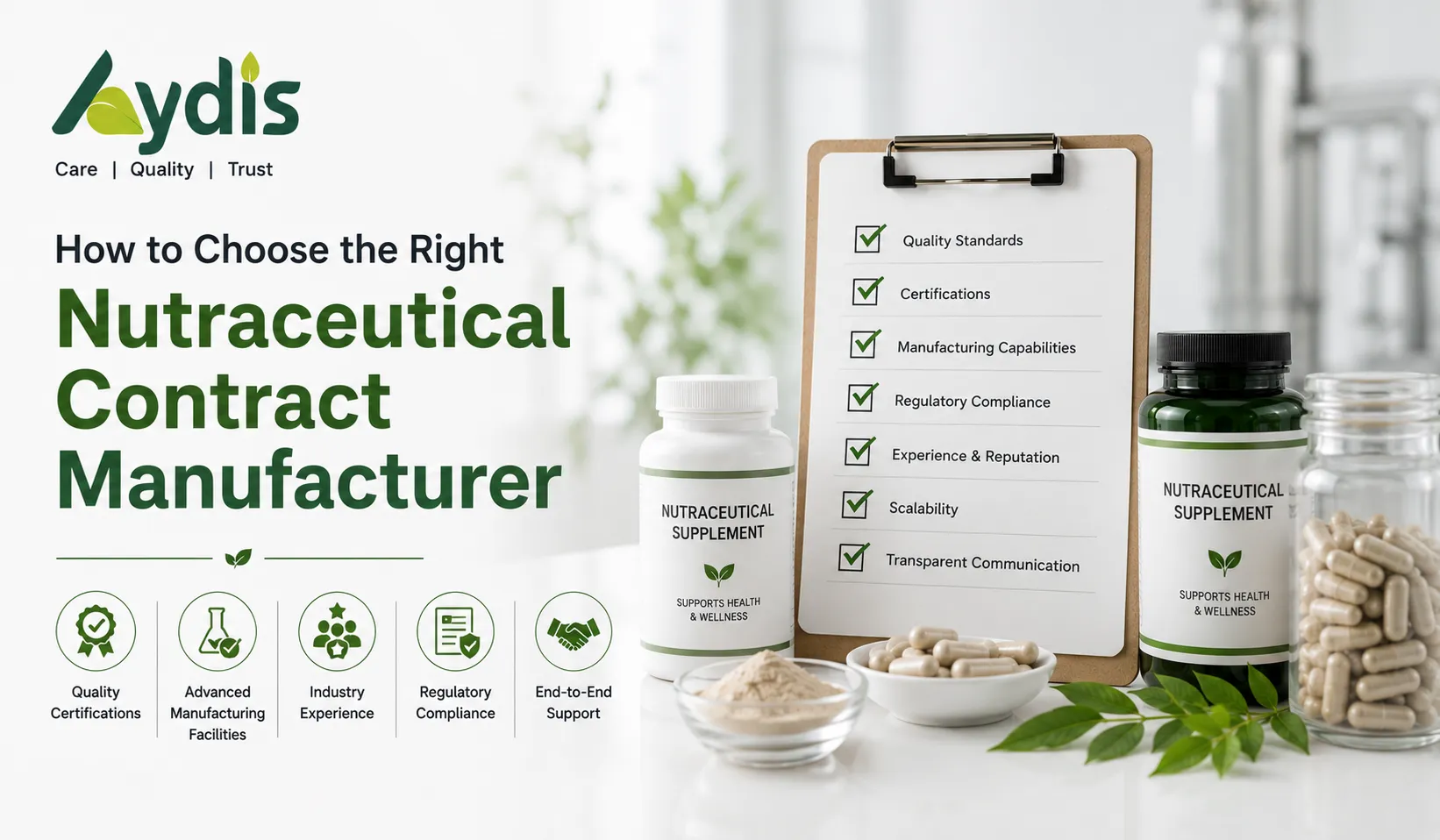

The Wrong Manufacturing Partner Can Break Your Brand Before It Even Launches
Most supplement founders spend months getting their branding right — the name, the logo, the packaging design, the social media strategy. Then they spend two weeks picking a manufacturer. That imbalance is one of the most common and costly mistakes in the Indian supplement industry.
Your nutraceutical contract manufacturer is not just a vendor. They are the reason your product is consistent or inconsistent, safe or problematic, compliant or non-compliant. They are the reason your customers reorder — or don't. A weak manufacturing partner means delayed shipments, quality failures, FSSAI compliance risks, and customer complaints that no amount of good marketing can fix.
The good news: choosing the right manufacturer is not complicated once you know what to actually look for — and more importantly, what questions to ask before you sign anything. This guide gives you both — a complete, India-specific evaluation framework built for founders, brand owners, doctors, distributors, and businesses at every stage of the supplement journey.
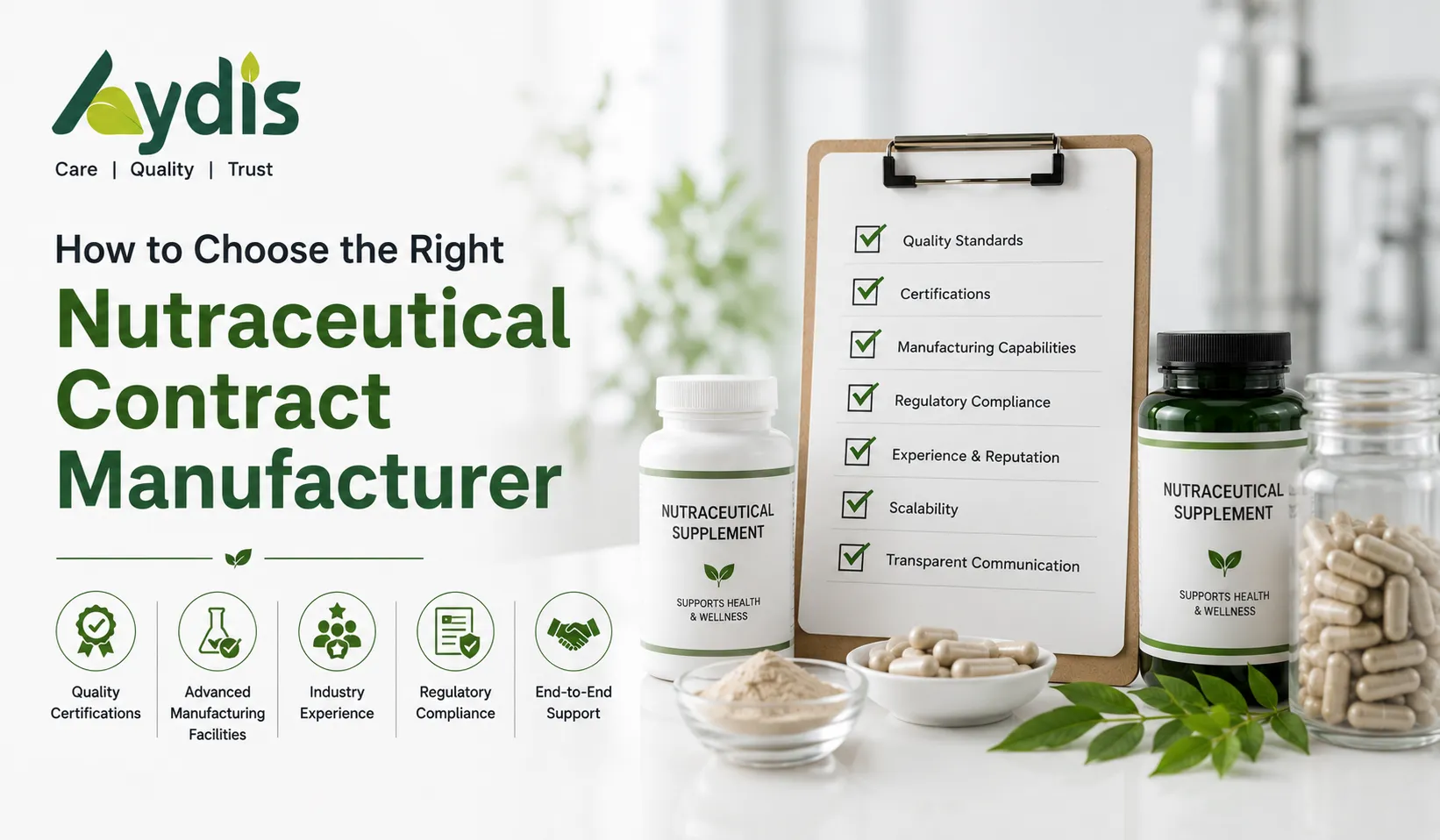
Step One: Define Your Own Requirements Before You Talk to Anyone
Most brands make the mistake of starting their manufacturer search by Googling "best nutraceutical manufacturer in India" and calling whoever appears first. This approach puts the manufacturer in control of the conversation from the very beginning.
Before you contact a single manufacturer, get clear on your own requirements. The more specifically you can define these, the faster and more accurately you can evaluate whether any given manufacturer is actually a fit.
Define these before your first conversation:
Your dosage form — Are you launching capsules, tablets, a powder, a syrup, a sachet, or an oil? Each format requires different equipment, different expertise, and different minimum order quantities. A manufacturer that specialises in liquid syrups may not be the right partner for a complex tablet formulation, even if they technically offer both.
Your formulation status — Do you have a complete formula, a partial concept, or just a product idea? A manufacturer's response to this question tells you a great deal about their R&D capability. If you have only an idea, you need a manufacturer with genuine formulation development support — not one that hands you a catalogue and asks you to pick.
Your target consumer and health claim — What health outcome does your product support? Immunity? Joint health? Sports recovery? Women's hormonal balance? Pediatric nutrition? Different categories have different ingredient considerations, dosage requirements, and FSSAI compliance pathways. A manufacturer experienced in your specific category will flag issues that a generalist might miss.
Your launch timeline — Are you trying to get to market in four weeks or four months? Be honest about this. It affects whether private label (faster) or custom contract manufacturing (more differentiated, slower) is the right approach for your first product.
Your volume expectations — A pilot batch to test market response looks very different from a launch order for a national retail listing. Know your range and confirm the manufacturer can handle both ends of it.
Once you have clarity on these five things, your shortlisting process becomes sharper, your conversations become more productive, and you're much less likely to commit to a partner who was never the right fit in the first place.
The 10-Point Evaluation Framework: What to Assess in Every Manufacturer
1. GMP and ISO Certification — Verify, Don't Just Accept
GMP (Good Manufacturing Practices) certification is the most important quality credential any nutraceutical manufacturer can hold in India. It confirms that the facility follows documented, audited, and consistently enforced standards across raw material handling, production, quality control, and batch documentation.
But here's something most blogs don't tell you: there is a meaningful difference between a manufacturer who says "we follow GMP standards" and one who can hand you a current, valid GMP certificate with a certification number, issuing body, and expiry date.
Ask every manufacturer to share:
- Their current GMP certificate (confirm it is valid and has not lapsed)
- Their ISO certificate — whether ISO 9001 (quality management) or ISO 22000 (food safety management)
- Their FSSAI license, confirmed to cover the specific product categories and dosage forms you need
Do not proceed with any manufacturer who hesitates to share these documents. A legitimate, certified facility has nothing to hide. If a certificate cannot be produced within a day of your request, treat it as a serious warning sign.
2. In-House Dosage Form Capability — What They Actually Manufacture vs. What They Claim
A manufacturer's product catalogue and their actual in-house manufacturing capability are sometimes two different things. Some manufacturers offer a broad range of dosage forms on paper but subcontract certain formats to third parties — which means your product goes through an extra production layer you may not even be aware of.
This matters for three reasons: quality control (you lose visibility over a production stage), timelines (coordination with an external party adds delays), and accountability (if something goes wrong, responsibility gets shared and diluted).
Ask specifically: "Is this dosage form manufactured at your own facility, or do you subcontract it to another manufacturer?"
For each format you're considering — capsules, tablets, syrups, powders, sachets, softgels, oils — confirm the answer. If the manufacturer has dedicated equipment for that format at their own site, they should be able to describe it. If they're vague, ask for a facility tour or a list of equipment for that production line.
3. Formulation and R&D Capability
Not every brand arrives with a complete formula. Even brands that do benefit from a manufacturer who can review and strengthen a formulation before it goes into production.
A manufacturer with genuine R&D capability should be able to:
- Help develop a formula from a product brief or health outcome target
- Advise on ingredient interactions, stability considerations, and bioavailability
- Recommend ingredient sources and grades aligned with FSSAI requirements
- Guide dosage decisions based on current regulatory and market norms
- Flag any ingredient restrictions or claim limitations relevant to your product category
The quality of the formulation conversation in your very first meeting is one of the most reliable indicators of a manufacturer's true expertise. A manufacturer who immediately suggests improvements, asks clarifying questions about your target consumer, and raises compliance considerations you hadn't thought of is a very different partner from one who simply says "tell us the formula and we'll produce it."
4. Raw Material Sourcing and Ingredient Quality
The quality of any nutraceutical product is determined at the raw material stage — before a single capsule is filled or a single tablet is pressed. A manufacturer who uses low-grade or unverified ingredients cannot produce a genuinely high-quality finished product, regardless of how impressive their production equipment looks.
Questions to ask:
- Where do you source your key raw materials?
- Do you test incoming raw materials for identity, purity, and potency before they enter production?
- Can you provide Certificates of Analysis (CoA) for raw materials used in my product?
- Do you use standardised extracts where applicable?
A reliable manufacturer will have documented supplier qualification processes and will test incoming materials as a matter of standard practice. Ask to see an example CoA from a recent raw material batch — a trustworthy manufacturer will share this without hesitation.
5. Quality Control Process — At Every Stage, Not Just at the End
Quality control in nutraceutical manufacturing is not a single end-of-line check. It is a process that should run through every stage of production: raw material testing on arrival, in-process checks during manufacturing, and finished product testing before dispatch.
Ask the manufacturer to walk you through their QC process step by step. Specifically:
- What tests are performed on raw materials at intake?
- What in-process controls are applied during manufacturing?
- What finished product testing is done before a batch is approved for dispatch?
- Who conducts the testing — an in-house lab, a third-party lab, or both?
- What documentation is provided with each batch (Certificate of Analysis, batch manufacturing record)?
An in-house quality control laboratory at the manufacturing facility is a strong positive signal. Access to third-party accredited lab testing for finished products is an additional layer of assurance.
6. FSSAI Compliance and Labeling Support
In India, FSSAI regulations for nutraceuticals, health supplements, and functional foods determine what claims you can make, what ingredients you can use, how your label must be structured, and what declarations are mandatory. Getting any of this wrong can result in regulatory action, product recall, or label reprinting costs that wipe out your early margins.
An experienced nutraceutical contract manufacturer should provide proactive FSSAI guidance, not reactive problem-solving after your packaging has already been designed. Specifically, they should:
- Confirm which FSSAI product category your formulation falls under
- Review your intended label claims for compliance before you go to print
- Ensure all mandatory label elements are present — product category declaration, "NOT FOR MEDICINAL USE" statement, ingredient list, nutritional information, batch number, and expiry
- Flag any ingredient quantities that exceed FSSAI's RDA limits for the relevant category
If a manufacturer's response to FSSAI compliance questions is vague or dismissive, consider it a warning. Regulatory non-compliance becomes your problem as the brand owner, even when the source is the manufacturer's oversight.
7. Minimum Order Quantities and Flexibility for Your Stage of Business
Minimum order quantities (MOQs) are a practical reality of nutraceutical manufacturing — machinery runs and raw material procurement have minimum thresholds that make very small batches uneconomical. But the right MOQ for your business depends entirely on where you are in your brand's journey.
A first-time brand testing market response needs the freedom to order a small pilot batch — enough to validate demand without overcommitting inventory capital. An established brand scaling a successful product needs a manufacturer with the capacity to handle significantly larger runs without delays.
Before committing to a manufacturer, confirm:
- What is the MOQ for your specific dosage form and packaging format?
- Is there a different MOQ for private label versus custom manufacturing?
- Can you start with a smaller pilot batch and scale up on subsequent orders?
- Does pricing improve meaningfully at higher volumes?
Be cautious of manufacturers who insist on very high MOQs for a first order without offering any flexibility. A manufacturer who has genuine confidence in the quality of their product should be willing to let a new brand start with a manageable order size.
8. Production Capacity and Scalability
A manufacturer who is the right partner for your first 5,000-unit batch needs to also be the right partner for your 50,000-unit batch twelve months later. Switching manufacturers mid-growth trajectory is operationally disruptive and can introduce product consistency issues that are difficult to explain to existing customers.
Ask potential manufacturers:
- What is your current production capacity for this dosage form?
- How much of that capacity is currently committed to other clients?
- If our order volumes grow significantly over the next 12 months, can you accommodate that growth without delays?
- What is your typical production lead time, and how does that change at higher volumes?
A manufacturer who is transparent about their current capacity utilisation — and honest about what they can and cannot accommodate — is a more trustworthy partner than one who promises unlimited scalability without any supporting detail.
9. Packaging, Labeling, and Design Support
Packaging in nutraceuticals is both a marketing tool and a regulatory obligation. The right packaging format protects product integrity, meets FSSAI labeling requirements, and communicates your brand positioning effectively to the consumer.
Assess whether the manufacturer offers:
- A range of packaging options appropriate for your product — bottles, blister packs, sachets, stand-up pouches, tubes
- In-house or partner-supported label and packaging design
- Guidance on packaging materials appropriate for shelf life and stability
- Support for primary and secondary packaging within the same production process
A manufacturer who handles packaging in-house simplifies your operations significantly and reduces the number of separate vendors you need to coordinate. It also reduces the risk of packaging-related compliance errors introduced when labeling is managed by a separate party without regulatory expertise.
10. Communication, Transparency, and Process Clarity
This is the factor that most checklists skip — and it's often the one that determines whether a manufacturing partnership is pleasant and productive or frustrating and opaque.
Before committing, pay attention to how a manufacturer communicates during your evaluation process. Do they respond promptly and clearly? Do they provide direct answers to direct questions, or are they evasive? Do they proactively flag considerations you hadn't thought of, or do they simply tell you what you want to hear?
A manufacturing partner you'll work with for years needs to be able to communicate clearly when there's a problem — a delayed shipment, a raw material supply issue, a batch quality concern. If a manufacturer is difficult to get straight answers from when you're a prospective client, they will be significantly more difficult to manage once you've already signed and placed your first order.
Red Flags: Warning Signs to Watch for During Evaluation
Most guides on choosing a manufacturer tell you what to look for. Very few tell you what should make you walk away. These are the warning signs that consistently precede bad manufacturing partnerships.
They can't produce current certification documents promptly. A certified facility has its certifications on file and can share them the same day you request them. Delays or excuses around this are a serious warning.
They are vague about what is manufactured in-house vs. subcontracted. If a manufacturer cannot clearly answer "is this produced at your facility?" for your specific dosage form, assume the answer involves a subcontractor.
Their formulation support is a catalogue, not a conversation. A manufacturer who responds to your product idea by sending a product list rather than asking questions about your health target, your consumer, and your compliance requirements has limited actual formulation capability.
They promise faster timelines than are realistically achievable. Rushing production compromises quality. A manufacturer who consistently underpromises and overdelivers is more valuable than one who tells you what you want to hear.
They have no documented quality control process. If a manufacturer cannot walk you through their QC steps — from raw material testing to finished product analysis — in specific, concrete terms, their QC system is likely underdeveloped.
They discourage facility visits or excessive transparency. A confident, compliant manufacturer welcomes scrutiny. Reluctance to allow a facility visit or share documentation is a significant warning sign.
No written agreement or vague contract terms. Manufacturing arrangements should always be backed by a written agreement covering formulation ownership, batch specifications, quality standards, lead times, MOQs, and dispute resolution. A manufacturer who resists formalising these is not a safe partner.
10 Questions to Ask Every Manufacturer Before You Sign
Use this list in every manufacturer conversation. The quality of their answers will tell you more than any brochure or website.
- Can you share your current GMP and ISO certificates along with your FSSAI license covering this product category?
- Is this specific dosage form manufactured entirely at your own facility, or is any part of it subcontracted?
- What does your formulation development process look like if I come to you with a product concept rather than a complete formula?
- How do you test incoming raw materials, and can you provide a sample Certificate of Analysis?
- Walk me through your quality control process from raw material intake to finished product dispatch — what gets tested, at what stage, and by whom?
- What is your MOQ for this product, and is there a pilot batch option for a new brand?
- What is your current production capacity utilisation, and how would you handle a significant volume increase from us?
- Do you offer packaging and labeling support in-house, and can you review our label for FSSAI compliance before we go to print?
- What does your standard production lead time look like from order confirmation to dispatch?
- Can you share references from brands you currently manufacture for, particularly in a similar category to ours?
A Quick Reference: What Good, Average, and Poor Responses Look Like
| Question | Strong Response | Weak Response |
|---|---|---|
| Certification request | Documents shared within 24 hours, current and valid | "We are GMP compliant" with no documentation provided |
| Dosage form capability | Specific equipment and process described; confirms in-house | Vague confirmation; "yes we do that" with no supporting detail |
| Formulation support | Asks about health target, consumer, category; raises compliance points | Sends a product catalogue |
| Raw material testing | Describes intake testing process; offers to share CoA | "We source from good suppliers" |
| QC process | Step-by-step description with in-house lab detail | "We have strict quality control" with no specifics |
| MOQ flexibility | Confirms pilot batch option; outlines scaling pricing | Minimum order only; no flexibility discussed |
| FSSAI compliance | Proactively raises label claim requirements | Assumes you'll figure out compliance independently |
| Communication style | Direct, prompt, asks clarifying questions | Slow to respond; tells you what you want to hear |
Aydis: A Manufacturing Partner Built for Brands That Take Quality Seriously
If you're in the process of evaluating nutraceutical contract manufacturers in India, we'd like to introduce Aydis — clearly and directly, as a genuine option worth considering alongside others on your shortlist.
Aydis is a GMP and ISO certified nutraceutical and Ayurvedic contract manufacturer providing third-party and private label manufacturing services to brands, doctors, e-commerce founders, distributors, and healthcare companies across India. We serve businesses at every stage — from first-batch pilots to large-scale national production runs — and we deliver pan-India.
What we offer:
- Custom formulation development — from a product concept to a fully developed, stable, manufacturable formula, with R&D support at every stage
- Private label manufacturing — launch quickly using our proven existing formulations under your brand
- Third-party contract manufacturing — full-scale production for your custom formula, with complete QC, packaging, labeling, and dispatch
- Multiple dosage forms manufactured in-house — capsules, tablets, syrups and suspensions, Ayurvedic and wellness oils, powders, and sachets
- Category expertise — general nutrition, sports nutrition, women's health, men's health, pediatric nutrition, beauty nutrition, medical nutrition, and veterinary nutrition
- FSSAI-aligned compliance support — label review, claim guidance, and regulatory documentation as part of our standard process
- End-to-end quality control — raw material testing, in-process checks, finished product testing, and batch documentation on every production run
- Pan-India delivery — to your warehouse, fulfillment center, or distribution point, wherever in India you operate
We believe the right manufacturing conversation starts with understanding your product, your consumer, and your timeline — not with a catalogue. If you're evaluating partners, we'd welcome the chance to have that conversation.
Contact the Aydis team to discuss your nutraceutical manufacturing project →
Frequently Asked Questions
Q: How do I verify that a nutraceutical manufacturer's GMP certificate is genuine? Ask for the full certificate including the issuing certification body's name, the certificate number, the date of issue, and the expiry date. You can then contact the certifying body directly or check their online registry to confirm the certificate is current and valid. Reputable certification bodies in India include BIS, NQA, Bureau Veritas, SGS, and others. A valid certificate should not require any special convincing to obtain.
Q: What is the typical timeline from selecting a manufacturer to receiving my first batch? For private label products using existing formulations, timelines are generally shorter — the formulation is already developed and tested, so you're primarily waiting for production scheduling, packaging delivery, and manufacturing lead time. For custom formulations developed specifically for your brand, the process is longer because formulation development, stability testing, and any regulatory review add stages before production can begin. Discuss timelines explicitly with your manufacturer at the outset, and ask them to break the timeline down by stage rather than giving you a single overall estimate.
Q: Can I visit the manufacturer's facility before committing? Yes, and you should. A facility visit is one of the most reliable ways to assess a manufacturer's actual capabilities versus their claimed capabilities. You can observe production hygiene, equipment condition, lab setup, and the general organisation of the facility — all of which are difficult to assess from a brochure or website. A manufacturer who discourages or refuses a facility visit is a concerning choice.
Q: What documents should I receive along with each manufactured batch? At minimum, you should receive a Certificate of Analysis (CoA) for the finished product, confirming that the batch meets the agreed specifications for identity, purity, potency, and any relevant microbiological parameters. You should also have access to the batch manufacturing record, which documents every step of the production process for traceability purposes. Ask your manufacturer to clarify exactly what documentation they provide with every batch before you place your first order.
Q: Who owns the formula in a contract manufacturing arrangement? Formula ownership depends on how the arrangement is structured and what your written agreement states. If you develop a custom formula independently and commission the manufacturer to produce it, the formula is generally yours. If the manufacturer develops a custom formula specifically for your brand as part of the engagement, the ownership terms should be explicitly agreed in writing. Formulas derived from a manufacturer's standard catalogue (private label) typically remain with the manufacturer. Always clarify and document formula ownership terms before signing — this is a non-negotiable part of any professional manufacturing agreement.
Q: Is it advisable to work with multiple contract manufacturers for different products? Some brands choose different manufacturers for different product categories based on specialisation. This can make sense if, for example, one manufacturer excels at liquid syrups and another at complex tablet formulations. However, managing multiple manufacturing relationships adds operational complexity. For most brands — particularly in the early stages — building a strong relationship with a single reliable manufacturer who covers a broad range of dosage forms and categories is the more practical and efficient approach.
Q: What should a manufacturing agreement cover at minimum? A written manufacturing agreement should cover: product specifications and quality standards, formulation ownership, batch pricing and payment terms, minimum order quantities, production lead times and delivery timelines, quality control responsibilities and documentation requirements, handling of rejected batches or quality disputes, confidentiality obligations, and termination conditions. Never manufacture without a written agreement in place, regardless of how trustworthy a manufacturer appears.

























Sign in to leave a comment.