
The Problem Most People Discover Too Late
You've chosen the tiles. The contractor has laid them. The bathroom looks perfect. And then someone in your family slips. Maybe a near-miss, maybe something worse. And you realize the tiles you selected, tiles a showroom staff member told you were "anti-skid," had no actual slip-resistance rating behind them.
This happens often in Indian homes. Not because buyers don't care about safety. It happens because the information needed to make a safe choice is rarely presented clearly at the point of purchase.
Why "Looks Safe" Isn't Safe
A tile that feels dry and slightly rough in a showroom display can behave like glass on a wet bathroom floor. The showroom is dry. The tile is clean. There's no soap film, no water, no wet feet stepping out of a shower.
The relevant test is not how a tile feels dry. It's how it performs wet. That performance is measured in two ways:
- DCOF (Dynamic Coefficient of Friction): minimum 0.42 for wet interior floors (ANSI A326.3)
- R-rating (DIN 51130): minimum R10 for bathrooms, R11 for outdoor, R12 for commercial kitchens and parking
A tile with a DCOF of 0.18 to 0.30, which is common in polished and satin matte tiles, feels completely stable when dry. It becomes a slip hazard the moment any liquid is introduced. Over 70% of household fall injuries in India happen in bathrooms. That's not a coincidence. It's the direct result of wet floor surfaces with inadequate friction.
The Specific Traps to Avoid
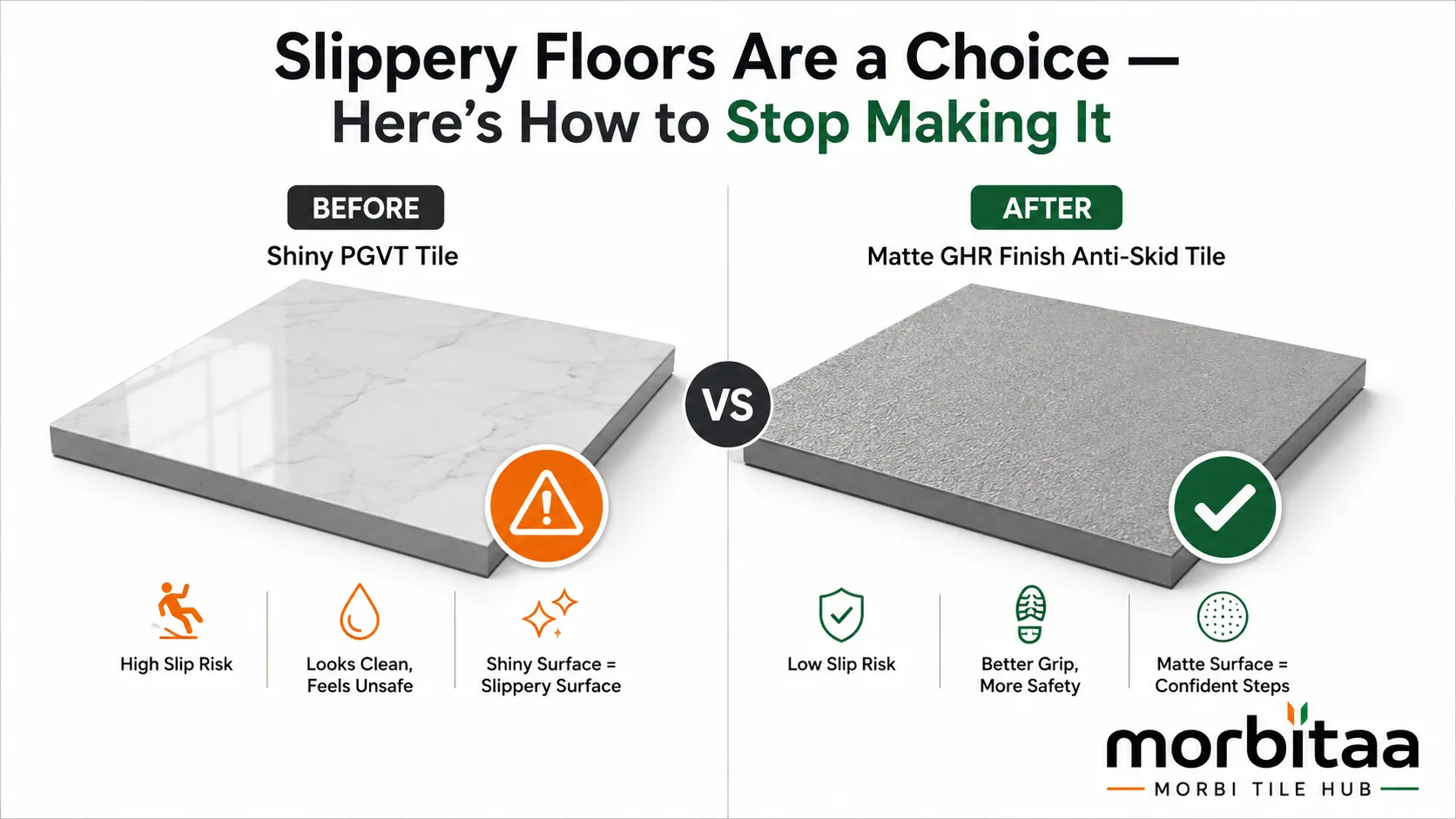
The satin matte trap: Satin matte is a smooth, low-sheen glaze. Many showrooms display it as an anti-skid option because it doesn't look glossy. In practice, it has minimal actual grip in wet conditions. It's one of the most frequently misrepresented finishes in the bathroom tile category.
The PGVT trap: Polished Glazed Vitrified Tiles look premium, feel stable when dry, and photograph beautifully. On any wet surface, they're dangerous. PGVT should never go in bathrooms, kitchens, outdoor areas, or any water-exposed zone.
The large-format trap: 600x1200mm and larger tiles look seamless and modern. On wet bathroom floors, minor firing warpage in large formats creates micro-hollows where water pools under the foot. This can cause sudden hydroplaning even on a tile rated R10. Smaller formats (300x300mm to 600x600mm) are more reliable for bathroom safety.
The cleaning trap: Standard floor cleaners and wax-based polishes deposit a residue film on textured Anti Skid Tile surfaces with every cleaning cycle. Over time, that film fills the micro-grip channels. A tile that started as R10 gradually loses its effective grip to cleaning residue. Use pH-neutral, residue-free products. No wax, no film-forming cleaners.
The Solution: Specify the Number, Not the Description
The fix is simpler than most buyers expect. Before confirming any tile purchase:
For bathrooms:
- R10 minimum (DIN 51130)
- DCOF 0.42 or above (ANSI A326.3)
- Finish: Matte, Sugar Finish, GHR, or Rain Drops; not satin matte, not PGVT
- Size: 300x300mm to 600x600mm; avoid large-format on wet bathroom floors
- Grout: Epoxy, not standard cement grout
For outdoor terraces and balconies:
- R11 minimum, R12 for monsoon-exposed open areas
- Water absorption 0.5% or less; porcelain or full-body vitrified only
- Ceramic tiles outdoors are not appropriate in any Indian region with freeze-thaw winters
For parking:
- R11 to R12, PEI IV or V, breaking strength 2000 N or above, thickness 15 to 20mm for vehicle-loaded areas
Installation Closes the Loop
Even the right tile, specified correctly, fails if the installation misses these points:
- Polymer-modified adhesive for all wet areas
- Epoxy grout; non-porous, chemically resistant, maintains joint drainage indefinitely
- Minimum 1:100 drainage slope toward every drain in every wet area
- Builders clean completed before first use; grout haze allowed to dry on a textured surface permanently fills its grip channels
The tile does most of the work. Installation makes sure that work isn't undone before the first person steps on it.
One Decision, Long-Term Safety
The cost difference between a correctly specified anti-skid tile and a matte tile with no rating is often smaller than buyers expect. The cost of a bathroom renovation done wrong and redone within two years is not.
Slippery floors are not inevitable. They're the result of choices made without complete information. With the right rating, the right finish, and the right installation, the floor that looks good can also be the floor that's safe.





























Sign in to leave a comment.