


Choosing the right project control certification depends on your current role, career goals, technical skills, and the responsibilities you want to take on next. The best choice should match your professional needs, cover relevant project controls competencies, and have transparent eligibility and assessment requirements. If your work involves planning, cost, risk, finance, or AI-enabled project delivery, compare the certification's scope before enrolling.
What Is a Project Control Certification?
A project control certification is a professional credential that assesses knowledge or competence in areas used to plan, monitor, forecast, and control project performance. Depending on the certification, it may cover project scheduling, cost management, earned value, risk analysis, forecasting, reporting, or project leadership.
Project controls professionals help teams understand whether a project is progressing according to its approved schedule and budget. They also analyse variances, identify emerging risks, and provide information that supports better decisions.
A suitable certification can help you structure your professional development and demonstrate assessed knowledge. However, its value depends on the assessment standard, relevance to your work, and acceptance by your target employers. A certificate alone does not guarantee a job, promotion, or salary increase.
Why Does Choosing the Right Certification Matter?
Not every certification covers the same responsibilities. A planning engineer may need deeper knowledge of scheduling, while a cost engineer may focus on estimates, budgets, and cost forecasting. A project manager may need broader competencies in governance, leadership, and delivery.
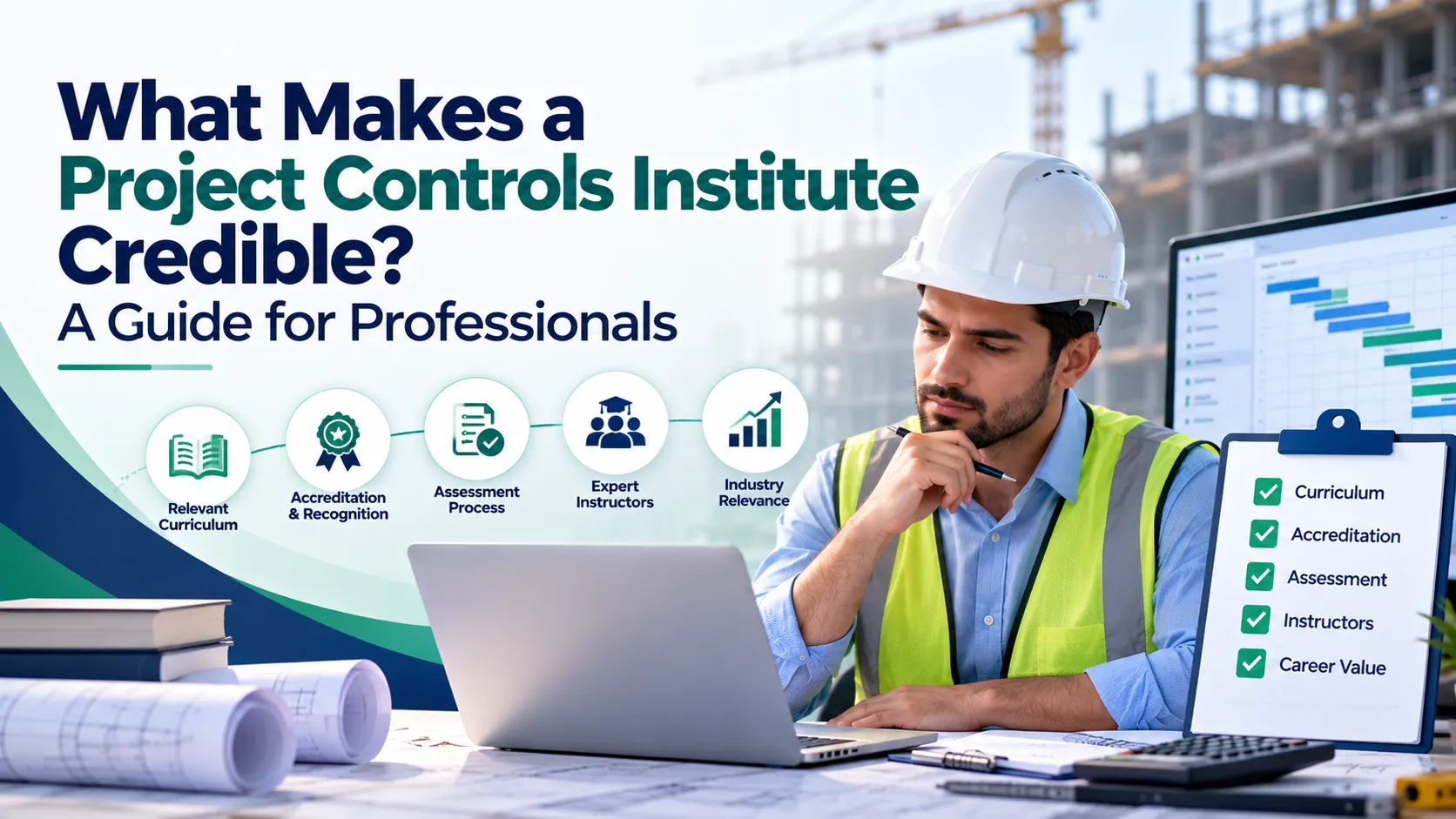
Before selecting a project controls course or certification, consider these factors:
- Career alignment: Does the credential support your current role or your next career step?
- Relevant competencies: Does it cover the planning, cost, risk, finance, or leadership skills you need?
- Assessment quality: Is competence assessed through a clearly explained examination or other formal process?
- Eligibility: Do you meet the experience and application requirements?
- Total cost: Are examination fees, membership, preparation materials, and renewal costs clearly explained?
- Industry relevance: Do employers and clients in your sector recognise or value the credential?
- Future readiness: Does the programme address current developments, such as AI-assisted forecasting and responsible use of project data?
These checks help you compare certifications based on evidence rather than choosing one simply because it is popular.
How to Choose the Right Project Controls Certification
1. Start with your career goals
Think about the responsibilities you want to handle over the next three to five years. Do you want to become a project controls manager, specialise in project finance, improve your planning skills, or move towards project leadership?
Your answer will help narrow down the options. A specialist credential may be appropriate if you want to deepen one technical skill. An integrated credential may be more suitable if your work connects schedules, costs, risk, forecasting, and financial performance.
2. Match the certification to your professional role
Different roles require different competencies.
- Planning engineers and schedulers: Look for coverage of project planning, critical path analysis, schedule baselines, progress measurement, and project schedule control.
- Cost engineers and cost controllers: Prioritise cost estimation, budgeting, cost management, earned value, and forecasting.
- Project controls engineers and managers: Consider integrated planning, cost, risk, performance reporting, and decision support.
- Project finance professionals: Look for financial modelling, project finance risk, bankability, cash flow, and investment analysis.
- Project managers: Consider governance, project planning, leadership, execution, stakeholder management, and AI-enabled project management.
If you are an engineer moving into project controls, check whether the certification provides an appropriate foundation or expects substantial prior knowledge.
3. Review the syllabus and competency framework
A certification title does not tell you everything about what you will learn or be assessed on. Review the official syllabus, competency framework, examination blueprint, and candidate guidance.
For integrated project controls, useful subject areas may include:
- Work breakdown structures and baseline planning.
- Schedule development and progress measurement.
- Project cost estimation and cost control.
- Earned value management and performance analysis.
- Risk identification, assessment, and forecasting.
- Project finance and commercial awareness.
- Data analysis, reporting, and responsible AI use.
Look for a clear connection between the syllabus and the decisions you make at work. A well-matched certification should help you develop relevant competencies rather than simply add another title to your CV.
4. Check eligibility, examination, and costs
Before enrolling, confirm the experience requirement, examination format, passing criteria, available delivery options, and total cost. Some credentials are open to a broad range of professionals, while others require specific education or experience.
If you are comparing project controls certification online options, also check whether the examination is remotely proctored, what identification is required, and whether resits incur an additional fee.
Do not compare prices alone. Consider what the examination assesses, how clearly the standard is defined, and whether the credential is relevant to your professional objectives.
Comparing PCI AI Certifications: PCL-AI, PFL-AI, and PML-AI
The Project Controls Institute (PCI AI) offers three credentials with different professional focuses. The right option depends on whether your work centres on integrated project controls, project finance, or broader project management and delivery.
1. PCL-AI: PCI AI Project Controls Leader
PCL-AI focuses on integrated project controls, bringing together planning, cost engineering, earned value, forecasting, risk, project finance, and the governed use of AI.
It may be worth considering if you work as a planning engineer, scheduler, cost engineer, project controls specialist, controls manager, or PMO professional and want to understand how different control functions connect.
Best suited to: Professionals seeking broad project controls competency across schedule, cost, risk, forecasting, and financial performance.
2. PFL-AI: PCI AI Project Finance Leader
PFL-AI focuses on project finance and financial modelling. Its published scope includes capital structure, bankability, financial coverage ratios, public-private partnerships, concession structures, financial close, and AI-enabled analysis.
It is more closely aligned with professionals responsible for project financing, infrastructure investment, financial analysis, or commercial finance than with those whose main responsibility is schedule control.
Best suited to: Project finance professionals, financial analysts, and people working with infrastructure finance and investment structures.
3. PML-AI: PCI Project Management Leader – AI
PML-AI focuses on project management, leadership, governance, planning, execution, and agile or hybrid delivery, including AI-enabled project management.
It may be relevant if your responsibilities extend beyond project controls into coordinating teams, managing delivery, overseeing governance, and making project-level decisions.
Best suited to: Project managers and delivery leaders who want to develop their understanding of management, governance, and AI-supported delivery.
A Simple Comparison: Which Certification Fits Your Goal?
Use these distinctions as a starting point rather than treating them as a universal ranking.
- Choose PCL-AI if you want integrated knowledge across planning, scheduling, cost, earned value, risk, forecasting, and project finance.
- Choose PFL-AI if your main professional focus is project finance, financial modelling, bankability, and infrastructure investment.
- Choose PML-AI if your goal is broader project management, leadership, governance, and delivery with AI.
- Consider a specialist certification if you need a narrow technical qualification in scheduling, cost engineering, estimating, or another specific discipline.
Before making a final decision, compare the official requirements and assessment details on the. Also check whether your intended employer, client, or professional body accepts or values the credential.
Why AI Skills Are Becoming Relevant in Project Controls
AI tools can help professionals identify unusual project trends, analyse large datasets, support forecasting, and prepare reports. However, an AI-generated result is not automatically accurate or suitable for a project decision.
Project controls professionals need to understand the quality of the underlying data, validate forecasts, recognise unsupported assumptions, and protect confidential information. They must also be able to explain why a recommendation is reasonable and when human judgement should override an automated suggestion.
When comparing an AI project controls certification, look beyond whether AI appears in the course title. Check whether the learning covers practical applications, output validation, governance, data quality, and professional accountability.
Final Thoughts
Choosing a certification is most useful when it supports a clear career goal and develops skills you can apply in real projects. Start with your role, identify the competencies you need, and compare the assessment standard, eligibility, costs, and professional relevance before enrolling. Project Controls Institute (PCI AI) offers PCL-AI, PFL-AI, and PML-AI for different professional focuses, so review the published requirements and select the pathway that best matches your responsibilities and future plans.
Frequently Asked Questions
Q1. Which project control certification is best?
There is no single best certification for everyone. Choose based on your role, career objectives, competency gaps, examination requirements, and the credential's relevance to your target employers.
Q2. What is the difference between project controls certification and project management certification?
Project controls credentials generally focus on schedule, cost, risk, forecasting, and performance measurement. Project management credentials typically cover broader responsibilities such as governance, leadership, coordination, and delivery. Some credentials overlap.
Q3. Can engineers pursue project controls certification?
Yes, provided they meet the specific eligibility requirements. Engineers working in planning, scheduling, cost estimation, construction, or project delivery may benefit from relevant project controls competencies.
Q4. Can I earn a project controls certification online?
Some credentials offer online enrolment, preparation, or remote examination. Confirm the delivery method, proctoring rules, and any location restrictions directly with the certification provider.
Q5. How much does project controls certification cost?
Costs vary by provider and credential. Check the examination fee separately from membership, training, study materials, retakes, and renewal charges. Verify the current fee before paying.
Q6. Do I need experience before applying?
It depends on the certification. Some require relevant professional experience, while others offer foundation-level pathways. Review the official eligibility criteria rather than assuming all project controls credentials have the same requirements.
Q7. Is AI knowledge important for project controls professionals?
AI knowledge can help with forecasting, reporting, risk analysis, and data interpretation. Professionals should also understand limitations, data privacy, validation, and the need for human oversight.
Q8. How can I compare project controls certifications fairly?
Compare the syllabus, assessment method, eligibility, cost, credential status, renewal requirements, and relevance to your career. Use official provider information and verify recognition with employers or clients where necessary.
























Sign in to leave a comment.