

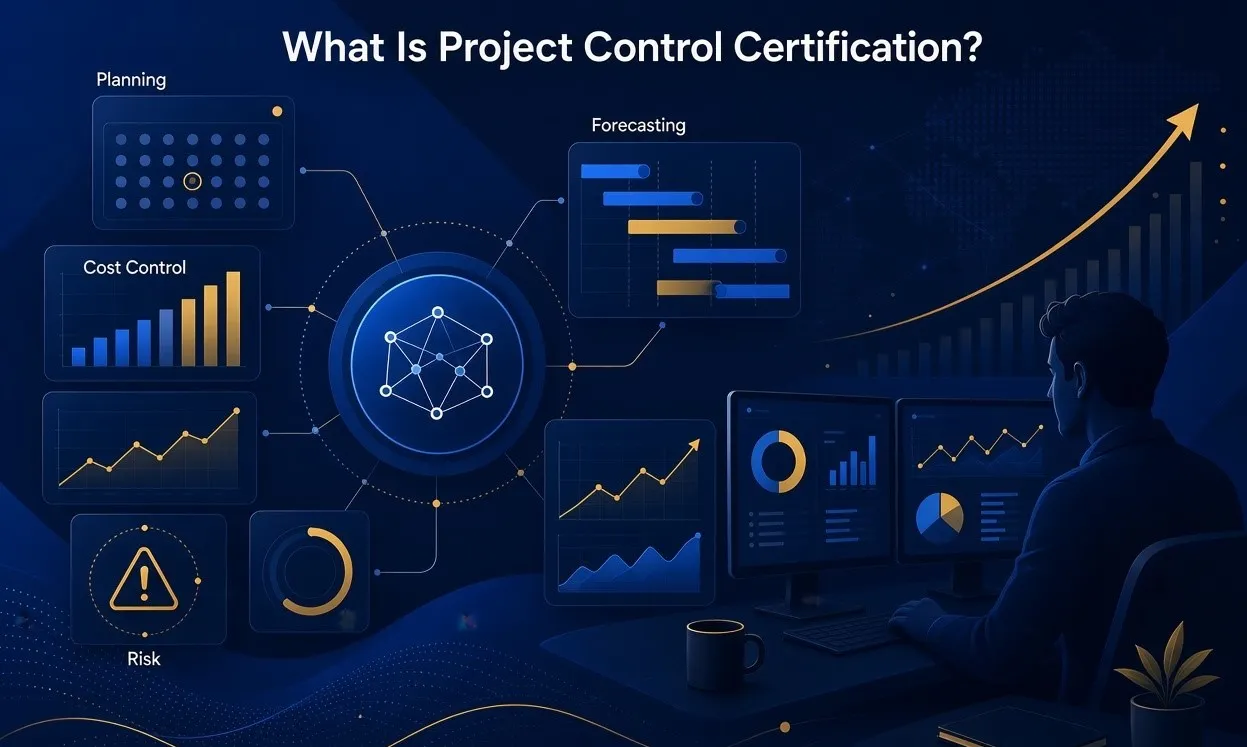
Project control certification is a professional credential that validates knowledge and applied skills in areas such as project planning, scheduling, cost control, forecasting, risk, reporting, and related project-finance activities. It is designed for professionals who help projects stay aligned with their planned cost, schedule, scope, and performance. Modern certifications may also address the responsible use of AI in project controls.
What Is Project Control Certification?
Project control certification is a professional qualification for people who work with the systems, processes, data, and decisions used to monitor and manage project performance.
Project controls typically bring together several connected disciplines, including:
- Project planning
- Project scheduling
- Cost estimation and control
- Performance measurement
- Forecasting
- Risk management
- Change and reporting processes
- Project finance
The purpose is not simply to create reports. Project controls help project teams understand where a project stands, identify potential problems, and make informed decisions.
The Project Management Institute describes project controls as including functions such as estimating, planning and scheduling, cost control, risk analysis, and reporting.
This is why a project controls professional certification can be relevant to planners, schedulers, cost engineers, project controls engineers, project managers, PMO professionals, and other people responsible for project performance.
Why Is Project Controls Important?
Large projects can change quickly. Costs can increase, schedules can move, risks can develop, and project assumptions can become outdated.
Without reliable controls, project teams may discover these issues only after they have become difficult or expensive to address.
Project controls create a structured way to monitor project performance.
For example:
Plan → Measure → Compare → Forecast → Identify risks → Take action → Report → Reassess
This process connects project information with management decisions.
Project controls are therefore closely connected to cost, schedule, risk, and performance management rather than being a separate reporting activity. PMI research describes project control systems as tools that help define objectives, measure performance, communicate results, and support better decisions.
What Does a Project Controls Certification Cover?
The exact syllabus depends on the certification body, but a comprehensive project controls certification may cover several core areas.
1. Planning and Scheduling
Planning establishes what needs to be delivered, while scheduling organizes activities, dependencies, milestones, and timelines.
Professionals may need to understand:
- Project planning
- Work breakdown structures
- Project scheduling
- Schedule management
- Schedule control
- Progress measurement
- Baseline management
A strong understanding of scheduling helps teams identify delays and understand their potential effect on project delivery.
2. Cost Control
Cost control focuses on understanding planned versus actual project expenditure and forecasting potential outcomes.
Relevant areas can include:
- Project cost estimation
- Budget development
- Cost management
- Cost forecasting
- Variance analysis
- Earned value concepts
- Cost reporting
The objective is not simply to report what has already been spent. Good project cost control also helps answer questions such as:
Where are we now? Where are we likely to finish? What is causing the variance?
3. Risk Management
Projects operate with uncertainty. A project controls professional needs to understand how risks can affect cost, schedule, resources, and delivery.
Risk management commonly involves identifying risks, analyzing their potential effects, planning responses, and monitoring them throughout the project lifecycle. PMI describes risk management as being closely connected with cost, schedule, and quality.
4. Forecasting and Reporting
Forecasting converts current project information into an informed view of potential future performance.
Reporting then communicates this information to project managers, executives, clients, and other stakeholders.
Effective reporting should make important information understandable rather than simply producing large volumes of data.
What Is Integrated Project Controls?
Integrated Project Controls means connecting different control disciplines instead of managing them as isolated activities.
For example, a schedule delay can affect:
- Labour requirements
- Project costs
- Cash flow
- Procurement
- Risk exposure
- Expected completion dates
If scheduling and cost information are considered separately, the full impact may not be visible.
Integrated controls attempt to connect these relationships so project teams can understand the broader effect of a change.
This is one of the key ideas behind modern project controls: cost, schedule, risk, forecasting, and finance influence one another.
What Is AI Project Controls Certification?
An AI project controls certification combines traditional project-controls competencies with the responsible use of artificial intelligence.
AI can support activities such as:
- Project forecasting
- Risk analysis
- Project reporting
- Data analysis
- Trend identification
- Cost forecasting
- Scenario analysis
However, AI should support professional judgment rather than replace it.
For example, an AI system may identify a potential cost trend, but a qualified professional still needs to validate the underlying data, understand the assumptions, assess the context, and decide whether the output can be relied upon.
This principle is reflected in the current PCI AI approach, which describes AI as governed throughout the project-controls discipline and emphasizes human ownership of AI-supported outputs.
PCL-AI: PCI AI Project Controls Leader
The PCI AI Project Controls Leader (PCL-AI) is the Project Controls Institute's integrated project-controls credential.
According to the current PCI framework, PCL-AI covers planning, cost engineering, earned value, forecasting, risk, project finance, and governed AI use. The credential is aimed at professionals including planners, schedulers, cost engineers, project controls engineers and managers, PMO professionals, project managers, and project-finance professionals.
The current PCI certification information states that PCL-AI uses a scenario-based examination and has an eligibility route based on professional experience rather than requiring one specific academic qualification.
For someone researching a project controls leader certification, this makes PCL-AI particularly relevant to the broader question of how project controls, finance, and AI can be treated as connected professional competencies.
PFL-AI and PML-AI: How Do They Differ?
PCI currently lists three professional credentials, each addressing a different area.
1. PCL-AI
PCI AI Project Controls Leader
Focuses on integrated project controls, including planning, cost engineering, earned value, forecasting, risk, project finance, and governed AI.
2. PFL-AI
PCI AI Project Finance Leader
Focuses on project finance, financial modelling, capital structure, bankability, coverage ratios, PPP and concession structures, financial close, and AI-enabled analysis.
3. PML-AI
PCI Project Management Leader – AI
Focuses more broadly on project management, leadership, governance, planning, execution, agile/hybrid delivery, and AI-enabled project management.
In simple terms:
- PCL-AI: Project controls + cost + forecasting + risk + finance + AI
- PFL-AI: Project finance + financial modelling + financing structures + AI
- PML-AI: Project management + leadership + delivery + AI
This distinction can help professionals identify the credential that most closely matches their existing responsibilities.
Who Should Consider Project Controls Certification?
A project controls qualification can be relevant to professionals working in roles such as:
- Planning engineer
- Project scheduler
- Cost engineer
- Cost controller
- Project controls engineer
- Project controls specialist
- Project controls manager
- Project controls consultant
- PMO professional
- Commercial professional
- Project manager
- Project finance professional
It can also be relevant to professionals developing a project controls career path, particularly those working in construction, engineering, energy, infrastructure, EPC, software, or other project-based environments.
Project Controls Certification vs Project Management Certification
These terms are sometimes used interchangeably, but they are not identical.
Project management certification generally focuses on managing the broader project environment, including leadership, stakeholders, planning, execution, governance, and delivery.
Project controls certification focuses more specifically on measuring, forecasting, and controlling project performance across areas such as cost, schedule, risk, and related financial information.
A simple comparison is:
- Project management: “How do we manage and deliver the project?”
- Project controls: “How are we performing, where are we heading, and what evidence supports the next decision?”
- Project finance: “How is the project funded, structured, and financially evaluated?”
The three areas can overlap, but they serve different professional purposes.
What to Check Before Choosing a Project Controls Certification
Before enrolling in any project controls certification online course, review more than the course title.
Consider these factors:
1. Eligibility
Check whether the certification requires professional experience, education, training hours, or another prerequisite.
2. Competency coverage
Look at whether the syllabus covers the areas relevant to your career, such as planning, scheduling, cost, risk, forecasting, or AI.
3. Assessment method
Understand whether the credential requires an examination and whether the assessment tests recall, application, scenarios, or a combination.
4. Certification status
Check exactly who awards the credential and whether it is accredited, formally recognized, or developed with reference to a particular framework.
For example, PCI states that its certification framework is being developed with reference to ISO/IEC 17024 principles, while also explicitly stating that PCI is not currently accredited by ANAB, IAS, or another ISO/IEC 17024 accreditation body.
5. Relevance to your career
A certification should make sense for the work you actually want to perform.
A planning professional may prioritize scheduling and forecasting, while a project-finance professional may need deeper financial modelling and financing knowledge.
What Are the Benefits of Project Controls Certification?
The value of certification depends on the individual, employer, industry, and credential. However, structured certification preparation can help professionals organize their knowledge around a defined competency framework.
Potential benefits include:
- Demonstrating structured knowledge of project controls
- Identifying areas for professional development
- Building a common vocabulary across project teams
- Supporting career development discussions
- Developing knowledge across connected control disciplines
- Understanding emerging AI applications in project controls
Certification should not be treated as a guarantee of employment, promotion, salary growth, or professional recognition. Those outcomes depend on many factors, including experience, employer requirements, location, and the specific credential.
Project Controls Certification: A Simple Decision Guide
If you are deciding whether this type of certification is relevant to you, start with your role.
- You work mainly in planning or scheduling: Look for strong coverage of planning, scheduling, progress measurement, and forecasting.
- You work mainly in cost control: Prioritize cost management, estimation, variance analysis, earned value, and forecasting.
- You manage integrated controls: Look for coverage across schedule, cost, risk, forecasting, and finance.
- You work in project finance: Consider credentials focused on financial modelling, capital structure, and project-finance analysis.
- You manage projects: A broader project-management credential may align more closely with your responsibilities.
- You want to work with AI in controls: Look for a credential that addresses AI governance, validation, responsible use, and practical project-controls applications rather than generic AI literacy.
Final Thoughts
Project control certification is becoming increasingly relevant as projects become more complex and professionals are expected to connect planning, cost, schedule, risk, forecasting, finance, and data-driven decision-making. Project Controls Institute (PCI AI) offers the PCL-AI credential as an integrated project-controls certification with governed AI included as part of the competency model. Before choosing a credential, review its eligibility, syllabus, assessment method, certification status, and relevance to your career goals.
If you are exploring a project controls qualification, start by identifying the competencies you use today and the skills you want to develop next. That will give you a much clearer basis for choosing a project controls certification, training pathway, or professional development plan.
FAQs About Project Control Certification
Q1. What is project control certification?
Project control certification validates professional knowledge and competencies related to planning, scheduling, cost, forecasting, risk, reporting, and other project-control activities.
Q2. Is project controls certification suitable for engineers?
Yes. Project controls certification can be relevant to engineers working in planning, scheduling, cost control, project controls, construction, EPC, energy, and infrastructure.
Q3. What is PCL-AI?
PCL-AI stands for PCI AI Project Controls Leader. It is PCI's professional credential covering integrated project controls, cost engineering, earned value, forecasting, risk, project finance, and governed AI.
Q4. Is project controls certification available online?
Some certifications use online learning and/or online examinations. PCI currently describes its PCL-AI examination as proctored and available online or at a test centre.
Q5. What skills are important for a project controls professional?
Important skills can include project planning, scheduling, cost control, forecasting, risk management, data analysis, reporting, communication, and professional judgment.
Q6. Is project controls the same as project management?
No. Project controls focuses strongly on measuring and forecasting project performance, while project management covers the broader management and delivery of the project.
Q7. What is AI in project controls?
AI in project controls refers to using artificial intelligence to support activities such as forecasting, risk analysis, reporting, trend analysis, and other project-control processes while maintaining appropriate human oversight.
Q8. Does certification guarantee career advancement?
No. Certification can demonstrate knowledge or competency, but employment, promotion, compensation, and recognition depend on individual experience, employer requirements, market conditions, and other factors.
























Sign in to leave a comment.