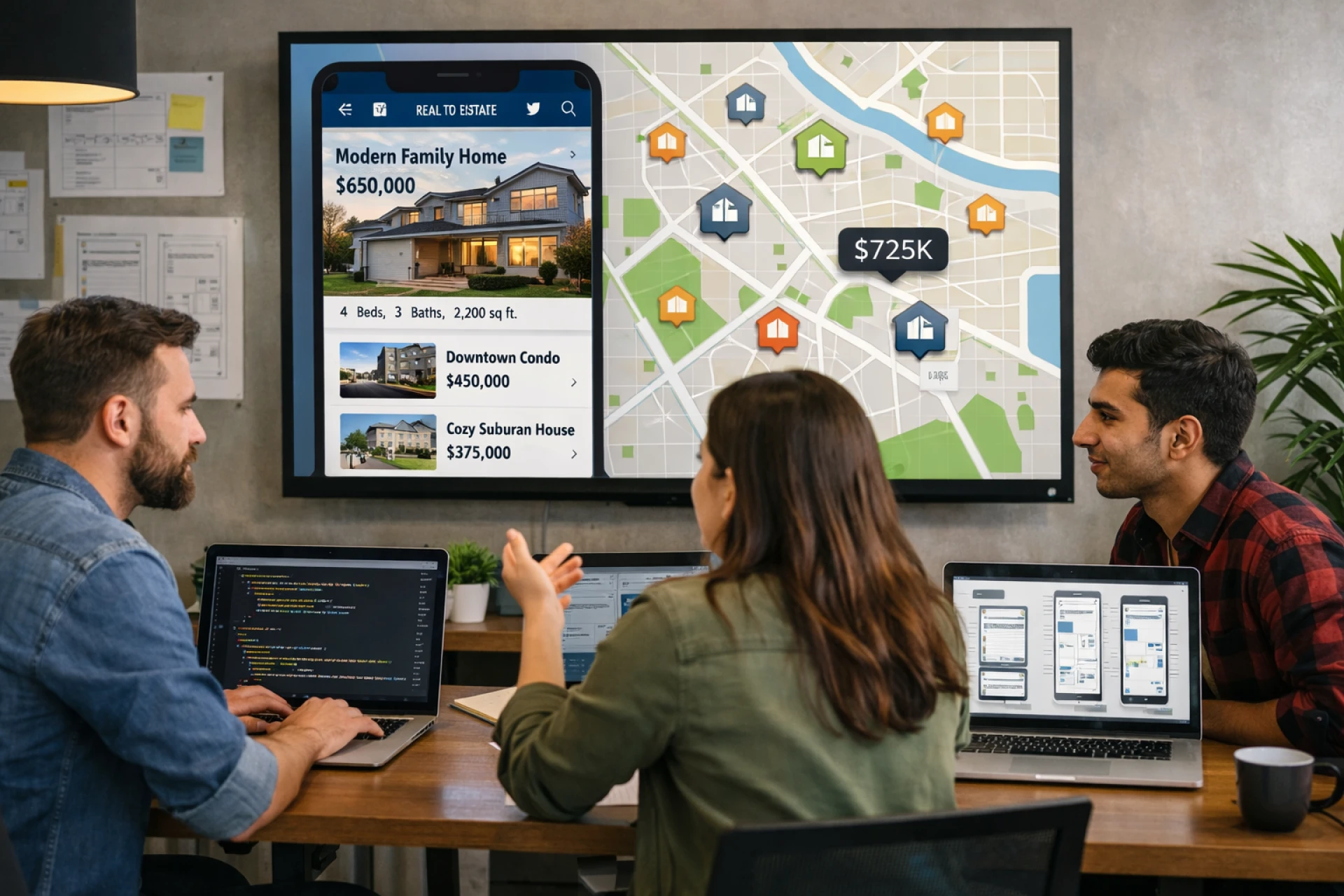

Building a real estate app like Zillow is no longer just a “nice-to-have” idea for property businesses. It has become one of the most profitable and scalable ways to digitize property discovery, lead generation, agent networking, and real estate transactions. A Zillow-style app is not simply a property listing platform. It is a complete real estate ecosystem that combines search, maps, valuation estimates, neighborhood insights, mortgage calculators, agent directories, saved searches, personalized recommendations, and communication tools.
However, developing a Zillow-like product requires a clear product roadmap, strong data architecture, and a long-term growth strategy. From the outside, Zillow looks like a simple search app. But behind the scenes, it is powered by massive property datasets, location services, AI-based personalization, and high-performance backend systems.
In this guide, you will learn how to plan, design, and build a real estate app like Zillow from scratch, including core features, tech stack, development stages, cost factors, and how to choose the right Zillow clone app development company.
Why Real Estate Apps Like Zillow Are Dominating the Property Market
Real estate has traditionally been driven by offline agents, word-of-mouth referrals, and printed listings. But modern buyers and renters now expect a digital-first experience where they can browse properties instantly, compare prices, explore neighborhoods, and connect with sellers or agents without friction.
A Zillow-style real estate app wins because it solves multiple user needs in one platform:
- Buyers can search, compare, shortlist, and contact agents
- Renters can filter listings by lifestyle needs and budget
- Sellers can estimate property value, list quickly, and attract leads
- Agents can build credibility, manage leads, and close deals faster
- Businesses can monetize through ads, premium placements, and agent subscriptions
This “multi-user marketplace” model is exactly why Zillow-like platforms scale so effectively.
Understanding the Zillow Business Model Before You Build
If you want to develop a real estate app like Zillow, you must understand what makes the platform profitable and sustainable. Zillow’s success is not only based on app design. It is based on a well-structured business model that keeps both users and real estate professionals engaged.
Key Revenue Streams in a Zillow-Like App
A Zillow-style platform can generate revenue through multiple monetization channels:
1) Featured Listings and Premium Visibility
Property sellers and agents can pay to boost their listings so they appear at the top of search results.
2) Agent Advertising and Subscriptions
Agents pay monthly to appear in recommended agent sections or get priority placement.
3) Lead Generation Fees
The platform can sell buyer and renter leads to agents and brokers.
4) Mortgage and Home Loan Partnerships
Many Zillow-like apps integrate mortgage calculators and redirect leads to partner banks and lenders.
5) Property Management Services
If you expand into rentals, you can monetize through tenant screening, rent collection, and maintenance tools.
A strong Zillow clone can eventually evolve into a full real estate SaaS ecosystem.
Defining the Core Users and Their Needs in a Zillow-Style App
Before development begins, you must define your target user roles clearly. Zillow is not built for one type of user. It is designed for multiple user groups that interact with each other.
1) Buyers
Buyers want speed, trust, and clarity. They need accurate listings, strong filters, maps, neighborhood details, and easy contact options.
2) Renters
Renters need budget-focused search, amenities filters, commute and lifestyle insights, and verified listings.
3) Sellers
Sellers want pricing intelligence, listing visibility, and a simple process to attract serious leads.
4) Real Estate Agents and Brokers
Agents want lead generation, profile visibility, reviews, communication tools, and CRM-like features.
5) Admin and Moderation Team
Admins need control over listings, users, content moderation, verification processes, and monetization management.
A Zillow-like app becomes successful when it delivers strong value to all these roles without making the experience confusing.
Must-Have Features to Build a Real Estate App Like Zillow
If you want your app to compete with Zillow, you must focus on the right feature set. Many startups fail by either building too few features (making the app feel incomplete) or building too many at once (leading to delays and high cost).
Below are the essential Zillow-style features that matter most.
User Registration and Profile Management
A Zillow clone must support:
- Email and phone-based signup
- Social login (Google, Apple)
- Buyer/renter profiles
- Agent profiles with business details
- Saved searches and favorites
Advanced Property Search With Filters
Search is the heart of any Zillow-like app. You need filters that real users actually use, such as:
- Buy / Rent / New Construction
- Property type (house, condo, apartment, land)
- Price range and price per sqft
- Bedrooms, bathrooms, area size
- Year built
- Amenities (parking, pool, gym, balcony)
- Pet-friendly rentals
- Furnished/unfurnished
- Open houses and recently listed
A powerful search experience directly increases retention and conversions.
Map-Based Listings and Location Search
Zillow is famous for its map-first browsing. Your app should include:
- Map pins with listing previews
- Draw-to-search functionality
- Nearby schools, hospitals, stores
- Commute-time visualization (optional)
- Heatmaps for pricing trends (advanced)
This is one of the biggest technical differentiators in real estate app development.
Property Listing Detail Pages
Your property detail page must be designed for trust and decision-making. It should include:
- High-quality photo gallery
- Video tours and 3D tours (optional)
- Full property description
- Address and location map
- Price history and tax info (if available)
- Mortgage estimate
- Neighborhood and school ratings
- Similar properties recommendations
- Agent contact options
The listing detail page is where leads are generated, so it must be conversion-focused.
AI-Based Recommendations and Personalized Feed
Modern Zillow-style apps use personalization to keep users engaged. You can implement:
- Recommended properties based on browsing history
- Similar listings suggestions
- Alerts for price drops
- Suggested neighborhoods based on preferences
This increases user retention and repeat sessions significantly.
Favorites, Shortlists, and Saved Searches
Users rarely buy or rent immediately. They compare for days or weeks. Your app must allow:
- Save listings
- Create favorites folders
- Save searches
- Get alerts for new listings matching criteria
- Get alerts for price changes
These features improve user stickiness and long-term engagement.
Property Valuation and Price Estimate Tools (Zestimate-Style)
A Zillow clone becomes more valuable when it offers pricing intelligence.
You can build a valuation feature using:
- Comparable sales (comps)
- Market trends
- Property details (size, location, condition)
- Historical pricing
- Machine learning (optional at MVP stage)
Even if your estimate is not perfect, users love having a reference point.
Agent Directory and Agent Profiles
Agents are one of the strongest monetization sources. A Zillow-style agent module includes:
- Agent profiles with photos and bios
- Verified badges
- Areas served
- Listings by agent
- Ratings and reviews
- Contact and inquiry forms
You can later monetize this section through featured placement and subscriptions.
In-App Chat, Inquiry Forms, and Lead Management
To generate leads effectively, your Zillow clone must support:
- “Contact agent” inquiry forms
- Direct messaging (chat)
- Lead notifications
- Call and email buttons
- Lead routing logic (for multi-agent listings)
For agents, you can later build a lightweight CRM dashboard.
Mortgage Calculator and Loan Assistance
Mortgage tools increase engagement and unlock partnerships. Common features include:
- Monthly payment calculator
- Down payment slider
- Interest rate adjustment
- Property tax estimates
- Insurance estimates
This feature is especially useful if you want to monetize through mortgage partner leads.
Admin Panel for Full Platform Control
Your admin panel must support:
- Listing approval and rejection
- User management
- Agent verification
- Content moderation
- Featured listing controls
- Reports and analytics
- Subscription and payment monitoring
Without a strong admin panel, managing the platform becomes operationally expensive.
Zillow Clone Development Approach: MVP vs Full-Scale Platform
One of the smartest ways to build a Zillow-like app is to start with an MVP (Minimum Viable Product). This helps you launch faster, validate demand, and avoid overspending.
What a Zillow Clone MVP Should Include
A realistic MVP should include:
- User registration
- Property listing browsing
- Filters and search
- Map view
- Property detail pages
- Favorites and saved searches
- Inquiry/contact form
- Basic admin panel
This is enough to launch, attract early users, and collect feedback.
What to Add After MVP Launch
Once the MVP proves demand, you can add:
- Agent subscriptions
- Chat system
- Valuation engine
- AI recommendations
- Price history
- Mortgage integrations
- Advanced analytics and reporting
- 3D tours and AR viewing
This staged approach is how most scalable marketplaces are built.
Step-by-Step Process to Develop a Real Estate App Like Zillow
A Zillow-style app should be built with a structured development lifecycle. Skipping steps often results in poor performance, weak UX, and scaling problems later.
Step 1: Market Research and Feature Planning
Start by analyzing:
- Local competitors
- Property listing platforms in your target region
- Agent behavior and lead workflows
- Data availability (MLS, government data, scraping rules)
- Monetization potential
Your product strategy should be aligned with real market needs, not assumptions.
Step 2: UI/UX Design for Search-Driven User Behavior
Real estate apps are search-heavy and decision-heavy. Your UI must support:
- One-handed navigation
- Fast filter application
- Clear listing cards
- Strong image-first design
- Trust elements like verified badges
A Zillow clone must feel premium and easy, otherwise users bounce quickly.
Step 3: Choosing the Right Tech Stack
Your tech stack must support:
- Fast search and filtering
- High image loading performance
- Scalable backend architecture
- Map integration
- Secure user data handling
A modern Zillow clone tech stack typically includes:
- Frontend: React Native or Flutter (for mobile), React (for web)
- Backend: Node.js, Django, or Spring Boot
- Database: PostgreSQL + Redis cache
- Search Engine: Elasticsearch or Algolia
- Cloud: AWS, Google Cloud, or Azure
- Storage: S3-compatible for images and videos
- Maps: Google Maps or Mapbox
- Notifications: Firebase Cloud Messaging
- Payments: Stripe or regional payment gateways
This stack supports both MVP and scaling stages.
Step 4: Backend Architecture and Data Model Design
A Zillow-like app needs a strong backend foundation.
Key database entities include:
- Users
- Properties
- Listings
- Locations
- Agents
- Inquiries
- Favorites
- Saved searches
- Reviews
- Subscriptions and payments
If you plan multi-city or multi-region expansion, build with scalability in mind from day one.
Step 5: Property Data Acquisition Strategy
This is one of the most overlooked parts of Zillow clone development.
You need a plan for how listings will enter your platform:
- Agent-submitted listings
- Broker onboarding
- Partnerships with listing providers
- MLS integration (if available in your market)
- Government or open data sources
- Manual listing entry for early stage
Without consistent listing data, even the best-designed app will fail.
Step 6: Development and Integration
During development, your team will build:
- Mobile app
- Web app (optional but recommended)
- Backend APIs
- Admin dashboard
- Search engine integration
- Map integration
- Notification systems
A professional Zillow clone app development company will typically deliver the product in sprints with weekly builds and milestone demos.
Step 7: Testing and Quality Assurance
Real estate apps must be tested for:
- Search accuracy and speed
- Filter combinations
- Map pin performance
- Image loading
- Login and authentication flows
- Security vulnerabilities
- Payment and subscription flows
- Cross-device compatibility
Testing is critical because bugs directly impact lead generation and user trust.
Step 8: Launch, Monitoring, and Continuous Improvement
Once launched, you should track:
- Search-to-contact conversion rate
- Most-used filters
- Drop-off points
- Listing view-to-inquiry ratio
- Agent subscription conversions
- Performance metrics (load time, crash reports)
A Zillow clone is not a one-time build. It is a continuously evolving platform.
How Much Does It Cost to Build a Zillow-Style Real Estate App?
The cost of developing a Zillow-like app depends on:
- Feature complexity
- Data acquisition method
- Map and search engine usage
- Platform scope (mobile only vs mobile + web)
- Admin panel complexity
- AI features and valuation tools
- Third-party integrations
Typical Zillow Clone Development Cost Ranges
Here are realistic cost estimates:
- Basic MVP Zillow clone: $5,000 to $10,000
- Mid-level Zillow-like platform: $10,000 to $20,000
- Advanced Zillow-style ecosystem: $20,000 to $25,000+
If you want valuation engines, personalization, and multi-region expansion, costs increase due to data and infrastructure complexity.
Common Challenges in Zillow Clone App Development and How to Solve Them
A Zillow clone is not a standard app project. It comes with unique technical and business challenges.
Challenge 1: Listing Data Accuracy and Freshness
If listings are outdated, users lose trust quickly.
Solution:
- Build listing expiration rules
- Add agent verification
- Implement listing refresh reminders
- Add moderation workflows
Challenge 2: Search and Filter Performance at Scale
As listings grow, search becomes slower.
Solution:
- Use Elasticsearch or Algolia
- Add caching with Redis
- Optimize database indexing
- Implement pagination and lazy loading
Challenge 3: Map Performance With Thousands of Pins
Too many pins can slow down the app.
Solution:
- Use clustering for pins
- Load pins dynamically based on zoom level
- Use lightweight listing previews
Challenge 4: Monetization Without Hurting User Experience
Too many ads reduce trust.
Solution:
- Offer premium placement only for relevant categories
- Clearly label promoted listings
- Maintain organic ranking quality
Key Differentiators That Can Make Your Zillow Clone More Competitive
If you want your Zillow clone to compete in 2026 and beyond, you should consider adding features that improve trust and reduce decision friction.
Verified Listings and Fraud Protection
Add:
- Listing verification badges
- Document upload checks
- Duplicate listing detection
- Agent and broker verification
Neighborhood Intelligence
Provide insights like:
- Safety scores
- Nearby facilities
- Average rent trends
- Property appreciation estimates
Virtual Tours and 3D Walkthroughs
Even basic video tours increase lead conversion.
Agent CRM and Lead Management Tools
Give agents:
- Lead dashboard
- Inquiry history
- Notes and follow-ups
- Response-time tracking
This increases agent retention and subscription conversions.
How to Choose the Right Zillow Clone App Development Company
Choosing the right Zillow clone app development company can be the difference between a scalable product and a platform that collapses under growth.
Here’s what you should evaluate carefully.
Proven Experience in Real Estate App Development
Ask for real estate projects in their portfolio. A generic app developer may not understand:
- Listing data structure
- Search-heavy UX
- Map performance
- Lead generation workflows
Strong Backend and Search Engineering Expertise
Your development partner must have experience with:
- Elasticsearch or Algolia
- High-performance databases
- Multi-region scalability
- Cloud infrastructure
Ability to Build Both Mobile and Web (If Needed)
Many Zillow-style businesses eventually require:
- Mobile apps
- Web apps
- Admin dashboards
- Agent portals
Choose a team that can handle the ecosystem.
Transparent Development Process and Documentation
Your partner should provide:
- Sprint planning
- Weekly progress demos
- Clear milestones
- API documentation
- Post-launch support
Security and Compliance Practices
Since real estate apps handle sensitive data, ensure:
- Secure authentication
- Encrypted storage
- Role-based access
- Secure admin panel access
A professional Zillow clone app development company will always prioritize security and scalability.
Zillow Clone Launch Strategy: How to Enter the Market Successfully
A Zillow clone needs more than development. It needs a launch strategy that ensures the platform has listings and users.
Step 1: Start With One City or Region
Real estate is local. It is easier to dominate one region than to spread too thin.
Step 2: Onboard Agents and Brokers Early
Before launch, onboard:
- 20–50 agents
- 5–10 brokerages
- property managers for rentals
Offer early access and premium benefits.
Step 3: Build Trust With Verified Listings
Verified listings make users feel safe and increase inquiries.
Step 4: Invest in SEO and Local Search Visibility
Your platform should rank for:
- “homes for sale in [city]”
- “apartments for rent in [area]”
- “property prices in [neighborhood]”
A Zillow clone becomes more powerful when it is supported by strong SEO.
Conclusion
Developing a real estate app like Zillow requires more than building a property listing interface. A successful Zillow clone must combine advanced search, map-based browsing, property detail experiences, user personalization, lead generation tools, and scalable backend architecture. The smartest approach is to launch an MVP first, validate the market, and then expand into valuation tools, agent subscriptions, AI recommendations, and advanced analytics.
If you want to build a platform that can scale across cities and generate long-term revenue, partnering with an experienced Zillow clone app development company is often the most reliable way to ensure strong performance, security, and future-ready architecture.
FAQs
How long does it take to develop a real estate app like Zillow?
A basic MVP can take 10 to 16 weeks, while a mid-level Zillow clone usually takes 4 to 7 months depending on features, platforms, and data integrations.
What is the most important feature in a Zillow clone?
Search and filtering performance is the most important feature because it directly affects user experience, retention, and lead generation.
Do I need MLS integration to build a Zillow-style app?
Not always. You can start with agent-submitted listings, broker partnerships, or curated property data. MLS integration is useful but depends on your target market.
What tech stack is best for Zillow clone development?
A modern Zillow clone typically uses React Native or Flutter for mobile, Node.js or Django for backend, PostgreSQL for storage, and Elasticsearch or Algolia for fast search.
How can a Zillow clone app generate revenue?
A Zillow clone can monetize through featured listings, agent subscriptions, lead generation fees, mortgage partnerships, and property management tools.
Should I build a Zillow clone as mobile-only or mobile + web?
For long-term growth, mobile + web is ideal. Many users browse properties on web first, then continue on mobile for saved searches and alerts.
Why should I hire a Zillow clone app development company instead of freelancers?
A Zillow clone requires complex backend engineering, search optimization, map performance tuning, security, and long-term support. A professional Zillow clone app development company can deliver a scalable product with structured development and post-launch maintenance.



























Sign in to leave a comment.