
If you’ve ever walked into a large office tower, hotel, warehouse, or shopping centre and watched your mobile signal disappear instantly, you already know how frustrating indoor connectivity can be.
One moment your phone works perfectly. The next moment you’re pacing around the building holding your phone toward the ceiling like you’re trying to negotiate directly with the nearest cell tower.
In 2026, poor mobile coverage in large buildings is no longer just an inconvenience—it’s a serious operational issue for businesses, tenants, customers, and property owners. As workplaces become more connected and mobile-dependent, reliable indoor signal has become a core infrastructure requirement.
That’s why companies across Australia are investing heavily in solutions focused on fixing poor mobile coverage, especially in modern high-rise and commercial buildings.
📶 Why Large Buildings Still Have Mobile Signal Problems
A lot of people assume 5G solved mobile coverage problems everywhere.
Not exactly.
Modern buildings are actually becoming more difficult for mobile signals to penetrate because of materials like:
- Reinforced concrete
- Steel framing
- Energy-efficient glass
- Underground construction
Ironically, the smarter and more energy-efficient buildings become, the more they block cellular signals.
Large commercial buildings also create additional challenges because of:
- Long internal distances
- Dense occupancy
- Network congestion
- Multiple carrier requirements
This often leads to:
- Dropped calls
- Slow mobile internet
- Weak signal bars
- Unreliable indoor communication
And honestly, few things frustrate employees faster than hearing:
“Sorry, you’re breaking up…”
every two minutes during an important call.
📡 Why Indoor Connectivity Matters More in 2026
The way businesses operate has changed dramatically over the past few years.
Modern workplaces now rely heavily on:
- Cloud platforms
- Mobile collaboration apps
- VoIP communication
- Video conferencing
- Real-time messaging systems
When indoor mobile coverage fails, productivity suffers quickly.
Industries most affected by poor mobile coverage in large buildings include:
- Hospitality
- Healthcare
- Retail
- Warehousing
- Commercial offices
- Residential towers
Hotels need reliable guest connectivity. Hospitals require uninterrupted communication for staff. Warehouses depend on mobile-connected logistics systems. Retail businesses rely on mobile payments and customer engagement tools.
In many ways, mobile coverage has quietly become just as important as electricity or Wi-Fi.
🏢 How Mobile Signal Boosters Help Large Buildings
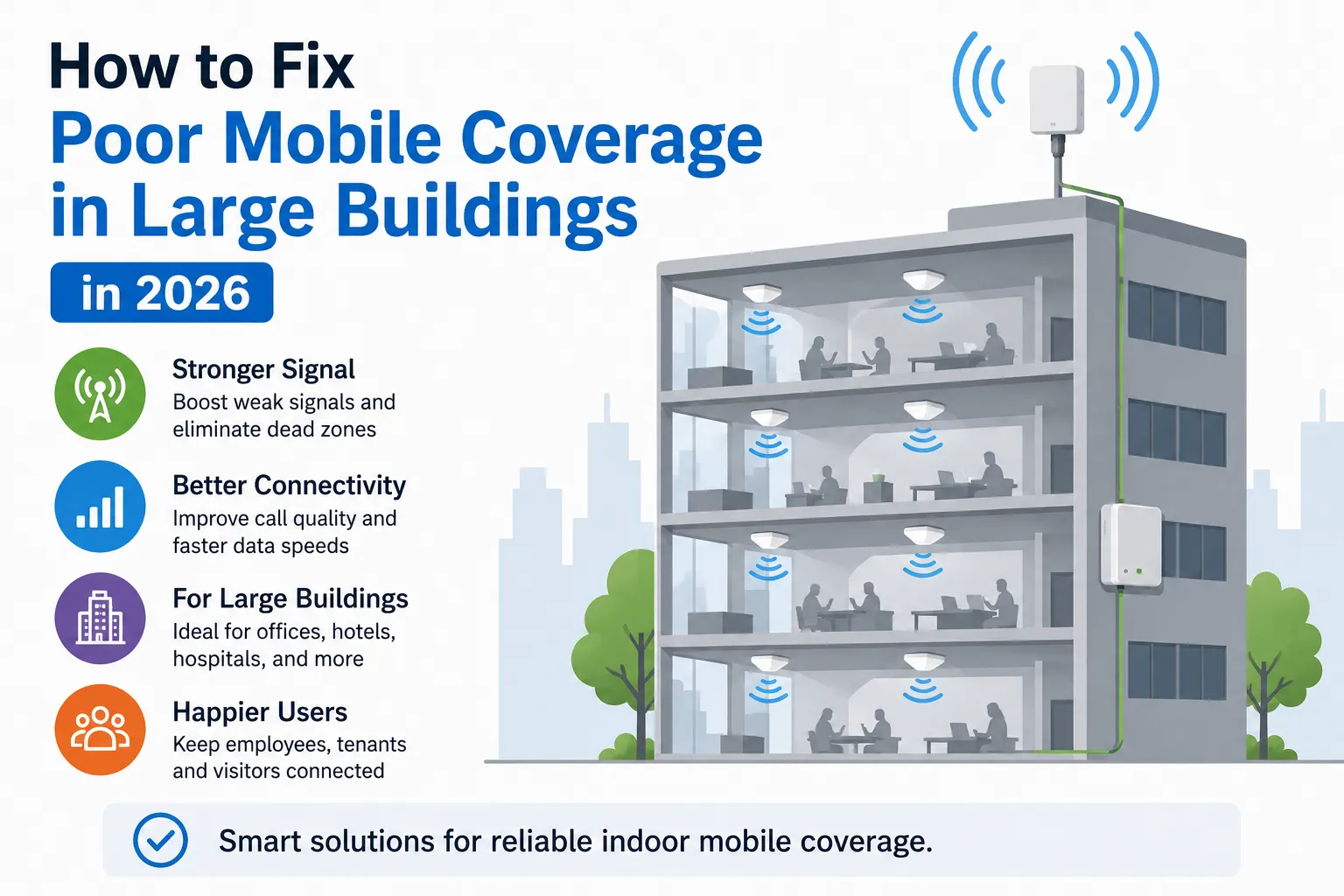
One of the most common solutions for fixing poor mobile coverage is deploying a mobile signal booster for large buildings.
A signal booster works by:
- Capturing existing outdoor mobile signal
- Amplifying the signal
- Redistributing stronger coverage indoors
This typically involves:
- Outdoor donor antennas
- Signal amplifiers
- Indoor coverage antennas
- Structured cabling systems
The result is stronger and more consistent signal throughout the building.
For many medium-sized offices or hotels, boosters provide a practical and cost-effective way to improve connectivity without major infrastructure reconstruction.
🚀 Why DAS Systems Are Becoming More Popular
For larger or more complex buildings, standard boosters may not be enough.
That’s where Distributed Antenna Systems (DAS) come into play.
A DAS solution distributes mobile signal throughout the building using multiple strategically placed antennas. Instead of relying on a single signal source, coverage is spread evenly across:
- Offices
- Hallways
- Basements
- Elevators
- Parking areas
This creates more stable and scalable indoor connectivity.
Many telecom experts now consider DAS infrastructure essential for large commercial properties, especially as 5G adoption continues to grow.
📶 5G Is Increasing Indoor Coverage Challenges
This surprises many building owners.
While 5G delivers faster speeds outdoors, high-frequency 5G signals often struggle more with building penetration compared to older mobile technologies.
That means:
- Better outdoor performance
- But potentially weaker indoor reception
As a result, demand for:
- Indoor wireless infrastructure
- DAS deployments
- mobile signal booster for large buildings solutions
is rapidly increasing across Australia.
Property developers are also starting to include indoor mobile coverage planning during construction phases instead of treating it as an afterthought later.
That’s a pretty major industry shift.
💡 Mobile Coverage Impacts Customer Experience Too
People often think indoor coverage is only an employee issue.
It’s not.
Customers notice poor signal immediately.
Examples include:
- Guests struggling with hotel connectivity
- Shoppers unable to process mobile payments
- Residents frustrated by dropped calls
- Visitors losing navigation access indoors
Poor connectivity directly affects:
- Customer satisfaction
- Online reviews
- Tenant retention
- Workplace productivity
And let’s be honest—nothing feels more awkward than watching someone walk around a lobby searching for enough signal to complete a payment.
🧠 Where This Analysis Might Be Limited
To be fair, every building has different connectivity requirements.
A small office might only need a basic booster system, while a high-rise tower may require:
- Full DAS infrastructure
- Multi-carrier integration
- Fibre backbone systems
- Advanced antenna distribution
The right solution depends on:
- Building size
- Existing signal strength
- Occupancy levels
- Carrier requirements
- Future scalability needs
So while there are excellent technologies available for fixing poor mobile coverage, there’s no universal one-size-fits-all solution.
Professional site assessments still matter a lot.
😄 A Quick Reality Check
If your building’s official mobile coverage strategy is:
“Try standing near the window.”
…it might be time for a serious infrastructure upgrade.
And if employees already know the building’s “magic signal spots,” the problem is probably bigger than anyone wants to admit.
🔮 What Happens Next?
Indoor connectivity technology is evolving quickly.
We’re already seeing:
- AI-assisted network optimization
- Smarter building connectivity systems
- Better integration between Wi-Fi and cellular networks
- Increased adoption of neutral-host DAS infrastructure
At the same time, some big questions remain:
- How future 6G networks will perform indoors
- Whether indoor wireless systems will become mandatory in new buildings
- How carriers and building owners will share deployment costs
For now, though, one thing is clear: businesses can no longer ignore poor mobile coverage in large buildings. Investing in modern indoor wireless solutions and mobile signal booster for large buildings technology is becoming essential for staying productive, competitive, and fully connected in 2026.
























Sign in to leave a comment.