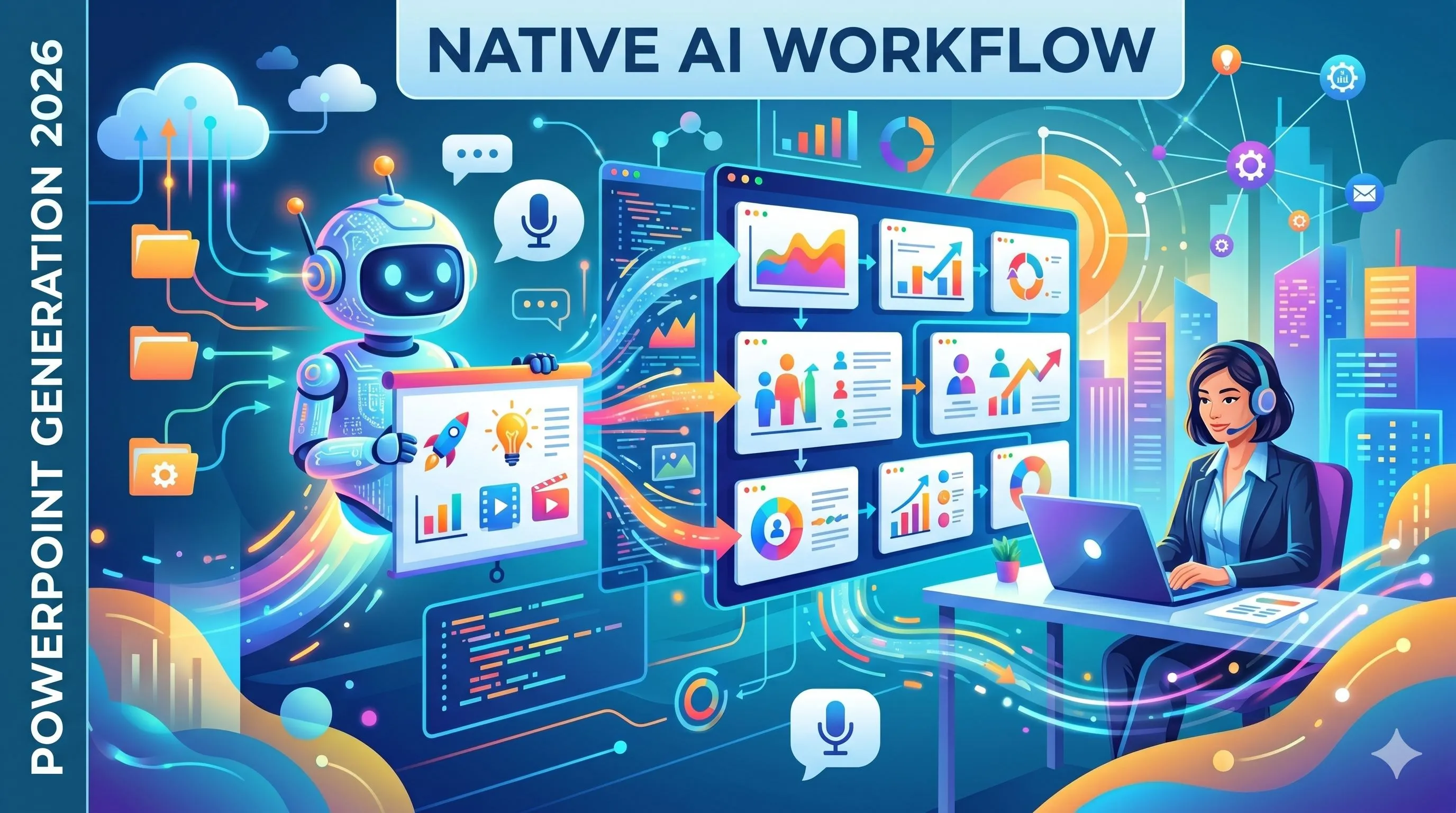

If you look back at how professionals built presentations just a few years ago, the process seems incredibly archaic. You would open a blank slide, stare at the screen, and spend hours manually adjusting text boxes, resizing graphics, and searching for the exact hex code of your company’s brand blue. It was a tedious, mechanical process that drained creativity and wasted millions of hours of valuable corporate time.
By 2026, the landscape has completely transformed. Artificial intelligence has moved out of the experimental phase and has become the foundational engine for corporate communications. However, the way we use this technology has also matured. We are no longer relying on clunky web-based wrappers that export broken layouts. Today, true professionals use deeply integrated, native intelligence.
If your team is still spending their evenings formatting slides, it is time to modernize. Here is the definitive guide on how to intelligently generate presentations in 2026.
Step 1: Abandon the Web Apps and Go Native
The very first step in modernizing your workflow is evaluating the architecture of your tools. In the early days of presentation automation, the market was flooded with standalone browser applications. While they looked flashy, they suffered from the dreaded "export trap." You would build a beautiful deck online, but the moment you exported it to a true corporate format, the layouts shattered and charts turned into uneditable, flat images.
In 2026, the standard is native integration. You need an ai for powerpoint solution that lives directly inside your Microsoft ribbon. Because a native add-in interacts with the actual .pptx file architecture, there is no export process. The slides are built using native shapes, text boxes, and live data charts right on your canvas.
Before you commit your team to a platform, you must rigorously evaluate its underlying technology. There are several severe red flags to watch for when picking an AI tool, including proprietary web canvases, rigid uneditable graphics, and the inability to link to live Excel data. Choosing a native tool bypasses all of these risks immediately.
Step 2: Master the Art of Contextual Prompting
Once you have the right software installed, the next step is input. The golden rule of artificial intelligence remains true: garbage in, garbage out. If you type a generic, five-word command into your tool, you are going to get a highly generic, narratively empty slide deck in return.
When you use a system to ai generate ppt drafts, you must act as a strategic director. The AI is handling the layout and design, which means your sole responsibility is providing rich, contextual information.
A high-quality prompt in 2026 includes four specific elements: the target audience, the core objective of the meeting, the key data points that must be highlighted, and the desired call to action. Instead of asking for a "Q3 Sales Deck," you should ask for a "10-slide Q3 review aimed at the executive board, highlighting our 15% growth in the enterprise sector and arguing for increased marketing spend in Q4."
If your team is struggling to get the exact output they need, it is highly recommended that they study structured presentation prompts to generate slides. Learning how to effectively communicate with the machine is the single most important skill for a modern knowledge worker.
Step 3: Enforce Your Corporate Master Templates
One of the biggest mistakes companies make when implementing automated design is abandoning their visual identity. If you let an intelligent system run wild, it will default to whatever colors and fonts it thinks look best. In a corporate environment, this leads to a fragmented, chaotic brand presence where every department’s presentations look entirely different.
The 2026 workflow solves this by anchoring the automation to your official corporate master templates. Before you generate a single word of text, your native software should read your company's .potx files. It extracts the strict rules regarding your primary and secondary color palettes, your typographical hierarchy, and your mandated logo placements.
By forcing the generation engine to operate exclusively within these guardrails, you guarantee that every single presentation created by your team is 100% brand-compliant. It eliminates the need for marketing directors to manually police decks before client meetings.
Step 4: Utilize Conversational Editing
The most powerful advancement in the 2026 presentation workflow is the shift in how we edit. The days of clicking through five different menus to change a chart style or resize a grid of images are over.
Once your initial draft is generated, the workflow shifts to conversational refinement. If a slide feels too text-heavy, you simply tell your native assistant to "summarize this text into three concise bullet points." If the data visualization is not impactful enough, you command it to "change this pie chart into a side-by-side comparison matrix."
The AI acts as your dedicated graphic designer sitting right next to you. It instantly executes the formatting commands, allowing you to iterate on the design at the speed of thought. Because the system is native, these changes apply to the actual presentation layers, keeping everything perfectly editable for your colleagues.
The Bottom Line: Reclaiming Your Strategy
The ultimate goal of learning how to properly use intelligent presentation software is not just to build slides faster. It is about fundamentally reallocating your human capital.
When you eliminate the mechanical friction of the design process, you give your professionals their most valuable resource back: time. By leveraging native integration, strategic prompting, and brand-enforced automation, your team can finally stop acting like amateur graphic designers and return to focusing on the clarity, persuasion, and impact of their core message.


























Sign in to leave a comment.