
How to register a Section 8 Company
A Section 8 Company, registered under the Companies Act, 2013, is formed with the primary objective of promoting arts, commerce, charity, education, environmental protection, sports, science, research, social welfare, or similar objectives. Unlike typical NGOs (Non-Governmental Organizations), Section 8 Companies benefit from a more structured and formal legal framework.
Key Differences Between NGOs and Section 8 Companies
- Legal Framework:
- NGOs: Can be structured as trusts, societies, or Section 8 Companies, each governed by different state-specific or central laws.
- Section 8 Companies: Incorporated exclusively under the Companies Act, 2013, providing a uniform legal structure akin to corporate entities.
- tax benefits for Section 8 Companies
- NGOs: Must apply separately for tax exemptions under Section 12AA and Section 80G of the Income Tax Act.
- Section 8 Companies: Automatically eligible for tax exemptions under Section 12AA and Section 80G, provided they meet the necessary criteria.
- Regulatory Authority:
- NGOs: Supervised by varying authorities depending on their structure—trusts under the Indian Trusts Act, 1882; societies under the Societies Registration Act, 1860.
- Section 8 Companies: Governed uniformly by the Ministry of Corporate Affairs (MCA) and must adhere to the Companies Act, 2013.
- Compliance and Governance:
- NGOs: Compliance requirements differ based on their structure and the laws governing them.
- Section 8 Companies: Must follow strict compliance standards as per the Companies Act, 2013, including maintaining accurate financial records, conducting annual audits, holding regular board meetings, and filing annual returns with the MCA.
Process of registering a Section 8 Company in India
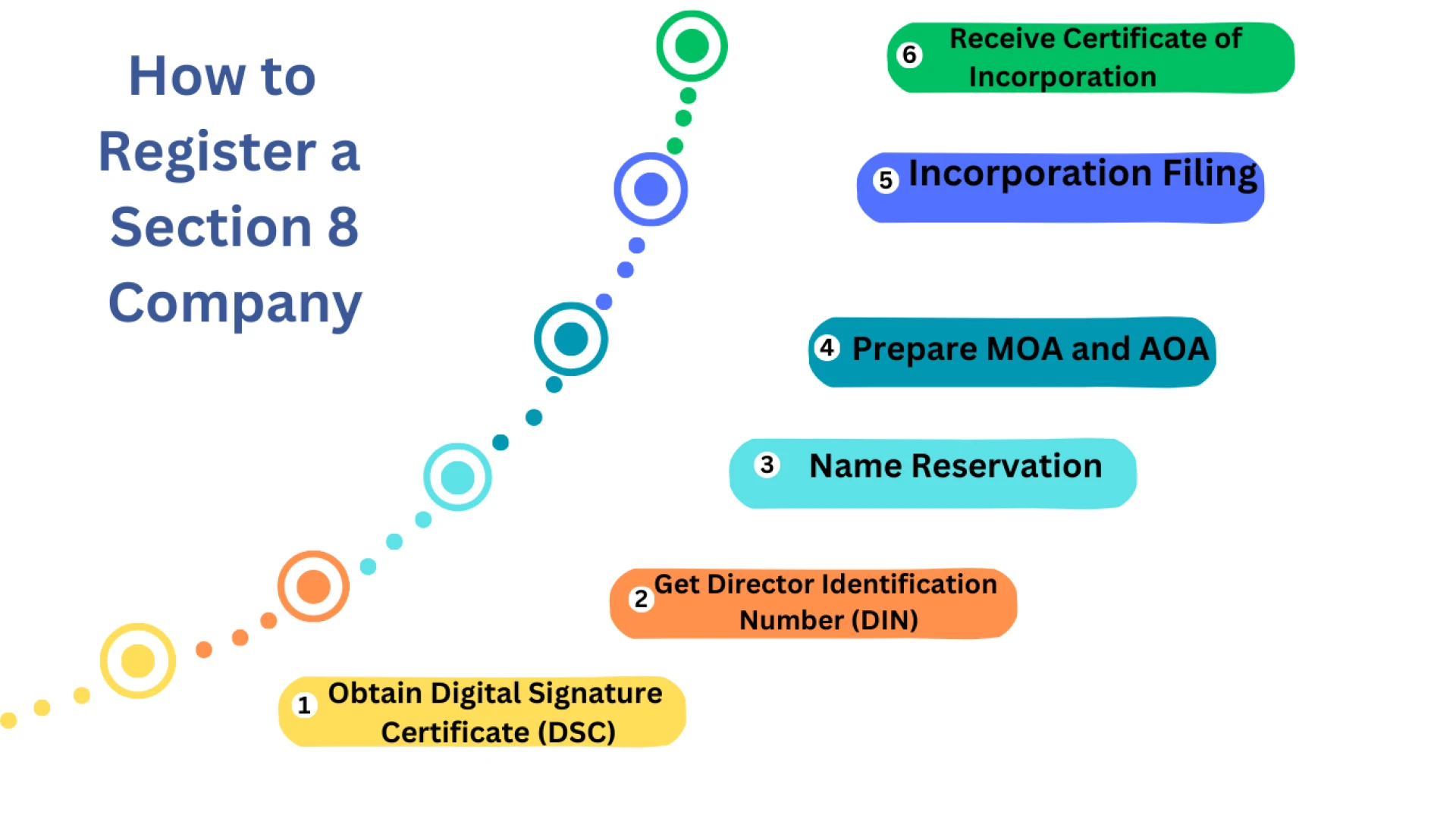
- Obtain Digital Signature Certificate (DSC): Secure a DSC for the proposed directors.
- Get Director Identification Number (DIN): Apply for DIN for the proposed directors.
- Name Reservation: Apply for name reservation via the MCA portal.
- Prepare MOA and AOA: Draft the Memorandum of Association (MOA) and Articles of Association (AOA) outlining the company’s objectives and governance policies.
- Incorporation Filing: File the incorporation application with the necessary documents, including MOA, AOA, affidavits, and declarations, to the MCA.
- Receive Certificate of Incorporation: Upon approval, the Registrar of Companies (ROC) issues a Certificate of Incorporation, formally establishing the entity as a Section 8 Company.
How to Check Registration Status on MCA Website
You can verify the registration status of your Section 8 Company on the MCA website by following these steps:
- Access the MCA Services Section: Visit the MCA’s official website and to the "MCA Services" section.
- Select "View Company Master Data": Choose the "View Company Master Data" option.
- Enter Corporate Identification Number (CIN): Input your company\'s Corporate Identification Number (CIN) in the provided field.
- Submit the Details: Click the "Submit" button to view your company\'s current registration status.
The MCA offers online access to information about all registered companies, including Section 8 Companies, ensuring transparency and ease of access to essential details.
Establishing a Section 8 Company in India involves following a detailed process designed to ensure a transparent and structured legal framework for charitable organizations. By adhering to the steps outlined above, you can successfully register a Section 8 Company and take advantage of the benefits of tax exemptions and stringent governance standards. Additionally, the MCA’s online portal provides a convenient means to check the registration status and obtain vital information about your company, thereby enhancing transparency and compliance.
Ability SEO Tips:
Use keywords such as "Section 8 Company registration," "how to register a Section 8 Company," "Section 8 Company compliance," "tax benefits for Section 8 Companies," and "MCA Section 8 Company."
Include long-tail keywords like "process of registering a Section 8 Company in India" and "benefits of Section 8 Company under Companies Act 2013."
Use headings and subheadings with keywords for better search engine visibility.
Ensure the article is well-structured with bullet points and numbered lists for read.





















Sign in to leave a comment.