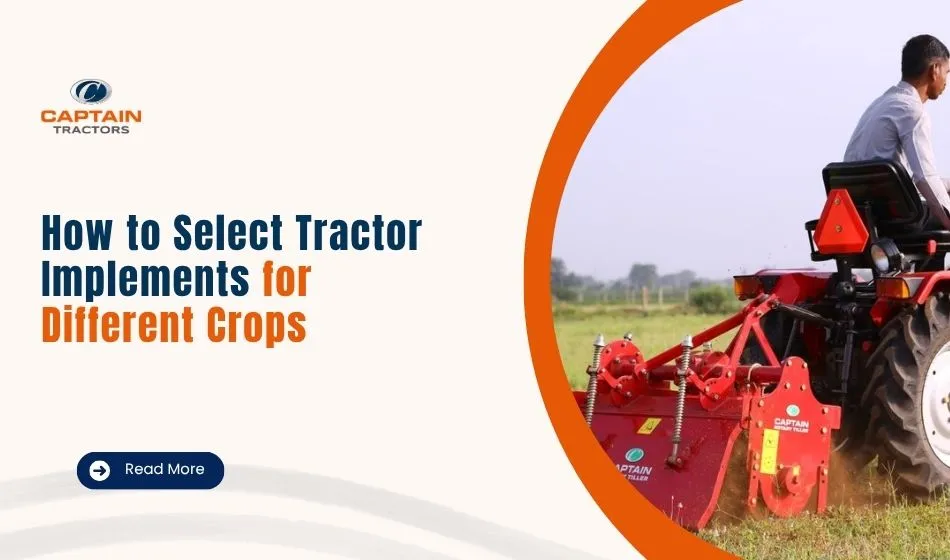

Different crops require different farming operations. Land preparation, planting, cultivation, weed management, harvesting, and transportation can all require specific equipment.
Choosing the right tractor implements can help farmers perform these tasks according to the requirements of the crop and field. However, an implement that works well for one crop may not be suitable for another.
Farmers should consider crop type, soil condition, row spacing, farm size, tractor horsepower, and the specific operation before selecting an implement.
Why Crop Type Matters When Choosing Implements
Crops differ in their planting patterns, root systems, row spacing, and cultivation requirements. For example, a vegetable crop planted in narrow rows may require a different implement setup from a crop grown across a large open field.
Before choosing an attachment, farmers should identify:
- The crop being cultivated
- Required farming operations
- Row and plant spacing
- Soil type and condition
- Farm size
- Tractor horsepower
- Required working depth and width
Implement compatibility
This helps farmers select equipment based on actual field requirements rather than choosing an implement only by size or price.
Tractor Implements for Cereal Crops
Crops such as wheat, rice, maize, and other cereals are commonly grown across larger field areas.
Depending on the farming system, tractors may be used with implements for:
- Soil preparation
- Seedbed preparation
- Sowing
- Cultivation
- Weed management
Transportation
For larger open fields, farmers may consider implements with suitable working widths to cover more area during each operation. However, the implement must remain within the tractor's recommended power and operating capacity.
Tractor Implements for Vegetable Crops
Vegetable farming often involves defined rows and relatively intensive field management. Crops such as tomatoes, onions, potatoes, chillies, and other vegetables may require repeated cultivation and weed-management operations.
For these crops, farmers should pay close attention to implement width and row spacing.
A suitable implement can help with operations such as:
- Seedbed preparation
- Inter-row cultivation
- Weeding
- Soil management
Transportation
When working between established crop rows, the implement should provide sufficient clearance to reduce the risk of damaging plants.
Tractor Implements for Orchard Crops
Fruit crops such as mangoes, citrus, guava, and other orchard crops create a different machinery environment.
Trees are usually planted in rows, and available space can become restricted as the orchard develops. Compact machinery and appropriately sized attachments can therefore be useful for selected orchard operations.
Farmers may use suitable implements for:
- Inter-row cultivation
- Weed management
- Mowing
- Soil maintenance
Material transportation
When selecting equipment for orchards, tractor width, implement width, turning space, and tree-row spacing should be considered together.
Tractor Implements for Cotton and Similar Row Crops
Cotton and other row crops require careful management between planted rows. Cultivation and weed control may be carried out at different stages of crop growth.
Farmers should choose implements that match the row spacing and allow the tractor to operate without interfering with the plants.
Working depth should also be considered because deeper soil engagement can require more tractor power.
Tractor Implements for Sugarcane
Sugarcane can require several operations, including land preparation, planting, intercultural cultivation, weed management, and transportation.
Because these operations can have different requirements, farmers may need more than one implement during the crop cycle.
The tractor's horsepower, lifting capacity, and compatibility with each attachment should be checked before selecting the equipment.
Match the Implement With Tractor HP
Crop type is only one part of implement selection. The tractor must also have suitable power for the selected attachment.
Farmers should check the implement manufacturer's recommended horsepower range before purchase.
For example, an implement designed for heavier soil-engaging work may have different power requirements from equipment used for lighter cultivation or mowing.
The tractor's:
- Horsepower
- Weight
- Lifting capacity
- PTO requirements
- Hydraulic capacity
- Drive type
should all be considered when selecting an attachment.
Farmers can explore tractor models and compare specifications according to their farm requirements.
Consider Row Spacing Before Choosing an Implement
Row spacing is especially important for vegetables, cotton, orchards, and other crops planted in defined patterns.
An implement that is too wide may not fit between rows. An attachment that is too narrow may not provide the required coverage for the operation.
Measure the crop spacing and compare it with the tractor and implement dimensions before purchase.
This is particularly important when selecting mini tractor implements for small farms, vegetable fields, and orchards.
Consider Soil Conditions
Soil type and moisture can influence implement selection.
Hard or compacted soil may require different equipment and power requirements compared with lighter soil. Wet conditions can also affect traction and field performance.
Farmers should consider the normal soil conditions in their fields and select implements according to the recommended operating requirements.
Consider the Full Crop Cycle
Farmers should avoid choosing an implement for only one operation when the tractor is expected to perform several tasks.
Instead, list the main operations required throughout the crop cycle.
For example:
Land preparation → planting → cultivation → weed management → harvesting support → transportation
This can help farmers determine which implements they actually need and whether their tractor can support them.
Check Implement Compatibility
Before purchasing any tractor attachments, farmers should confirm compatibility with their tractor model.
Important specifications include:
- Recommended tractor horsepower
- Hitch type
- PTO requirements
- Hydraulic requirements
- Lifting capacity
- Implement weight
- Working width
Working depth
Checking these specifications in advance can help prevent compatibility problems.
Farmers can explore tractor implements and attachments based on their intended agricultural applications.
Choose Implements According to Farm Size
Farm size also influences implement selection.
Small farms may benefit from compact equipment that is easier to maneuver in restricted areas. Larger farms may require wider implements for covering more field area.
For smaller operations, a compact tractor such as the Captain 120 Little Master can be evaluated based on its specifications and intended applications.
Farmers requiring more power can also compare models such as the Captain 200 DI 2WD and Captain 200 DI 4WD.
The appropriate combination depends on the crop, field conditions, implement requirements, and workload.
Common Mistakes When Selecting Tractor Implements
Farmers can avoid several common mistakes by evaluating the complete farming setup before purchasing.
Choosing Based Only on Price
The lowest purchase price does not necessarily mean the implement is suitable for the farm. Compatibility and application should be considered first.
Ignoring Tractor Capacity
An implement should fall within the tractor's recommended operating specifications.
Overlooking Crop Spacing
This can be a major issue in vegetable and orchard farming, where machinery needs to operate between rows.
Selecting One Implement for Every Task
Different operations may require different equipment. Farmers should identify the tasks they actually need to mechanize.
Not Checking Specifications
Horsepower, PTO, hydraulic requirements, lifting capacity, and implement dimensions should be checked before purchase.
Final Thoughts
Selecting tractor implements for different crops requires more than choosing equipment based on crop name. Farmers should consider the specific operation, crop spacing, soil conditions, farm size, tractor horsepower, and implement compatibility.
Vegetable crops may require narrow and maneuverable equipment, while orchards can place greater emphasis on compact dimensions and row clearance. Open-field crops may allow the use of wider implements when the tractor has sufficient power and operating capacity.
By matching the implement to both the crop and tractor, farmers can build a practical machinery setup that supports different stages of crop production.
FAQs
1. How do I choose tractor implements for my crop?
Consider the crop, farming operation, row spacing, soil conditions, tractor HP, and implement compatibility.
2. Are the same tractor implements suitable for every crop?
No. Different crops and farming operations can require different implement types and dimensions.
3. Why is row spacing important?
The tractor and implement need sufficient clearance to operate between crop rows without damaging plants.
4. Does tractor HP affect implement selection?
Yes. Each implement has recommended tractor power requirements that should be checked before use.
5. Can mini tractors use different implements?
Yes, provided the implements are compatible with the mini tractor's horsepower, lifting, hitch, PTO, and hydraulic specifications.






















Sign in to leave a comment.