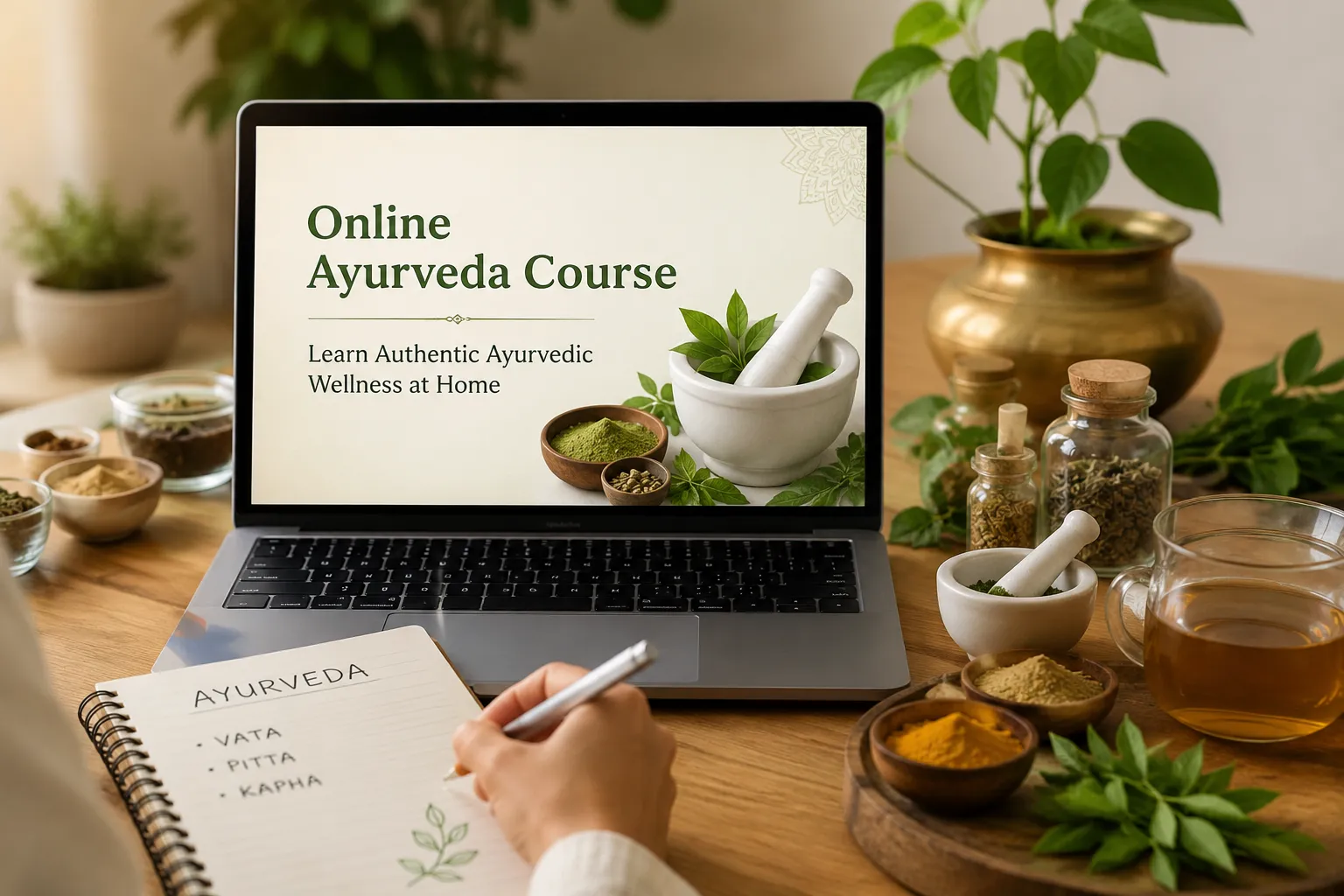

Learning Ayurveda does not require a background in traditional medicine. Beginners can start with foundational concepts such as the doshas, daily routines, nutrition, herbs, and Ayurvedic philosophy through a structured beginner course. The key is to study gradually, use reputable sources, understand the limits of traditional wellness practices, and avoid treating Ayurveda as a substitute for qualified medical care.
What Is Ayurveda, and Why Are Beginners Interested?
Ayurveda is a traditional system of health and wellness that originated in India. The word combines ayus (life) and veda (knowledge), reflecting its broad interest in how people live, eat, rest, and maintain balance.
For someone encountering Ayurveda for the first time, the terminology can seem unfamiliar. Words such as dosha, prakriti, agni, and dinacharya have specific meanings, so learning them in context is more useful than trying to memorize a long list of definitions.
Modern interest in Ayurveda often begins with practical questions:
- How can I create a healthier daily routine?
- What does Ayurveda say about food and digestion?
- What are the three doshas?
- How can traditional wellness practices fit into modern life?
- Can I study Ayurveda online as a complete beginner?
These questions provide a sensible starting point.
Do You Need Medical or Traditional Medicine Experience?
No. A beginner does not need to be a doctor, therapist, yoga teacher, or practitioner of traditional medicine to study introductory Ayurveda.
What matters more is having an open but careful approach to learning. Ayurveda contains a large body of traditional knowledge, and understanding its concepts takes time.
A good beginner should be prepared to:
- Learn basic terminology before advanced concepts.
- Study Ayurveda within its historical and philosophical context.
- Compare traditional ideas with current health knowledge.
- Ask qualified professionals when health concerns arise.
- Avoid making medical claims based solely on introductory study.
This approach makes learning more useful and responsible.
Start With the Core Principles
Trying to study every Ayurvedic concept at once can quickly become confusing. Start with the foundations.
1. The Three Doshas
The doshas: Vata, Pitta, and Kapha are among the best-known Ayurvedic concepts. They are traditionally described through combinations of the five elements and are used within Ayurveda to discuss individual constitution and patterns of balance.
At the beginning, focus on understanding the general characteristics associated with each dosha rather than trying to diagnose yourself.
2. Prakriti
Prakriti refers to an individual's constitution in Ayurvedic thought. Learning this concept helps explain why Ayurveda places importance on individual differences rather than recommending exactly the same routine for everyone.
3. Agni and Digestion
Agni, commonly translated as digestive fire, is another central Ayurvedic concept. Traditional Ayurvedic teachings connect digestion with overall well-being and daily habits.
4. Dinacharya
Dinacharya refers to a daily routine. This is one of the most practical areas for beginners because it encourages attention to regular habits such as waking, eating, personal care, activity, and rest.
Choose a Structured Way to Study Ayurveda
You can learn through books, workshops, educational videos, or online courses. For someone starting from zero, a structured course can make the learning process easier because concepts are introduced in a logical order.
When comparing an online Ayurveda course, look for:
- Clear explanations of foundational Ayurvedic concepts
- Qualified and experienced instructors
- A well-organized curriculum
- Appropriate discussion of traditional and modern perspectives
- Practical examples without exaggerated health claims
- Accessible lessons suitable for beginners
- Opportunities to review and reinforce concepts
If you prefer flexible study, you can learn Ayurvedic principles online and work through the fundamentals at your own pace.
Learn Ayurveda Through Everyday Observation
One of the most interesting parts of studying Ayurveda is connecting theory with everyday habits.
Instead of immediately changing your entire lifestyle, keep a simple observation journal. Note things such as:
- Meal timing
- Sleep patterns
- Energy levels
- Daily activity
- Stress levels
- General digestion
- How different routines make you feel
The purpose is not to diagnose a health condition. It is to become more aware of patterns and understand how Ayurvedic teachings discuss daily living.
This reflective approach can make Ayurvedic lifestyle practices easier to understand because the ideas are connected to real experiences rather than remaining abstract definitions.
Be Careful With Herbs and Supplements
Ayurvedic education often includes herbs, oils, and traditional preparations. This is an area where beginners should be particularly cautious.
Natural does not automatically mean safe for everyone. Herbs can interact with medicines, vary in quality, and may not be appropriate during pregnancy, certain medical conditions, or particular stages of life.
Before using an Ayurvedic herb or supplement for a health concern, speak with an appropriately qualified healthcare professional. Introductory Ayurveda education should increase understanding, not encourage self-treatment of serious conditions.
Ayurveda and Yoga: Related but Not Identical
People who already practice yoga may naturally become interested in Ayurveda. Both traditions developed in India and share historical connections, but they are not the same subject.
Yoga commonly focuses on practices involving movement, breath, meditation, and philosophy. Ayurveda traditionally focuses more broadly on health, daily living, diet, constitution, and well-being.
Studying both can provide useful context, but each should be learned on its own terms.
A Simple Beginner Study Plan
If you are unsure where to begin, try this six-week approach:
Week 1: Learn Ayurveda's history, terminology, and basic philosophy.
Week 2: Study the five elements and the three doshas.
Week 3: Explore prakriti, digestion, and traditional approaches to daily balance.
Week 4: Study dinacharya, food principles, sleep, and seasonal routines.
Week 5: Review herbs, oils, and traditional practices from a safety-conscious perspective.
Week 6: Revisit the major concepts and connect them to everyday wellness.
You do not need to master everything during the first six weeks. Strong fundamentals are more valuable than rushing into advanced material.
What Makes a Good Ayurveda Beginner?
The strongest learners are not necessarily those who memorize the most Sanskrit terms. They are people who ask sensible questions, check sources, recognize the difference between traditional claims and established medical evidence, and know when professional healthcare advice is needed.
Approach Ayurveda with curiosity and critical thinking. That balance allows you to appreciate its traditional knowledge without making promises that the evidence does not support.
Start With Knowledge, Not Complexity
You do not need a medical background to begin studying Ayurveda. Start with the fundamentals, choose reliable educational material, keep your expectations realistic, and give yourself time to understand the concepts.
The most rewarding part of beginner-level Ayurveda study is often not learning a complicated treatment; it is gaining a new perspective on everyday habits, individual differences, food, rest, and wellbeing.
Frequently Asked Questions
1. Can I learn Ayurveda without studying medicine?
Yes. Introductory Ayurveda courses can be suitable for complete beginners. You can learn foundational concepts without having formal medical training.
2. Is Ayurveda difficult for beginners?
The basic ideas are approachable, but the subject becomes more complex as you progress. Learning terminology and studying one concept at a time makes it easier.
3. Can I learn Ayurveda online?
Yes. Online learning can be a convenient option for studying Ayurvedic philosophy, doshas, daily routines, nutrition principles, and other foundational topics from home.
4. How long does it take to learn basic Ayurveda?
There is no single timeframe. A few weeks of consistent study can provide an introduction, while developing deeper knowledge requires much longer and more systematic study.
5. Should beginners start taking Ayurvedic herbs?
Not automatically. Learn about herbs first, and consult a qualified healthcare professional before using them, especially if you take medication or have an existing health concern.
6. Can Ayurveda replace modern medical treatment?
Ayurveda should not be used as a replacement for necessary medical diagnosis or treatment. Traditional wellness practices and professional healthcare can have different roles.
7. What should I study first in Ayurveda?
Start with Ayurvedic history and philosophy, the five elements, three doshas, prakriti, agni, and dinacharya. These concepts provide a useful foundation for further study.



























Sign in to leave a comment.