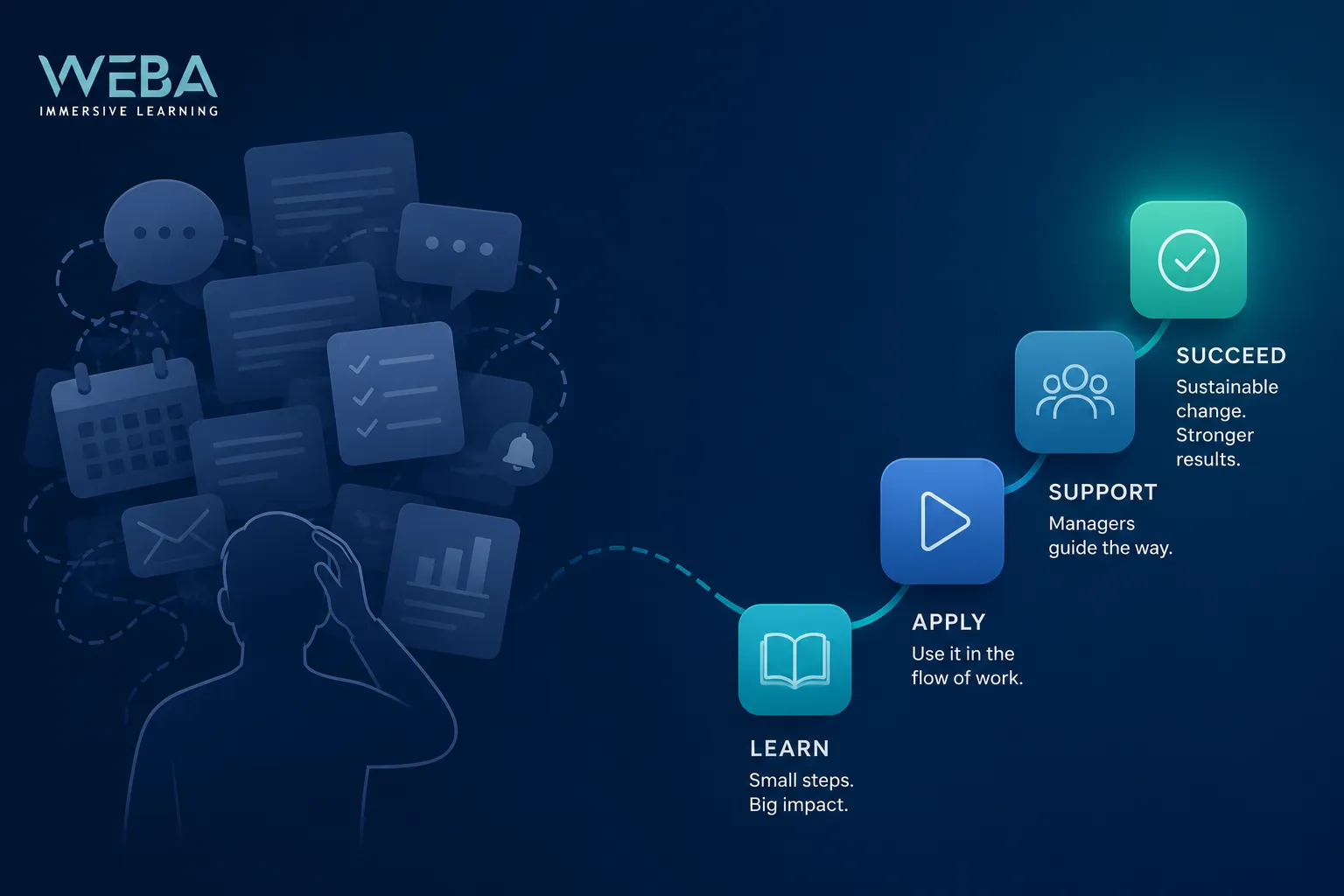

Change used to be an event. A new system rollout, a merger, a process redesign: something with a start date and an end date. That's no longer how most employees experience it. By 2025, the average employee was navigating around 14 concurrent enterprise change initiatives, up from 10 in 2022, with overlap rates between initiatives exceeding 60% in many organizations. Change isn't a project anymore. It's the operating environment.
This creates a specific problem for L&D teams: how do you train people for change without adding to the very overload that's already undermining their ability to absorb it?
Most organizations get this wrong in a predictable way. They treat "more training" as the fix for "more change," piling on modules, town halls, and toolkits until the training itself becomes another source of fatigue. The result is a paradox familiar to anyone who has run a change program: the harder L&D pushes, the less sticks.
A typical example: a company rolls out a new LMS, updates its expense policy, and reorganizes two departments within the same quarter, each with its own training module, deadline, and completion tracker. Individually, none of these changes is unreasonable. Together, delivered through separate, disconnected training pushes, they compound into exactly the kind of overload that causes people to disengage from all three.
Fixing this starts with understanding what's actually happening in employees' heads when change training fails.
Why Change Training Backfires
Change training backfires because it exceeds working memory limits. Cognitive Load Theory, first described by educational psychologist John Sweller, holds that working memory can only handle roughly five to nine chunks of new information at a time. When training delivers more than that in one sitting, a full system walkthrough, a complete new process, an entire policy change, the excess doesn't get skipped. It gets lost, and it takes the material that came before it down with it.
Now stack that against organizational reality. Gartner's research shows employees' willingness to support enterprise change dropped from 74% in 2016 to 43% in 2022, a trend that has continued as change volume has climbed. Separately, Gartner's HR practice found that only 32% of business leaders say their most recent change effort achieved what they define as "healthy adoption," meaning employees acted on the change, did so on time, and didn't suffer a hit to performance or wellbeing in the process.
Put these two data points together and the picture is clear: it isn't that employees are unwilling to change. It's that the training approach is exceeding what people can actually process, on top of everything else already competing for their attention.

Change Fatigue Isn't Resistance, and Treating It That Way Makes Training Worse
One of the most persistent mistakes in change management is misreading fatigue as resistance. They look similar from the outside, disengagement, slow adoption, pushback, but they call for opposite responses.
Resistance is addressed by building a stronger case for the change: more communication, more justification, more urgency. Fatigue is made worse by exactly that response. When employees are already cognitively depleted, adding more content, more explanation, and more "why this matters" messaging doesn't build buy-in. It accelerates the exhaustion that caused the disengagement in the first place.
This distinction matters because it flips the design brief. The goal of change training isn't to convince people harder. It's to reduce the cognitive cost of adopting the change in the first place.
The Change Absorption Framework
Four principles hold up consistently across well-run change programs, and together they form what's worth thinking of as a Change Absorption Framework: pace it, chunk it, reinforce it, and support it. The name reflects the goal directly. The constraint isn't how much information you can deliver. It's how much an employee can actually absorb, retain, and act on, given everything else already competing for their attention.
1. Pace the training to match the change, not the project timeline
Most change training is scheduled around when the business needs the change live, not around how much a person can realistically absorb in that window. Prosci's benchmarking research offers a useful proxy for what "well-paced" looks like in practice: initiatives with excellent change management are up to seven times more likely to meet their objectives than those with poor change management, and active, visible sponsorship alone increases success likelihood by 29%. The organizations getting this right aren't necessarily training more. They're spacing training deliberately around the ADKAR sequence (Awareness, Desire, Knowledge, Ability, Reinforcement) instead of compressing all five stages into a single launch week.
Practically, this means resisting the instinct to front-load every detail before go-live. Awareness and desire-building can happen weeks ahead of the skills training itself, so the actual "how to do this" learning arrives when people are ready to act on it, not when they're still processing that the change is happening at all.
2. Chunk content into microlearning units, not comprehensive modules
Chunking means breaking training into task-sized units instead of one long comprehensive module, a direct, practical application of Sweller's cognitive load research. Instead of one 45-minute module covering an entire new process, break it into task-sized units, five to ten minutes each, built around a single decision or action a person needs to take. This isn't just a delivery preference; it's a direct response to working memory limits. Each unit should be usable and complete on its own, so an employee can apply it immediately rather than holding several disconnected pieces in mind until "the full picture" arrives later.
This is precisely the gap a structured microlearning approach is designed to close, replacing long-form change training with focused, task-specific modules that employees can complete in the flow of work rather than in a single high-stakes session.
3. Reinforce instead of relying on a one-time event
Reinforcement, not additional new content, is the more efficient lever for locking in adoption, which matters because L&D budgets are already being asked to do more with less: ATD's most recent State of the Industry data shows formal learning hours per employee have fluctuated sharply in recent years, while expectations for skills development keep rising. Spaced follow-ups, short refreshers, and manager check-ins two and four weeks after initial training do more to lock in adoption than a longer initial session ever will, and they cost far less to produce.
4. Make leadership support visible, not just present
McKinsey's transformation research consistently finds that the presence of digitally capable, visibly engaged leaders is one of the strongest predictors of whether a change effort sticks. Respondents are meaningfully more likely to report success when leaders actively use new channels to reach employees and when roles are clearly redefined around the change. For training specifically, this means managers need their own short, focused enablement, not so they can deliver the training themselves, but so they can answer questions and reinforce it credibly when employees hit friction.
This gap between leadership and frontline readiness shows up in other change-adjacent research too. Microsoft's 2025 Work Trend Index found that 67% of leaders reported familiarity with new AI agent technology, compared to just 40% of employees, a visibility gap that mirrors what happens in any change effort where leadership enablement outpaces frontline enablement. If managers understand a change better than the people they support, the training gap doesn't close. It just moves down a level.
A Quick Checklist
Before launching the next round of change training, it's worth testing the plan against a short list:
- Is any single session asking employees to absorb more than 5–9 new concepts at once?
- Does training arrive close to when people will actually use it, rather than weeks before?
- Is there a reinforcement touchpoint scheduled after the initial session, not just before it?
- Have managers been given enough context to support the change, separate from the employee-facing training itself?
- Could this module be broken into a smaller, standalone unit without losing its usefulness?
None of these questions require a bigger budget to answer. Most require the opposite: cutting a session in half, spacing two deliverables two weeks apart instead of launching them together, or handing a manager a one-page prep sheet instead of asking them to sit through the same module as their team. The fixes tend to be structural, not additive.
The Real Goal Isn't More Training, It's Less Friction
The instinct to combat change fatigue with more training is understandable, but it treats the symptom as the cause. Employees aren't under-trained; they're over-loaded. The organizations that navigate constant change well aren't the ones running the most sessions. They're the ones that have redesigned training to fit inside employees' actual capacity to absorb it: paced deliberately, chunked into usable pieces, reinforced over time, and backed by leaders who show up for it.
That shift, from "more content" to "less cognitive cost," is the difference between change training that gets completed and change training that actually changes behavior.




























Sign in to leave a comment.