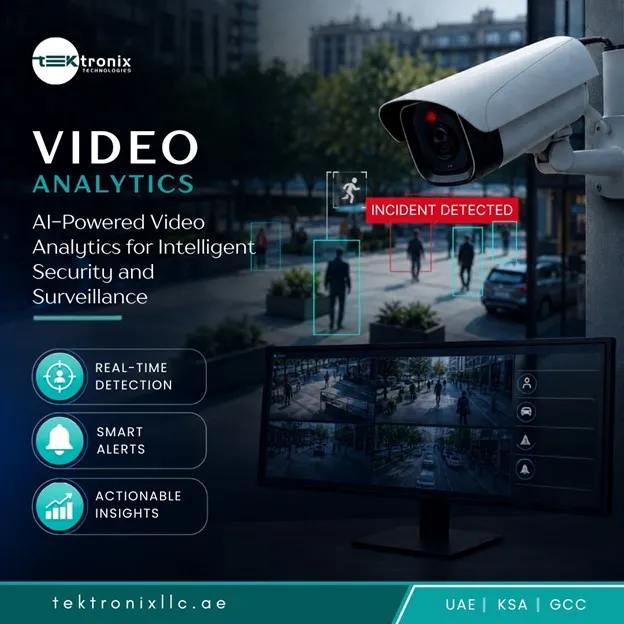

Modern Video Analytics is changing what a security camera actually does. Instead of passively recording footage that a guard reviews hours later, today's cameras interpret what they see in real time — recognizing faces, flagging suspicious behaviour, and alerting response teams before an incident escalates. Across the UAE, this shift is redefining how airports, malls, hospitals, and government facilities in Dubai and beyond approach physical security.
This guide explores how intelligent camera systems work, what separates a genuinely capable platform from a basic recording setup, and how security teams across the Emirates can deploy these tools to move from reactive monitoring to proactive protection.
The Shift from Passive Recording to Intelligent Monitoring
For decades, a security camera's job ended at capturing footage. Someone still had to watch the feed live or scrub through hours of recording after the fact to find anything useful — a process that is slow, labour-intensive, and prone to human fatigue during long, uneventful shifts. AI-Powered Video Analytics changes that equation entirely by processing every frame as it happens, automatically identifying faces, counting people, tracking movement patterns, and surfacing only the events that actually require human attention.
This shift matters enormously for the UAE's dense high-rise developments and expanding smart-city infrastructure, where the sheer volume of daily foot traffic through malls, transit hubs, and mixed-use towers makes manual, human-only monitoring practically impossible to scale cost-effectively.
Video Analytics Software: The Intelligence Layer Behind Every Camera
The camera itself is only the sensor; the real capability lives in the Video Analytics Software processing what it captures. Modern platforms run deep-learning models trained to distinguish a person from a shadow, a genuine intruder from a stray animal, and a loitering individual from someone simply waiting for a ride — distinctions that dramatically reduce the false alarms that once made security teams tune out camera alerts altogether.
Edge processing has become a defining feature of leading platforms, allowing analysis to happen directly on or near the camera rather than routing every frame to a distant cloud server. This reduces latency for time-sensitive alerts and keeps facilities operational even during a temporary network interruption.
Video Analytics Solutions Across UAE Industries
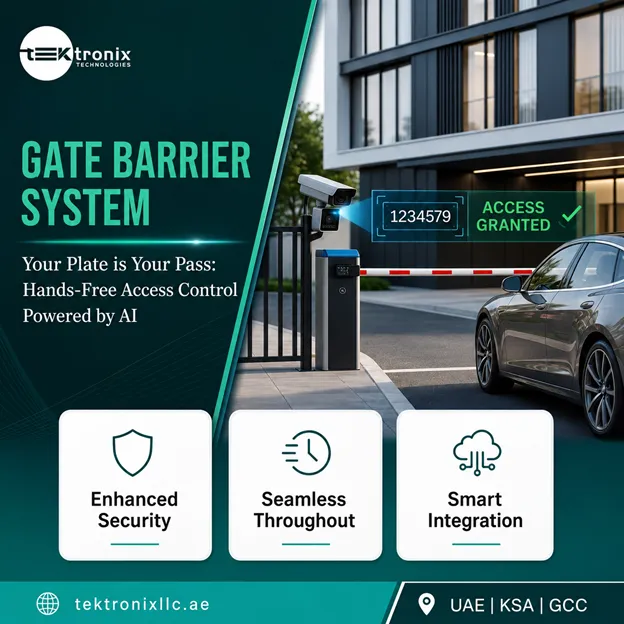
The strongest Video Analytics Solutions are rarely generic — they are tuned to the specific risks of the environment they protect. A shopping destination in Dubai needs crowd-density monitoring and queue analysis; a hospital needs restricted-zone alerts around pharmacies and neonatal units; a logistics hub near a major port needs vehicle and license-plate recognition at gate checkpoints. Deploying the right configuration for each environment is what separates a genuinely useful system from an expensive camera network that nobody actively uses.
- Retail and hospitality: queue length monitoring, crowd density alerts, and loss-prevention analytics.
- Healthcare: restricted-zone access alerts around pharmacies, labs, and patient-only areas.
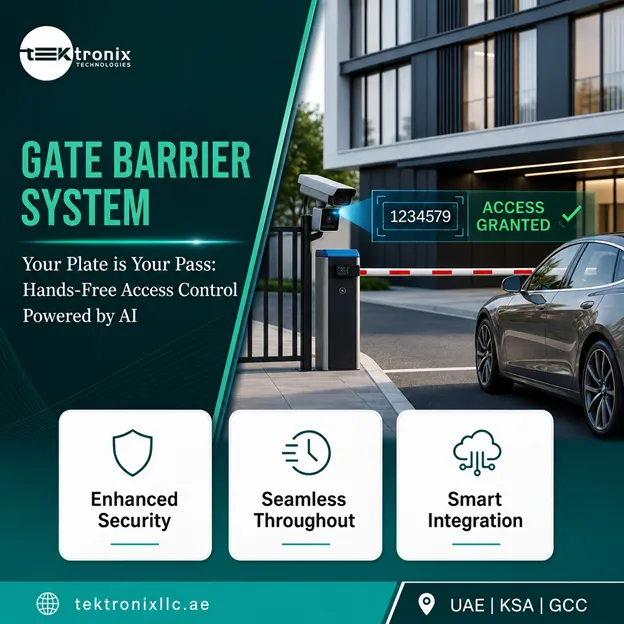
- Transportation and logistics: vehicle recognition, license-plate capture, and gate-checkpoint automation.
- Government and critical infrastructure: perimeter intrusion detection and watchlist screening.
- Commercial towers: tenant verification and after-hours lobby monitoring.
Real-Time Identity Verification: Knowing Exactly Who Is Present
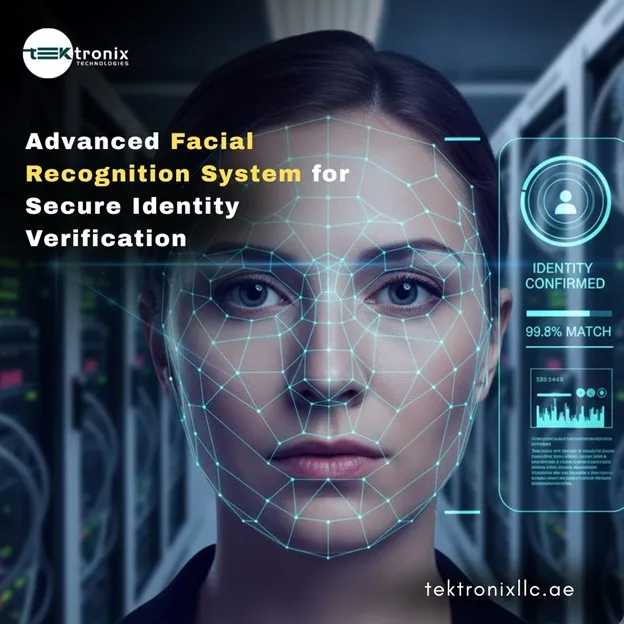
At the center of facial-recognition-enabled security is Real-Time Identity Verification — the ability to confirm a person's identity against an enrolled database or watchlist within a fraction of a second, without requiring them to stop, present a badge, or interact with staff. This capability powers everything from VIP recognition at a Dubai hotel entrance to instant alerts when a known individual on a security watchlist enters a monitored perimeter.
Accuracy across diverse populations matters enormously in a market as internationally diverse as the UAE. Leading platforms are trained across a wide range of skin tones, facial coverings, and lighting conditions common across the Emirates, rather than optimized narrowly for a single demographic group.
AI-Powered Threat Detection: Spotting Danger Before It Escalates
Beyond identity verification, AI-Powered Threat Detection analyzes behaviour patterns to flag genuinely concerning activity — a person moving against normal crowd flow, an abandoned bag left unattended in a transit hub, or a vehicle circling a secure perimeter repeatedly. These behavioural cues, invisible to a camera that only records, become actionable intelligence when interpreted by a model trained specifically to recognize pre-incident indicators.
The value here is speed. A security operations team alerted within seconds of a developing situation has a meaningful window to intervene, compared to discovering the same incident hours later while reviewing archived footage after the fact.
Anti-Spoofing: Defending Facial Recognition Against Fraud
Facial recognition is only trustworthy if it cannot be fooled by a printed photo, a video replay, or a mask held up to the lens. Anti-Spoofing technology analyzes depth, texture, and subtle natural movement to confirm that a real, living person is present, rejecting fraudulent attempts in real time before they ever reach the identity-matching stage.
This layer of protection is especially critical in unattended checkpoints and after-hours entrances where no human operator is present to visually catch an obvious spoofing attempt, making the software itself the last meaningful line of defense against impersonation.
Video Analytics UAE: Regulatory and Deployment Landscape
Rolling out a Video Analytics UAE -wide deployment requires more than installing cameras and switching on facial recognition. Organizations must align biometric data collection with UAE federal data protection regulations, secure appropriate consent for facial enrollment where required, and configure data storage and retention in line with national cybersecurity guidance. Vendors experienced in the UAE regulatory environment can help facilities avoid costly compliance rework after installation.
Video Analytics Dubai: Intelligent Security for a Global City
As one of the world's most visited and densely developed cities, Dubai presents a unique combination of scale, diversity, and smart-city ambition that makes intelligent video security especially valuable. A Video Analytics Dubai deployment benefits from local installation and support teams who understand the emirate's mix of building types — from DIFC financial towers to major retail and entertainment destinations — and can tune analytics models to match real site conditions rather than a generic factory configuration.
How Tektronix Deploys AI-Powered Facial Recognition Across the UAE
Tektronix has spent years designing and deploying intelligent video security infrastructure for retail, healthcare, hospitality, and government clients across Dubai and the wider UAE. Our engineering team combines hands-on deployment experience with a deep understanding of regional compliance requirements, giving security teams a partner who can tune analytics models to real operating conditions rather than a generic factory configuration.
Security teams evaluating this technology can review our full AI-powered video analytics and facial recognition platform to see supported use cases, hardware compatibility, and deployment examples from clients across the UAE.
Our deployments integrate facial recognition with existing access control, visitor management, and alarm infrastructure, so facilities gain a unified security layer without discarding equipment already in place. Every project includes local onboarding, model tuning for site-specific conditions, and ongoing technical support — the hands-on service that distinguishes a trusted regional integrator from an offshore software license.
For technical details on how our real-time facial recognition and threat detection engine handles watchlist screening and anti-spoofing verification, explore the dedicated solution page linked above.
Feedback from security operations teams who have deployed our platform consistently cites three benefits: a sharp drop in false alarms compared to legacy motion-detection systems, faster incident response thanks to real-time behavioural alerts, and confident rejection of spoofing attempts that would have gone unnoticed on older camera-only setups.
Why Vendor Experience Matters for AI-Driven Security Deployments
Facial recognition and behavioural analytics process sensitive biometric and personal data, so vendor credibility deserves the same scrutiny as model accuracy claims. Security leaders should ask prospective integrators how long they have deployed analytics platforms specifically in the UAE market, request references from comparable facilities, and confirm how model retraining, false-positive tuning, and biometric data governance are handled after go-live.
A partner who documents real deployment history, holds relevant certifications, and maintains a locally available support team is far more likely to deliver a system that stays accurate over time, rather than one that performs well only during an initial vendor demonstration.
Integrating Video Analytics with Existing Security Infrastructure
Few organizations start from a blank slate. Most facilities already operate a mix of CCTV cameras, access-control readers, and alarm panels installed at different times by different vendors. The strongest platforms are designed to work alongside this existing investment rather than requiring a full rip-and-replace, applying analytics to compatible existing camera feeds while adding new sensors only where genuine coverage gaps exist.
This integration extends beyond cameras. When facial-recognition alerts trigger an automatic door lock through the access-control system, or when a flagged individual on a watchlist is cross-referenced against visitor-management records, security teams gain a coordinated response rather than three separate systems that never talk to each other — an outcome increasingly expected by enterprise and government tenants across Dubai's premium commercial developments.
Measuring Return on Investment for Intelligent Security Systems
Security leaders evaluating a new deployment often ask how the investment translates into measurable value. In practice, savings accumulate across several fronts: reduced staffing costs from automating first-level alert triage, faster incident resolution that limits liability exposure, fewer false alarms that waste guard response time, and stronger compliance documentation that shortens regulatory audit cycles. Loss-prevention use cases in Dubai's retail environments frequently pay for themselves directly through reduced shrinkage once queue and behaviour analytics are active.
Because pricing models vary between per-camera licensing, per-site subscriptions, and bundled hardware-software packages, facilities should request a proposal that maps costs directly to camera count, expected alert volume, and desired integrations before selecting a vendor, rather than comparing headline prices alone.
What's Next: The Future Trajectory of UAE Video Security
As the UAE's smart-city initiatives mature, expect analytics platforms to move further toward predictive capability — anticipating crowd surges before they become dangerous, flagging infrastructure anomalies before they cause an outage, and coordinating across thousands of connected sensors in real time. Multimodal systems that combine facial recognition with audio analysis, thermal imaging, and drone-based aerial coverage are already emerging in early pilot deployments across the region's largest developments.
Organizations that build a flexible, integration-ready foundation today will be far better positioned to adopt these next-wave capabilities as they mature, rather than needing to replace their entire security architecture every few years to keep pace with advancing technology.
Best Practices for Deploying Video Analytics Successfully
- Pilot analytics at a small number of high-value cameras before a full-site rollout.
- Tune false-positive thresholds specifically for each site rather than using default factory settings.
- Review facial-enrollment consent language to ensure it satisfies UAE data protection requirements before go-live.
- Integrate alerts directly into existing security operations workflows so staff are not monitoring a separate screen.
- Schedule periodic model updates to keep anti-spoofing and detection accuracy current against new techniques.
Facilities that treat intelligent video security as an evolving program — rather than a one-time camera installation — see the strongest long-term accuracy and the fastest return on their security investment.
Conclusion
Video Analytics is redefining physical security across the UAE, turning passive cameras into active protection. AI-Powered Video Analytics built on capable Video Analytics Software enables sector-specific Video Analytics Solutions, powered by Real-Time Identity Verification, AI-Powered Threat Detection, and reliable Anti-Spoofing safeguards. Organizations pursuing Video Analytics UAE compliance or a focused Video Analytics Dubai deployment achieve the strongest results with an experienced regional integration partner.
Video Analytics Solutions
AI-Powered Video Analytics
Real-Time Hazard Detection
























Sign in to leave a comment.