
AI can draft fast. However, first drafts often feel flat, repetitive, and vague. This article shows a simple way to humanize AI-generated text for seo without losing speed. You will learn a repeatable workflow, see short examples, and keep a compact checklist you can use on every piece. The aim is not to over-polish. The aim is to make each page sound like a person wrote it for another person, and to meet search expectations at the same time.
Why humanizing AI text helps rankings and readers.
Search engines reward pages that help users complete tasks. Readers reward the same pages with longer attention and more shares. When a draft reads like a template, users skim and leave. That behavior can lower engagement signals and make the page harder to rank. By adding voice, proof, and structure, you create a page that feels reliable and is easier to navigate. This is practical SEO. It is also good writing.

A quick view of the workflow
Start with meaning, then move to sound. Confirm the goal and the audience. After that, shape the voice and rhythm. Next, add examples, sources, and data. Finally, do an on-page SEO pass and a last accuracy check. At a glance, the order looks like this:
- Purpose and audience → one clear outcome
- Voice and rhythm → short and medium sentences, varied openings
- Examples and evidence → concrete numbers, dates, sources
- Structure → logical headings, scannable paragraphs, helpful bullets
- On-page SEO → title, slug, internal and external links, alt text
- Final checks → facts, names, steps, and dates verified
Keep this sequence the same for every article. Consistency saves time and raises quality.
Step 1: Clarify purpose and audience
Begin with one sentence that states what the reader will achieve. For quick drafts or early ideas, JenAI Chat can give you a base text that you later shape into a clear and human article. Name who the reader is and what they already know. This one-minute step prevents bloat. For example: “This guide helps freelance editors shape AI drafts into client-ready posts in under an hour.” With that line in front of you, choices become easier. You know what to cut and what to add.
As you plan, decide where to place your focus keyphrase. Use humanized AI-generated text for seo once in the introduction, once in a subheading or early paragraph, and once more in the conclusion. That frequency is natural and avoids stuffing.
Step 2: Find a human sound
Read a paragraph out loud. If you trip, the sentence is too long. If every sentence sounds the same, the rhythm needs variety. Simple fixes work best: split one long line, merge two short ones, and change a few openings. Ask a quick question in the middle of a section to keep attention. In practice, you will learn how to make AI writing sound human by focusing on plain words, concrete verbs, and natural flow.
Now check phrasing. Replace filler like “it is important to note that” with direct language. Swap abstract nouns for actions. When the draft hesitates without reason, choose a firm statement. These small moves reduce friction and build trust fast.
Step 3: Tune tone and style to your brand
Open two or three of your best articles. Note sentence length, common phrases, and how you structure arguments. Use the same patterns here. Some brands like small stories. Others prefer clean lists and clear steps. Match the texture your readers expect. In sections that carry opinion or advice, you will edit AI-generated text for tone so it feels consistent with the rest of your site.
Step 4: Add examples, proof, and E-E-A-T
Readers believe what they can check. After each major claim, attach a small piece of evidence: a number, a date, a quote from practice, or a named source. When you cite, keep it specific and recent. These additions add E-E-A-T to AI content because they show real experience and care.
Before: “This method improves engagement.”
After: “This method raised average time on page from 1:12 to 2:03 in four weeks.”
When possible, include a screenshot or a simple chart and write descriptive alt text. Alt text helps accessibility and also clarifies your message for search engines.
Step 5: Fix clarity first, then polish
Clarity edits come before style edits. Remove repeated ideas. Replace vague verbs with precise actions. Trim hedging unless uncertainty is the truth. Many lines will improve when you rewrite AI sentences for clarity and focus on what the reader must do next.
After clarity, smooth the sound. Break any chain of identical openings. Use questions, short commands, and transitional lines to change pace. With this approach, you avoid robotic AI phrasing without forcing a fake voice.
Step 6: Structure for scanning
Most readers scan before they commit. Help them decide fast. Use short paragraphs (two to four sentences), clear subheadings, and compact lists where they truly help. Put key takeaways at the top of a section, not the bottom. This is the heart of the first AI content guidelines, and it often separates average pages from useful ones.
A tiny example shows the difference, just as comparing DreamFace Free vs Pro features quickly shows which tier is worth your time and which one holds you back.
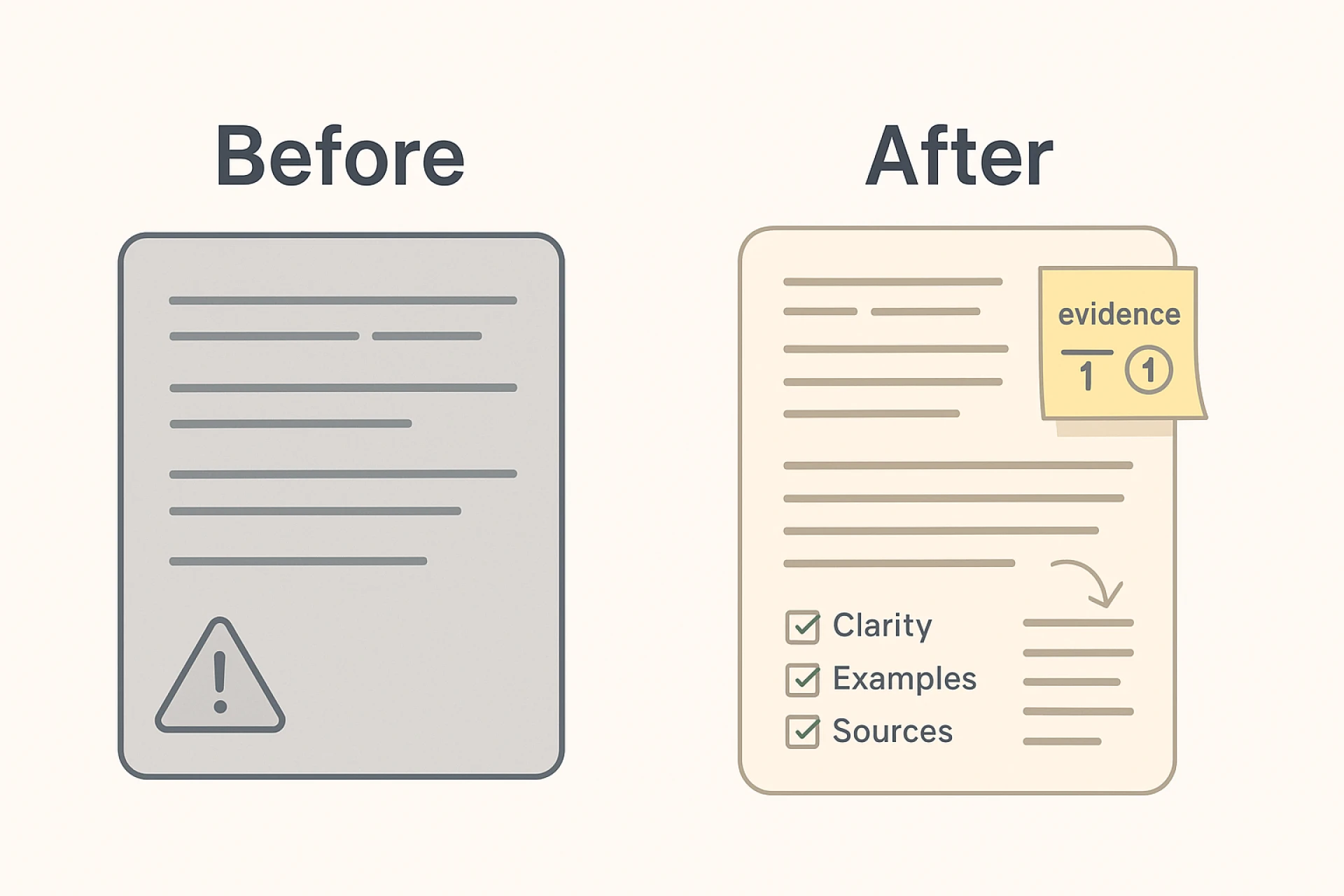
Before: A wall of text that blends three ideas: what to do, why it matters, and how to measure it.
After: A lead sentence that states the outcome, one paragraph that explains the why, and a small list with the exact steps.
Step 7: Add human signals
A few signals tell readers that a person shaped the draft. Explain one choice you made and why. Share one mistake you saw and how you corrected it. Insert a small calculation that checks a claim. Sprinkle one or two natural language cues in AI drafts, such as “here is the short version,” or “watch for this common error.” These cues do more than soften tone. They guide action.
Step 8: Accuracy, fairness, and detection
Accuracy is not optional. Run a dedicated fact pass for names, numbers, dates, and step-by-step instructions. If you link to data, open the source and confirm the figure again. When you do this on every article, you automatically fact-check generated articles, and you lower the risk of publishing a wrong detail.
When an AI checker flags a paragraph, take a calm approach. Add specific examples, revise repeated phrases, and cite a real source. Quality edits like these often reduce AI detection false positives because they add detail and variety that statistical systems look for. The goal is truth and clarity, not gaming a test.
Step 9: Keep a person in the loop
A tool is a partner, not a replacement. Make human review non-negotiable. A second set of eyes can catch tone slips, jargon, and missing steps. Build a simple sign-off flow: writer, editor, and final approver. This habit is called human-in-the-loop AI editing, and it raises quality while keeping speed.
Step 10: On-page SEO pass
Once the writing feels human and helpful, complete a short on-page pass:
- Put the focus keyphrase in the title, the introduction, and one early subheading.
- Use a short, descriptive slug.
- Write an image alt that describes the action (for example, “Editor revises AI draft to sound natural.”).
- Add one internal link to a related article your readers already trust.
- Add one outbound link to a credible source that supports a key claim.
- Check that paragraphs are scannable and that headings guide the eye.
None of these tasks is complex. Together, they help search engines and readers understand your page quickly.
Before-and-after paragraph upgrade
Here is a compact demonstration.
Before:
“AI is used to create content. The content may not always meet quality standards, and editors might be able to fix this by making changes to the text.”
After:
“AI can create a first draft in minutes. That draft is a starting point. Add one real example, cite one source, and show what changed after you applied the method. Then trim repeated phrases and vary sentence openings. The result reads clearly, and it helps the reader finish a task.”
The revision uses concrete steps, varied rhythm, and a clear promise. That is the pattern you want across the article.
A compact checklist you can actually use
Keep a short list next to your editor window. Use it exactly as written:
- Outcome stated in one sentence at the top
- Audience named; prior knowledge noted
- Redundant lines removed; long sentences split
- Evidence attached to key claims; dates and numbers verified
- Subheadings descriptive; paragraphs short; lists only where helpful
- Keyphrase placed naturally; slug and alt text set
- Internal and external links added for context
- Final read-aloud pass to catch rhythm issues
This list is small by design. You will use it because it fits in your head.
Bringing it all together
When all the steps come together, the process feels easy. Start with meaning before anything else. Think first about the outcome and the audience. After that, focus on the sound of the writing until the words flow in a natural way. Add examples, numbers, or a source to make ideas stronger. Build a clear structure so a busy reader can scan, learn, and act quickly. At the end, set the basics of on-page elements and check for accuracy.
Some moves help right away. Mixing short and long sentences keeps the rhythm fresh and avoids robotic phrasing. Adjusting the style makes the draft match your brand voice. Adding facts or data points helps add depth to AI content. Heavy lines become lighter once you rewrite AI sentences for clarity. Small natural language cues in AI drafts, such as “here is the quick step” or “watch for this mistake,” make the text sound alive.
Correct details matter most. Each article needs a full fact check so every name, number, and step is correct. If a checker raises a warning, add real details or trim repeated words to reduce AI detection false positives. A tool like Easy AI Checker can help spot lines that sound too flat, so you know where to add more human detail. With steady practice, the first AI content guidelines become natural. Keep a human reviewer involved through human-in-the-loop AI editing so quality never drops. Step by step, this is how to make AI writing sound human and clear.
Conclusion
Perfect templates feel safe, but they rarely help a real person finish a real task. A human page does. When you humanize AI-generated text for seo, you make value visible: a clear voice, honest proof, and a shape that respects time. Save the compact checklist. Use it on your next draft. Edit with care and publish with confidence. Over time, you will see longer sessions, better engagement, and stronger rankings built on trust.































Sign in to leave a comment.