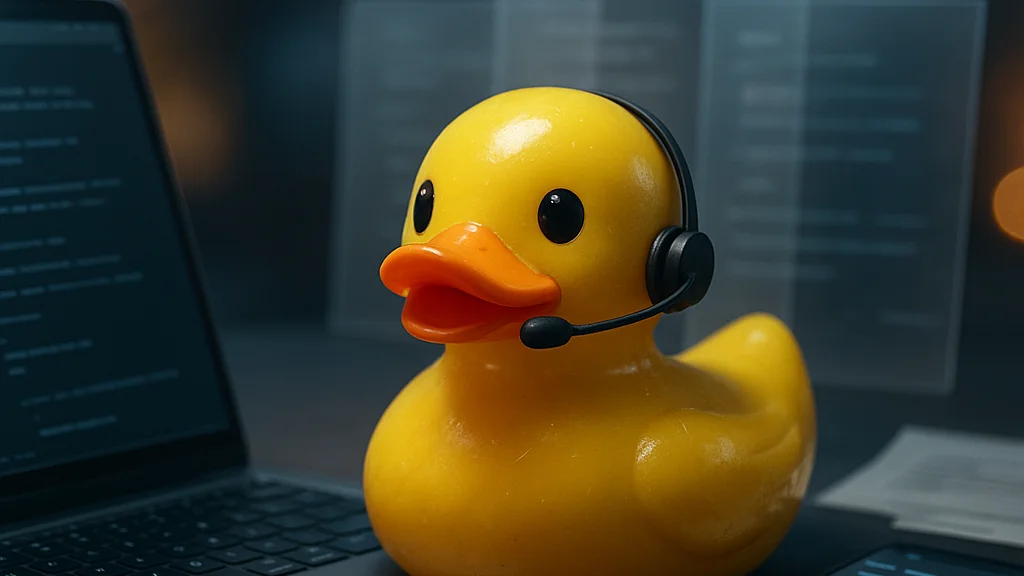

The odd thing about software in 2026 is that developers now talk to their terminals like stressed detectives in a procedural. The terminal, annoyingly, talks back—and occasionally makes a useful point. GitHub Copilot CLI’s new Rubber Duck review agent sits right inside that shift: a tool that turns the old ritual of explaining code out loud into an AI-assisted review pass that can question assumptions, flag weak logic, and surface likely problems before a human reviewer burns an afternoon on them.
That matters because code review has become one of the most expensive bottlenecks in modern engineering. Teams ship faster, repositories are larger, and AI-generated code has inflated output without reducing the need for scrutiny. If anything, the opposite happened. More code means more review, more subtle failure modes, and more opportunities for a confident model to produce something that compiles, passes a narrow test, and still behaves like an IKEA shelf assembled with one screw missing. It stands—until it doesn’t.
GitHub’s move is not arriving in isolation. It follows a broader expansion of Copilot from autocomplete assistant to agentic collaborator, with the command line becoming a particularly strategic surface. The CLI is where developers inspect diffs, run tests, lint code, manage environments, and verify fixes. Adding a Rubber Duck review agent there is less a novelty than a statement: GitHub wants review to happen earlier, closer to the act of coding, and with more machine assistance than the industry used to consider tasteful.
That is the headline. The more interesting story is what this addition says about how software teams now manage trust—trust in generated code, trust in review workflows, and trust in AI systems that increasingly sound like a colleague who skipped stand-up but still left comments. Dry, but consequential.
Why “rubber ducking” became product strategy
The term “rubber duck debugging” is old developer folklore with a stubbornly practical core. You explain your code, line by line, to an inanimate object—traditionally a rubber duck—and the act of verbalizing your reasoning exposes the bug. It is absurd, which is partly why it works. Human beings routinely discover their own mistakes the moment they are forced to narrate them in sequence. Sitcom logic, yes, but also cognitive science in office clothes.
GitHub’s adaptation turns that private ritual into an interactive review mode. Instead of merely generating code or summarizing a diff, the agent is designed to interrogate intent: Why is this branch handled separately? What assumptions does this regex make? What happens when the API returns partial data? In effect, the AI is not only offering answers; it is prompting a developer to defend the code before another person has to. That is a subtle but important shift from assistant to reviewer.
The timing makes sense. Generative coding tools have pushed more work upstream at extraordinary speed. Microsoft has repeatedly framed Copilot as a productivity layer for developers, and GitHub has steadily widened its scope across IDEs, pull requests, and terminal workflows. The command line is especially attractive because it is low-friction and deeply integrated into engineering habits. Developers may ignore another dashboard. They do not ignore the shell.
Coverage of the rollout has focused on workflow gains, but the strategic angle is bigger. GitHub is trying to capture the moments between writing and merging code—the gray zone where quality is either rescued or quietly compromised. That helps explain why this feature sits alongside other CLI enhancements. TechTimes reported in June that GitHub Copilot CLI added a pre-commit security scanner, describing it as “LLM inference at the detection layer” in its coverage of the security scanner release. Review, security, and explanation are converging inside one interface.
Rubber Duck review is less about replacing peer review than about forcing clarity earlier—before weak reasoning hardens into merged code.
That is why this feature deserves more attention than the slightly meme-friendly name suggests. It productizes a developer habit, then places it in the exact place where modern teams already negotiate quality. Neat trick. Slightly sinister efficiency. Very 2026.
How the Rubber Duck review agent fits into Copilot’s larger evolution
GitHub Copilot did not begin life as a reviewer. It began as a code completion engine—controversial, impressive, often useful, occasionally too eager by half. Over time, GitHub expanded it into chat, documentation help, test generation, pull request summaries, and broader agent-like behavior. The CLI extension is part of that progression, but it also represents a deeper architectural change: Copilot is no longer just helping write code; it is increasingly orchestrating decisions around code.
A useful reference point is the rise of the Copilot SDK and agent-building ecosystem. InfoWorld’s report on building AI agents with the GitHub Copilot SDK underscored how GitHub is opening pathways for more specialized, workflow-aware agents. That matters because Rubber Duck review is not simply one feature bolted onto the CLI. It is evidence of a platform strategy where agents can inspect context, reason over repository state, and intervene at specific stages of development.
Seen this way, the CLI becomes a kind of control room. A developer writes code in the IDE, stages changes in Git, runs tests in the terminal, and asks an agent to review assumptions before pushing. Then another agent may scan for security issues pre-commit. Finally, human reviewers inspect the pull request with more context and, ideally, fewer obvious defects. Each step is narrower and more specialized than the original “AI pair programmer” pitch. That specialization is exactly why adoption has matured.
WriteUpCafe has already tracked this transition from novelty to workflow infrastructure in its earlier look at the Rubber Duck review agent and in a companion analysis of why the feature matters. Both capture the broad appeal. What deserves emphasis now is the sequencing: GitHub is stacking review, security, and reasoning into one command-line layer because that is where developer intent is freshest and mistakes are cheapest to catch.
There is also a market logic here. AI coding assistants increasingly look similar when measured purely by code suggestion quality. The differentiator is workflow depth—how well the tool supports review, debugging, testing, and governance. A terminal-native review agent is sticky because it embeds itself in muscle memory. Once a team’s pre-push routine includes “ask the duck what I missed,” switching costs rise. Ridiculous sentence, but commercially true.
- Phase 1: autocomplete and snippet generation
- Phase 2: chat-based explanation, refactoring, and test help
- Phase 3: workflow agents for review, security, and repository-aware reasoning
- Phase 4: policy-aware, team-specific automation tied to enterprise development processes
The Rubber Duck agent belongs squarely in Phase 3. It is not the end state. It is the rehearsal.
What the agent likely changes in day-to-day code review
The cleanest way to understand the feature is to stop thinking about it as “AI reviews code” and start thinking about it as “AI improves the first draft of a review conversation.” Human review is still where accountability lives. But the first pass—the one that catches inconsistent naming, shaky edge-case handling, missing tests, unclear intent, suspicious assumptions, and silent complexity creep—can be partially automated if the agent has enough context and the prompts are well designed.
That changes daily practice in at least four ways. First, it can reduce reviewer fatigue. Senior engineers spend a surprising amount of time pointing out issues that are not intellectually deep, just annoying and recurring. If an agent can ask the obvious questions before a pull request is opened, humans can spend more time on architecture, risk, and product logic. Nobody became a staff engineer to keep typing “please handle null input” forever.
Second, it can improve self-review discipline. Many developers already skim their own diff before pushing, but self-review is uneven under deadline pressure. An agent that actively interrogates the code introduces friction in a useful place. Friction gets a bad reputation in software—usually deserved—but quality control without friction is just optimism with syntax highlighting.
Third, it may compress review cycles for distributed teams. When engineers work across time zones, a missing explanation in a pull request can cost half a day. A Rubber Duck pass can surface rationale earlier, making the eventual PR description sharper and reducing back-and-forth. That is especially relevant for global teams where handoffs matter more than heroic coding sessions.
Fourth, it creates a structured record of reasoning. If teams save or summarize the agent’s review prompts and responses, they gain lightweight documentation about why certain implementation choices were made. That is useful for audits, onboarding, and incident analysis. It is also useful when someone revisits the code six months later and wonders who thought this branch structure was elegant. The answer is usually “nobody, exactly.”
- Before coding: clarify intent and edge cases with the agent
- Before commit: run a Rubber Duck pass on changed files
- Before push: pair the review with security scanning in the CLI
- Before merge: let human reviewers focus on system impact and business risk
This does not erase the known limitations of AI review. Models can miss subtle domain bugs, overstate confidence, or suggest generic fixes that do not fit the codebase. They can also produce a false sense of safety—the classic “the bot looked at it, so it must be fine” trap. Still, used correctly, the agent is not a substitute for judgment. It is a forcing function for better judgment. Slightly preachy sentence, but earned.
The most valuable review comment is often not a fix but a question that exposes a hidden assumption. A good Rubber Duck agent should do that repeatedly.
That is why teams adopting the feature should measure more than speed. Fewer review rounds, lower defect escape rates, and better PR clarity are stronger indicators than raw time saved. Fast is nice. Correct is nicer.
The 2026 context: why this release lands differently now
If GitHub had shipped this two years earlier, it might have looked like a clever accessory. In 2026, it lands in a very different environment. AI-generated code is now normal across startups, enterprises, and internal tooling teams. The debate is no longer whether developers will use AI, but how organizations will govern AI-assisted output without turning every sprint into a compliance workshop. That is where review agents become operationally important.
Recent product moves reinforce the pattern. The pre-commit security scanner covered by TechTimes suggests GitHub is pushing model-assisted checks closer to the moment of change, not just the moment of deployment. Security and review are being shifted left together. Meanwhile, the agent-building direction described by InfoWorld points toward customizable AI roles that can reflect team conventions, stack-specific risks, and internal standards. Rubber Duck review is therefore both a standalone feature and a preview of more tailored review logic to come.
There is also pressure from enterprise buyers. Large organizations have moved beyond pilot programs and now want measurable governance: auditability, policy alignment, traceability, and reduced defect leakage. A CLI-based review agent can support that agenda if it produces explainable prompts, integrates with existing Git workflows, and helps standardize pre-push checks. It is easier to justify to leadership than a vague promise of “developer creativity.” CFOs tend not to finance vibes.
Coverage across developer media has increasingly framed AI tools in terms of workflow reliability rather than novelty. That shift matters. The market has matured enough to ask harder questions: Does the tool reduce rework? Does it improve review quality? Does it help juniors learn, or merely let them ship mistakes faster? Does it create new security blind spots? Those questions are more useful than the old benchmark theater around who generates a sorting function in fewer tokens.
For readers following this story through WriteUpCafe, this analysis of how the Rubber Duck agent changes code review and this companion piece on how it reshapes review culture are useful context. The key development since those discussions is that GitHub’s CLI strategy now looks less experimental and more systematic. Review, security, and agent extensibility are starting to form a coherent operating model.
That coherence is the real 2026 story. Not that an AI can ask your code awkward questions. It is that the awkward questions are becoming infrastructure.
Who benefits most—and where the friction will show up first
Not every engineering team will get the same value from a Rubber Duck review agent. The biggest gains are likely to appear in organizations with high code volume, mixed seniority, and frequent pull requests—places where review quality varies because time does. Startups moving quickly on product features, platform teams maintaining internal tooling, and enterprise groups dealing with sprawling repositories all fit the profile. If the review queue already feels like a group project nobody volunteered for, an agent can absorb some of the repetitive load.
Junior developers may benefit disproportionately, though not always in the way vendors advertise. The obvious advantage is immediate feedback. A less obvious one is that a questioning agent can teach review habits: think about edge cases, defend assumptions, explain trade-offs, verify test coverage. That mirrors what a strong mentor does, minus the calendar Tetris. The risk, of course, is overreliance. If juniors begin treating the agent as a final authority rather than a prompt for reasoning, the educational value drops fast.
Senior engineers gain something different: leverage. Instead of spending review time on routine issues, they can focus on architectural integrity, system interactions, and operational risk. That is where human judgment remains strongest, particularly in domain-heavy systems where context matters more than syntax. An LLM can notice a suspicious conditional. It may not understand why a seemingly harmless change could wreck a billing workflow in quarter close. Software has a talent for consequences off-screen.
Still, the friction points are real:
- False confidence: teams may overtrust agent feedback and underinvest in human review
- Prompt quality: weak prompts produce bland, generic comments
- Context gaps: repository-aware review helps, but domain knowledge remains uneven
- Workflow clutter: too many CLI checks can slow developers and encourage bypassing
- Governance concerns: enterprises will ask how review data is handled and retained
These are manageable problems, but they require policy and habit changes, not just installation. Teams should define when the agent is mandatory, what classes of issues it should focus on, and how its output is documented. They should also make it explicit that a passed AI review is not equivalent to approval. That sounds obvious until deadlines arrive and common sense quietly leaves the building.
The best implementations will treat the agent as a disciplined skeptic. The worst will treat it as a ceremonial checkbox. Software teams are very creative at turning useful tools into bureaucracy. Respectfully.
What to watch next in Copilot CLI and AI-assisted review
The Rubber Duck review agent is unlikely to remain a one-off novelty feature. The more plausible path is expansion into richer, policy-aware review flows. If GitHub continues down the route suggested by its SDK and CLI developments, the next wave will probably involve deeper repository memory, custom team rules, and tighter coupling between review prompts, test execution, and security checks. That would make the terminal an increasingly autonomous checkpoint rather than a passive shell.
One likely development is role specialization. Instead of one general review agent, teams may use several: a style reviewer, a security skeptic, a performance checker, a migration assistant, or a domain-specific policy agent. InfoWorld’s reporting on the Copilot SDK hints at the infrastructure for that broader agent ecosystem. Once organizations can shape agents around internal standards, the review process stops being generic and starts reflecting how the company actually builds software. Which is less glamorous than AI demos and far more valuable.
Another area to watch is evidence-backed feedback. Today, many AI review comments are useful but thinly justified. The next competitive step is for agents to ground suggestions in test failures, repository history, dependency behavior, or prior incidents. A review comment that says “this may break pagination” is fine. One that says “similar logic changed in commit history and caused an incident pattern” is much harder to ignore. The difference is context density.
Developers should also expect stronger convergence between review and security. The TechTimes report on Copilot CLI’s pre-commit security scanner points to a future where one command can inspect logic, flag vulnerabilities, and recommend fixes before code ever reaches a shared branch. For compliance-heavy industries, that is not just convenient—it is procurement-grade persuasive.
Practical takeaways for teams evaluating the feature are straightforward:
- Use the agent on smaller, frequent diffs first—signal quality is easier to judge there.
- Track review-round reductions, reopened bugs, and PR clarity—not just time saved.
- Pair Rubber Duck review with existing linting, tests, and security scanning rather than replacing them.
- Train developers to challenge the agent’s reasoning, especially when comments sound polished but vague.
- Document which classes of changes still require mandatory human scrutiny.
The broad takeaway is simple enough to survive product hype: GitHub is moving Copilot CLI from helper to checkpoint. The Rubber Duck review agent is part of that migration, and it arrives at a moment when teams need exactly this kind of structured skepticism. Not because developers forgot how to review code, but because the volume and velocity of AI-assisted development have made informal habits insufficient.
Explaining your code to a rubber duck used to be a private coping mechanism. Now it is productized, operationalized, and sitting in the terminal asking fair but slightly annoying questions. Which, if we are being honest, is what the best reviewers have always done.































Sign in to leave a comment.