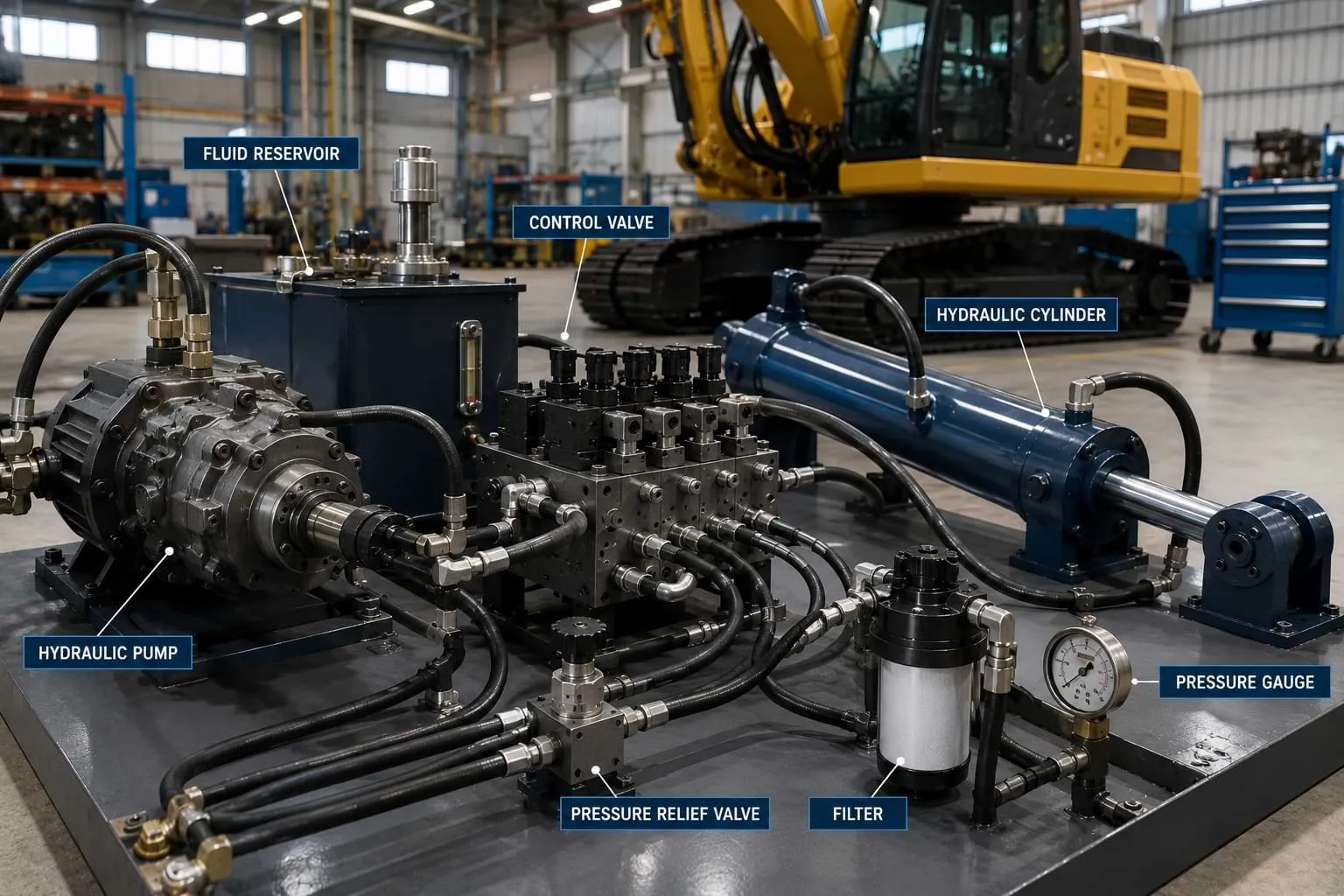
Efficiency, strength, and accuracy are crucial for maintaining smooth operations in today's industrial environment. Hydraulic components, which cooperate to transfer power through fluid pressure, are the core of every hydraulic system. The significance of hydraulic components in contemporary engineering and industrial applications may be highlighted by comprehending how they work and the reasons for their widespread use.
Recognising the Function of Hydraulic Components
The different sections of a hydraulic system that enable it to produce, regulate, and transfer power using pressurised fluid are known as hydraulic components.
These systems are very efficient at transmitting force over great distances with little loss since they work on the idea that liquids are incompressible.
Pumps, valves, cylinders, hoses, and reservoirs are all common components of a hydraulic system. These components work together to make a strong mechanism that can operate machines, lift large objects, and carry out precise actions.
The System's Core: Hydraulic Pumps
The pump is frequently regarded as the system's central component among all hydraulic parts. By forcing fluid through the system under pressure, it is in charge of transforming mechanical energy into hydraulic energy.
Hydraulic pumps come in a variety of forms, such as piston, vane, and gear pumps. Every kind is made to meet certain performance needs, such as continuous operation, variable flow, or high pressure.
Valves and Hydraulic Flow Control
Another crucial class of hydraulic parts is valves, which regulate the flow rate, pressure, and direction of hydraulic fluid. They serve as the system's regulators, making sure that fluid flows where it is required and at the proper speed.
By determining the fluid flow route, directional control valves enable operators to regulate the movement of equipment like lifting platforms and hydraulic arms. In order to avoid damage and guarantee safe operation, pressure control valves shield the system from high pressure.




























Sign in to leave a comment.