
I didn’t expect it to feel like this.
I’d heard people talk about sign painting as if it were some kind of quiet meditation, like the craft sneaks up on you and slows your mind down without asking for permission. But I never really believed them. I thought it was just a bit of retro nostalgia, the sort of romantic glow people put on things that look “old-school” and “authentic.”
Then I picked up a brush for the first time.
And suddenly the whole thing made sense.
I had enrolled in the Beginners Bootcamp from The Signpainters Academy, run by longtime sign painter Paul Myerscough. I didn’t know Paul then, though I’d skimmed enough of his videos on YouTube to know he had that classic “I’ve been doing this forever” steadiness in his hands. The videos weren’t flashy or overproduced. They felt like the closest thing you could get to learning at the elbow of someone who had spent decades painting real signs for real clients.
What I didn’t expect was how quickly the Bootcamp would strip away the assumptions I didn’t even know I had about the craft.
I thought it would be relaxing.
I thought it would be simple.
I thought I’d be “decent” in a weekend or two.
I was wrong about all of that.
But what replaced those expectations was far better, and honestly far more surprising.
This is the story of what happened when I joined the Beginners Bootcamp, what I learned from it, and why I now understand why so many people around the world, UK, USA, Canada, Europe, Australia, are rediscovering this trade that refuses to disappear.
Before I Started, I Had No Idea How Much Skill I Didn’t Have
Before the Bootcamp, my idea of sign painting was basically:
Brush + Paint + Letters = Sign.
And yes, those are technically the ingredients. But that’s like saying flour and water make bread. Without technique, timing, and practice, it’s just sticky paste on your table.
Within the first hour of Bootcamp training, Paul had me rethinking everything I knew about tools. I’d never given a single thought to how to properly load a brush. Or how much difference a mahl stick makes when you’re trying to pull a clean stroke. Or how paint consistency can change the whole personality of a letter.
The early modules of the Bootcamp break down the absolute basics:
- What kit you actually need
- How to care for your brushes
- How paint should behave on the palette
- How to hold the brush so it becomes an extension of your hand
- How to use your arm instead of your wrist so you don’t wobble
- Why a mahl stick is your new best friend
These sound simple, but they aren’t. Not at first.
And seeing them demonstrated in real time, exactly how Paul works, exactly how he solves mistakes, exactly how he fixes lines that go wrong, felt like getting the part of an apprenticeship you can’t get from books, Instagram, or short-form social tutorials.
The Bootcamp doesn’t rush you. Modules unlock week by week so you learn in the order that makes sense, not in the order you feel impatiently drawn toward.
That weekly pacing felt annoying for about five minutes.
Then I realised it was saving me from myself.
Because if you don’t learn the early skills correctly, everything else looks awkward or shaky. I didn’t want to build bad habits. And with this craft, once they’re in your hands, they stick.
The Moment That Hooked Me: The Four Lettering Styles
There’s something oddly intimate about watching a professional paint a letter by hand. You start noticing tiny things: the way they angle the brush, the micro-pauses you never catch unless you slow a video down, the way the paint settles into the edge of the stroke.
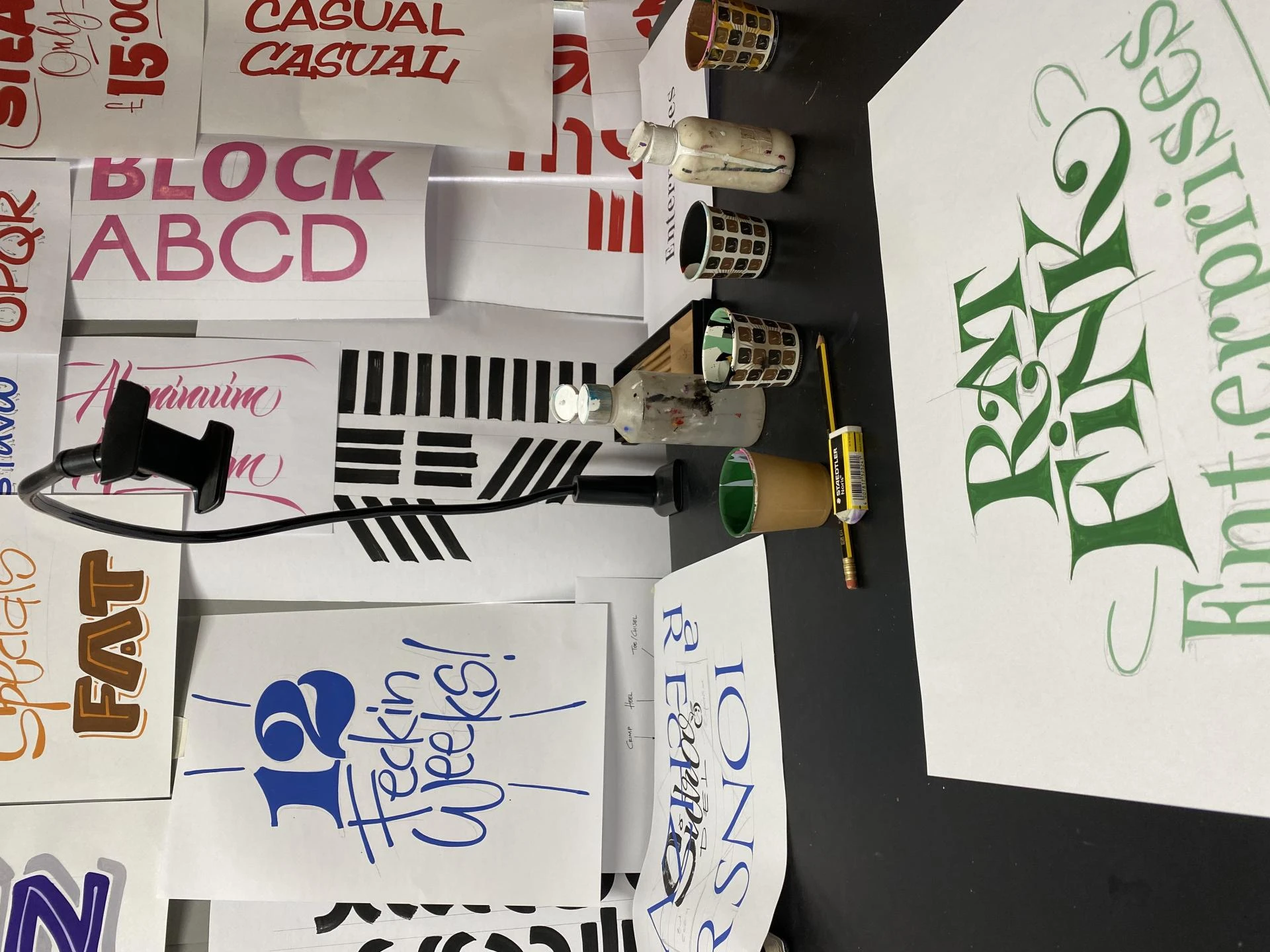
The Bootcamp teaches you the four main lettering styles that make up most traditional sign work:
- Casual
- Block
- Script
- Roman
At first, they all looked impossible. Script in particular made me feel like I was trying to sign my name using my wrong hand.
But Paul doesn’t just show you the letters. He explains the thinking behind them:
Why Casual has that loose rhythm.
Why Block needs such confident, straight pulls.
Why Roman is unforgiving if your proportions are off.
Why Script only flows when your brush does.
These aren’t things you understand by reading about them. You understand them by seeing them in real time.
One of the things that surprised me most is how much the Bootcamp focuses on building muscle memory. Paul repeats strokes until it becomes clear that repetition is the real secret of sign painting.
Not talent.
Not “creativity.”
Not some innate ability.
Just practice under guidance.
And that’s where the Bootcamp shines: guided practice, not guesswork.
Why Real-Time Video Changes Everything
A lot of online courses use polished edits to make everything look perfect. That’s not how Paul teaches. His videos inside the Bootcamp feel like you’re standing right beside him. The camera sits close enough that you can see the paint roll off the hair of the brush.
What truly changes the learning experience is that he doesn’t hide mistakes. He lets them happen. He fixes them on camera. He explains why they happened.
That single detail builds more trust than any marketing pitch ever could.
It also builds confidence. When you see a professional with 30+ years of experience say “ah, that line went off a touch,” and then calmly sort it out, you realise:
You don’t have to be perfect. You just need to know what to do next.
That lesson alone is worth the whole first month of training.
I Didn’t Expect the Community to Matter, But It Did
I’m not usually a “community” person when it comes to online learning. I’m more of a “let me watch the videos and leave quietly” kind of student.
But the peer-to-peer platform inside the Academy pulled me in before I even noticed.
Everyone in there is learning the same things. Everyone remembers what it felt like to pull their first shaky Casual stroke. Everyone knows what your Roman looks like when you haven’t quite understood proportion yet.
Watching other students share progress, sometimes brilliant, sometimes rough, made the whole thing feel like a collective project rather than a lonely hobby.
And when Paul gives direct feedback, you feel seen. Not in a performative way, but in a “here’s exactly how to improve that stroke” way.
That kind of specific, practical feedback is gold when you’re learning.
The Projects: Where Everything Starts Making Sense
The Bootcamp includes several projects, and at first they felt intimidating. Your brain goes:
“Wait, you want me to paint an actual sign? Already?”
But the projects aren’t just tasks. They’re designed to help you build a portfolio, which is essential if you ever want to earn from the craft, even as a side hustle.
Like Paul always says, you need images of your work. Nobody hires a sign painter without seeing what they can do.
The projects helped me see what I’d learned in the modules in a more complete way. They helped me understand layout, spacing, and how letters behave together once they’re not isolated on a practice sheet.
These projects changed the feeling from “I’m learning something interesting” to “I can actually do this.”
That shift is addictive.
Where the Bootcamp Fits Into the Bigger Picture of Learning
Halfway through, I started looking around the rest of the Academy.
The Full Course is massive, hundreds of hours of video, more advanced techniques, gilding, shading, glass work, distressed finishes, airbrush work, pictorials, board prep, and every trick Paul has picked up over more than three decades in the trade. If you’re aiming for a professional level, that’s the course that takes you all the way there.
And then I found The 26 Letters, which is like looking inside a master painter’s sketchbook. Each letter is a full demo, loaded with tips and process details. If you haven’t seen it yet, the breakdown on the site gives a clear sense of how much depth is in it. It’s the kind of material you’d never get for free on the internet.
I started understanding why people from all over the world train inside this Academy. It’s not just content. It’s the structure and the years of experience behind it.
For beginners, the Bootcamp is the gateway. It teaches you the foundations. It gets your hand ready. It gives you your first real taste of sign painting discipline.
But more importantly, it builds the one thing you actually need if you want to go further:
Confidence.
You can know everything about gear and paint, but if you don’t have confidence in your hand, you won’t enjoy the craft enough to stick with it.
The Bootcamp fixes that.
The Part I Didn’t Expect to Hit Me Personally
At some point, maybe week six or seven, I realised something strange was happening during practice sessions.
I’d settle into my workspace, load the brush, breathe out, and start on the first stroke of a letter.
And my mind would go quiet.
Not empty. Just calm.
If you’ve ever tried something like calligraphy, ceramics, or woodworking, you probably know the feeling. Your body gets busy enough to hold your attention, but not so busy that you can’t drift mentally. It’s focus without pressure.
Before sign painting, I hadn’t felt that sort of quiet in years.
One evening, I was practicing Roman letters, and I remember thinking: “This used to terrify me.” Suddenly I was pulling strokes that I wouldn’t have attempted a month earlier. They weren’t perfect, but they were mine. And they looked like actual Roman strokes, not hesitant guesses.
That moment of real progress, not theoretical progress, but progress your hands can feel, does something to you.
I started looking forward to my practice sessions the way people look forward to a good coffee or a weekly ritual.
I didn’t expect that.
But I’m glad it happened.
Why Learning From Someone With Real Industry Experience Matters
This is where the E-E-A-T part becomes obvious.
Paul isn’t someone who learned sign painting for the sake of teaching it online. He paints real signs. He has spent more than thirty years on actual jobs, making actual mistakes, working with actual clients.
He didn’t build the Academy because he wanted to create an online “content business.” He built it because he knew how hard it was to learn this craft before YouTube, before decent cameras, before online courses existed.
That kind of lived experience makes all the difference. It’s why the Bootcamp doesn’t feel like a generic online course. It feels like a proper apprenticeship, but fitted into a life that doesn’t allow you to spend three years in someone’s workshop.
And the personal support is real. You can email him directly. He looks at your work. He gives advice that actually helps. If you follow his Instagram at @thesignpaintersacademy
, you can see the sort of work he does and the kind of teaching approach he believes in.
And his YouTube channel, Paul Myerscough, gives you a sense of how he communicates, steady, practical, nothing rushed, nothing over-dramatic. That tone carries through the entire Bootcamp.
When you’re learning something like sign painting, that steadiness matters. It builds trust.
A Breakdown of What You Actually Learn in the Beginners Bootcamp
Here’s the practical side of what surprised me most:
You don’t just learn strokes. You learn systems.
In the Bootcamp, you learn:
- How to set up your workspace so you don’t constantly fight with your tools
- Why a palette is more than somewhere to put paint
- How to thin paint correctly (there’s an art to this)
- How to warm up your hand before you begin
- How to break down a letter into strokes instead of trying to paint it in one go
- How to pull cleaner lines by using your body instead of just your hand
- How to fix mistakes without creating new ones
These skills carry forward into every letterform you later learn.
The Bootcamp doesn’t skip the “boring” parts.
But those are usually the parts beginners skip on their own. And those skipped basics almost always create frustration later.
Paul’s philosophy is simple:
Learn slowly, practice consistently, build confidence, then progress.
It works.
Seeing Other Students’ Testimonials Suddenly Made Sense
Before I started, I saw testimonials on the website from people like Bobby Wiltshire and Jason Fitzpatrick. They talked about gaining confidence, improving technique, and learning more in the early weeks of the course than they had learned in years.
At the time, I thought, “They’re probably just being polite.”
After six weeks, I understood exactly what they meant.
When you have structure and guidance, and you’re being taught by someone who has been doing the craft for decades, you make progress that actually sticks.
You stop flailing.
You stop guessing.
You start improving.
That’s why the Bootcamp works.
The Moment I Realised I Wanted to Go Further
By the time I reached the shading modules, things started clicking. Shading gives letters dimension, and it was one of the first moments where what I’d painted looked like something I’d actually be proud to show someone else.
And then it hit me:
I didn’t want to stop at the Bootcamp.
I wanted to learn more.
More techniques.
More advanced skills.
More of the fun stuff, gilding, marbling, glass work, distressed letters, pictorials.
Once you get hooked, you want more.
That’s when I started reading about the Full Course, and it felt like walking into a much larger world. The Full Course includes everything in the Bootcamp, plus mountains of advanced work, business advice, full masterclasses, and direct access to Paul.
And then there’s The 26 Letters, which is included for free when you join the Full Course. It’s hard to describe how valuable it is until you watch it. Each letter is basically a mini-masterclass.
If Bootcamp is the foundation, The 26 Letters is the upgrade that turns someone from “interested learner” into “serious craftsman.”
The Real Surprise: This Craft Makes You Pay Attention to the World
Once you start learning sign painting, you can’t unsee it.
When I drive through town now, I look at shop signs differently. I notice which ones have real hand-painted charm and which ones were printed from a template. I notice spacing, weight, the curve of an S, the way shading changes the whole feel of a sign.
It’s as if a part of the world that had always been there suddenly lit up.
That’s what traditional crafts do. They reconnect you with something slower and more thoughtful. Something that asks you to put your phone down, breathe, and use your hands.
I didn’t expect that to happen.
But I’m glad it did.
So, Would I Recommend the Beginners Bootcamp?
Absolutely. And not because it’s trendy or “artsy” or because hand lettering looks good on Instagram.
I’d recommend it because it teaches real skills in a way that’s approachable, structured, and genuinely enjoyable. It gives you a proper grounding in the craft. It pushes you without overwhelming you. It builds your confidence one stroke at a time.
Most importantly, it opens the door to something bigger.
Some people join because they want a hobby.
Some because they want a new side-hustle.
Some because they dream of becoming full-time sign painters.
The Bootcamp works for all of them.
If you want to see exactly what’s included, you can explore the Beginners Bootcamp here:
If you want something deeper, you can look at the full training path:
And if you want to see the real artistry behind the craft, Paul’s alphabet series is worth a look:
You can also get a sense of Paul’s teaching style on YouTube:
And his day-to-day work and updates on Instagram:
Instagram: @thesignpaintersacademy
Final Thoughts: What Surprised Me Most
If you’d asked me before I started what I expected from the Beginners Bootcamp, I would’ve said something casual, something like a fun project or a way to unwind.
But what surprised me most was how deep the craft goes, how much skill it takes, and how satisfying it is when your hand finally begins to understand what your eyes are seeing.
What surprised me most was how quickly the Bootcamp built my confidence.
What surprised me most was how calming the practice became.
What surprised me most was how much I wanted to keep going.
If you’ve ever felt curious about sign painting, or you’ve wondered whether you could actually learn it from home, the Beginners Bootcamp proves that you can.
And if you let it, it might surprise you as much as it surprised me























Sign in to leave a comment.