Start With the Environment, Not the Budget
The most common board specification mistake is not choosing the wrong product — it is choosing the right product for the wrong conditions. Standard MDF in a moisture-exposed space. A generic fibreboard in a high-traffic commercial application. A site-applied laminate where a factory-bonded surface was the appropriate specification. Each of these is a decision that looks reasonable at the time and reveals its consequences months later.
In 2026, interior fit-out professionals working in demanding environments — particularly those managing interior fit-out projects in Qatar where climate conditions are among the most punishing that installed materials will encounter — cannot afford to treat board selection as a secondary specification decision. It shapes every other decision that follows.
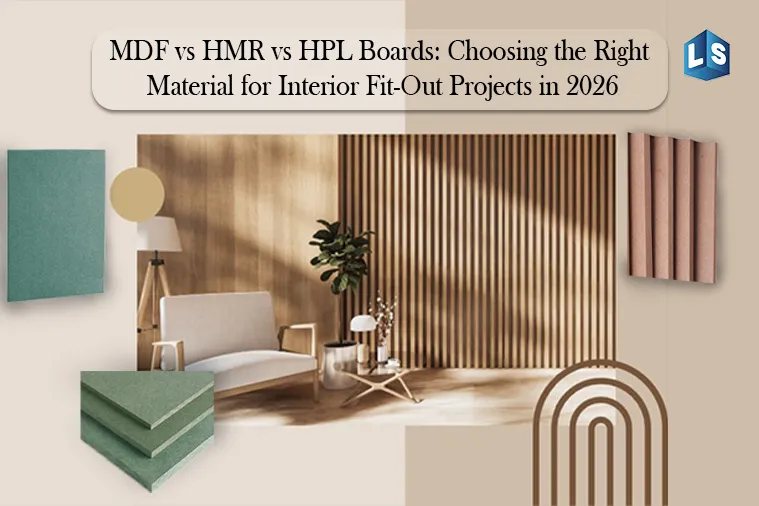
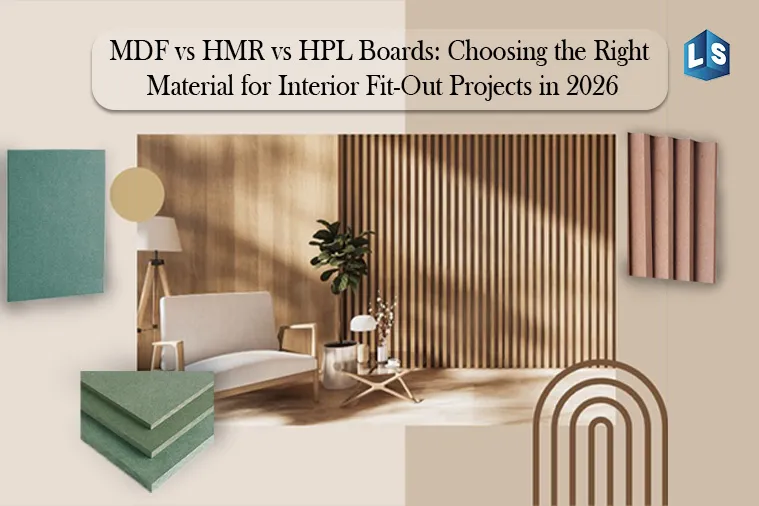
This guide covers the three board categories that define substrate specification in modern interior fit-out: MDF, HMR, and HPL. It explains what each one is engineered to do, where it performs best, and where it will fail if applied incorrectly.
MDF: Outstanding in Its Lane
The Case for MDF
Medium Density Fibreboard is manufactured by reducing timber to fine wood fibres, combining them with a resin binder, and compressing the mixture under heat and pressure into uniform, dense panels. Every variable that makes natural timber unpredictable in a fabrication environment — grain direction, density variation, knots, surface irregularity — is eliminated. What remains is a substrate of complete consistency from edge to edge and face to face. That consistency is what makes MDF the default substrate for dry interior applications. Paint and spray finishes adhere without interruption. CNC routing and detailed profiling produce clean, repeatable results. Edge shaping holds form without splintering. Fixings hold throughout the board's uniform density. For built-in storage, decorative wall panels, shaped architectural millwork, painted cabinetry, and shelving in dry spaces, MDF delivers results that cost-equivalent alternatives do not match.
The Limit That Cannot Be Overlooked
Standard MDF has no moisture resistance. This is not a minor limitation to be managed with edge sealing or careful installation. It is a fundamental material characteristic that determines whether MDF is the right board for an application at all. When standard MDF encounters sustained humidity, condensation, or water contact, the wood fibres absorb moisture and the board begins to swell. Dimensional stability is lost. Edges deteriorate. Surface finishes separate from the substrate. The process cannot be reversed. The installation must be replaced.
In Qatar, moisture risk is not confined to kitchens and bathrooms. Condensation from air conditioning systems accumulates near outlets and in wall cavities. Thermal bridging creates moisture conditions adjacent to external walls. Storage and utility spaces without consistent climate control experience humidity cycling that standard MDF cannot sustain over time. For any application in these conditions, a different board is required — and the cost of getting this wrong far exceeds the cost of specifying correctly from the outset.
HMR: The Moisture-Resistant Specification Qatar's Climate Demands
How HMR Boards Are Different
High Moisture Resistant boards are manufactured with specialist resin systems — melamine-urea-formaldehyde or phenolic formulations — integrated into the board's composition during production. This is a structural difference, not a surface treatment. The resin system changes how the board responds to moisture at the fibre level, preventing the absorption and swelling that causes standard MDF to fail in humid environments.
The workability of HMR is effectively identical to standard MDF. It accepts the same surface finishes — laminates, veneers, paints, foils — with the same quality and reliability. It machines, routes, and profiles in the same way with the same tooling. The upgrade from standard MDF to HMR changes the board's in-service behaviour without changing how it is fabricated or installed.
For fit-out work in Qatar, HMR is not a premium upgrade for high-budget projects. It is the baseline specification for any application where moisture is a regular or probable environmental condition. Given the range of applications that carry genuine moisture risk in Qatar's climate, that baseline applies more broadly than many specifications acknowledge.
V313 Compliance: The Verification That Matters
Moisture resistance is a product claim, and the standard that validates it is V313. This international test protocol cycles boards through sustained humidity and elevated temperature conditions that replicate the demands of real-world moisture-exposed installations over time. Boards that pass V313 have demonstrated genuine, consistent moisture resistance under conditions that mirror what installed boards face in service.
For Qatar projects, where the climate reliably generates the conditions that V313 tests for, confirming V313 compliance before finalising product selection is a straightforward step that protects the specification from products that claim moisture resistance without the testing to support it.
MR Grade and E1 Grade: The Right HMR for the Right Project
The Moisture Resistant Fibreboard MR in standard MR grade covers the majority of moisture-exposed interior fit-out applications. Available from 6mm to 25mm, it delivers humidity tolerance across kitchen cabinetry, bathroom furniture, utility storage, partition construction, and general joinery in moisture-risk environments. Surface finish compatibility and fabrication behaviour are unchanged from standard MDF. The difference is entirely in how the board performs in service.
Where indoor air quality standards are also a formal project requirement — in healthcare settings, educational facilities, premium residential developments, or hospitality projects with environmental certifications — HMR E1 grade boards provide V313-level moisture resistance alongside low formaldehyde emission compliance, meeting both specification requirements within a single product.
HPL Bonded Boards: Surface Durability Starts at the Factory
Why Factory Bonding Changes the Performance Equation
High Pressure Laminate bonded boards arrive on site as finished panels. The decorative surface is not applied during fabrication or installation — it is bonded to the panel core during manufacture under heat and pressure conditions that exceed what workshop or site adhesive processes produce. The practical result of this difference is a surface bond that is categorically stronger. Surface hardness is greater. Resistance to scratching, impact, and thermal exposure is more consistent. Tolerance for daily physical contact over extended service periods is demonstrably superior to site-applied laminate alternatives. For applications where the surface will face intensive use and where maintaining that surface's appearance matters over years rather than months, HPL's factory-bonded construction is the specification that delivers.
Design Range and Commercial Viability
HPL Bonded Boards are available across a broad design range: solid colors in matte and gloss finishes, stone and mineral effects, timber replicas with detailed grain character, and tactile textured surfaces. Specifying HPL for its surface durability does not require any aesthetic compromise. The performance advantage is additive — the visual design brief is met in full.
The applications where HPL specification makes the clearest economic case are high-wear commercial environments: office and meeting room furniture, retail counters and display surfaces, commercial kitchen work surfaces, hospitality furniture in continuous use, healthcare fittings where surface integrity is a hygiene requirement, and educational furniture under sustained daily physical use. In each case, the extended service life HPL delivers relative to site-applied alternatives makes the specification premium rational when evaluated against the replacement cycles it eliminates.
Understanding the Differences That Drive the Decision
MDF, HMR, and HPL are most usefully understood as three distinct solutions to three distinct sets of application demands rather than as competing options across a single performance scale. On surface finish for site-applied decoration, MDF and HMR are the appropriate substrates, both providing the smooth, consistent base that laminates, veneers, and paint require. HPL boards remove the site-application stage entirely, providing factory-quality surface consistency that on-site finishing cannot match in durability or uniformity. On moisture resistance, the separation is absolute. Standard MDF provides none and fails predictably in humid conditions. HMR is engineered specifically for moisture-exposed applications and maintains performance where MDF would deteriorate. HPL provides strong moisture protection at the surface layer through its bonded laminate face.
On machinability, MDF and HMR both support the full range of fabrication demands — routing, profiling, shaping, CNC work — cleanly and reliably. HPL boards can be cut and assembled effectively but are not the natural choice for highly detailed profile work and require appropriate tooling for clean edge results. On surface wear resistance over the operational life of the installation, HPL's factory-bonded surface performs in a different category from site-applied alternatives. The accumulated durability advantage becomes most visible across the replacement cycles of demanding commercial applications. On cost, the three boards reflect their performance capabilities. Standard MDF is the most accessible. HMR carries a moderate premium for its moisture engineering. HPL sits higher, reflecting the integrated surface and its lifecycle durability. The relevant cost comparison is always total cost across the installation's life, not board price at purchase.
What Qatar's Conditions Actually Require
Qatar's interior environment is more demanding than moderate-climate markets in ways that directly affect how board specification decisions should be calibrated.
High outdoor humidity, intense summer heat, and year-round heavily cooled interiors produce condensation patterns and moisture conditions that extend well beyond bathrooms and kitchens. External walls, AC-adjacent spaces, and storage areas without dedicated climate control all carry moisture risk levels that standard MDF cannot sustain across a normal fit-out service life.
The appropriate default for Qatar specification is to treat applications as moisture-exposed unless the environment can be positively confirmed as consistently dry with no proximity to any moisture source. The cost difference between MDF and HMR is modest at specification. The cost of replacing a failed installation in an occupied space — in materials, labour, and client confidence — is considerably greater.
Applying the Framework on Your Next Project
Board selection decisions become reliable when they follow a clear sequence. Begin with the moisture environment: if humidity or condensation exposure is regular or probable, standard MDF is not appropriate. Move to the surface finish approach: site-applied finishes suit MDF or HMR; a factory-quality surface without site application requires HPL. Then assess wear demand: intensive daily use favours HPL's bonded surface performance over site-applied alternatives for any application where replacement cost is significant. Finally, check emission requirements: E1 compliance demands HMR E1 grade or equivalent regardless of moisture conditions.
Applied consistently at the specification stage, this sequence produces board selections that match the real demands of each application rather than defaulting to habit or price.
Conclusion
MDF is the right board for dry environments where machinability and surface quality are the priorities. HMR is the right board when moisture resistance is required across the same application range. HPL is the right board when factory-bonded surface durability under wear is the primary specification requirement.
These are not interchangeable options. They are distinct materials built for distinct conditions. Specifying them accurately — at the start of the project, before materials are ordered and work begins — is how interior fit-out delivers what it promises, in Qatar's climate and everywhere else.
Originally published on: https://www.lstcco.com/mdf-vs-hmr-vs-hpl-boards-choosing-the-right-material-for-interior-fit-out-projects-in-2026/

























Sign in to leave a comment.