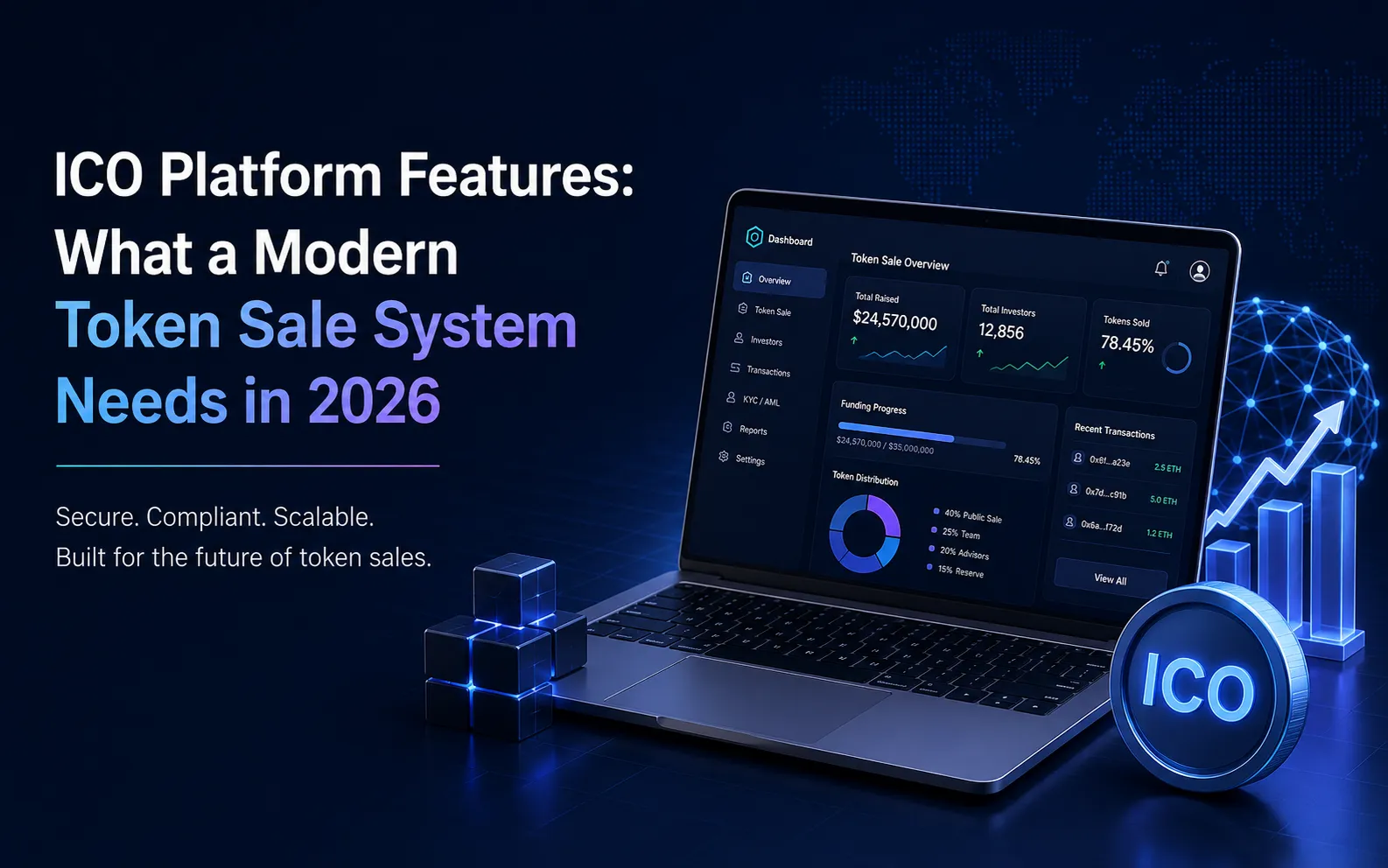

An ICO platform has evolved far beyond a simple website where investors purchase tokens. In 2026, a modern token sale system needs to connect investor onboarding, identity verification, payment processing, wallet connectivity, smart contracts, token allocation, compliance controls, analytics, and administration within one reliable environment.
This shift reflects the growing expectations around crypto fundraising. Investors want transparent information and predictable transaction flows. Businesses need stronger control over who participates, how funds move, and how tokens are distributed. Regulators are also paying closer attention to crypto-asset offerings and investor protection.
The technology supporting an ICO must address these requirements from the start. Ethereum token standards, for example, provide common interfaces that allow tokens to interact with wallets, exchanges, and other applications.
The most important ICO platform features in 2026 are not simply the features that make a platform look advanced. They are the ones that make the token sale secure, transparent, scalable, compliant, and easy to participate in.
1. Investor Registration and Account Management
The investor journey starts with registration. A modern ICO platform should provide a straightforward account creation process while collecting the information needed for verification and compliance.
Investors should have a secure dashboard where they can view their profile, verification status, token-sale eligibility, purchase history, token allocation, vesting schedule, and claim status.
Account management also needs strong security. Multi-factor authentication, session controls, password protection, suspicious-login detection, and appropriate account recovery processes can reduce risks around compromised accounts.
The platform should also separate investor permissions from administrator permissions. A regular investor should never have access to functions that can modify sale parameters or token allocations.
2. KYC, AML, and Eligibility Controls
Compliance is now a core platform feature rather than an optional add-on.
Depending on the offering and jurisdiction, an ICO platform may need to verify investor identity, screen participants, apply geographic restrictions, and maintain appropriate records.
The platform can connect with third-party KYC providers to automate identity verification. Once an investor passes the required checks, the platform can update their eligibility status and allow participation according to the configured sale rules.
Jurisdiction controls are particularly important for businesses running international campaigns. The platform can restrict participation based on predefined eligibility rules instead of relying entirely on manual reviews.
Regulatory requirements vary across markets. In the European Union, MiCA establishes requirements for certain crypto-asset offerings, including specific requirements concerning crypto-asset white papers and information provided to investors.
The U.S. regulatory environment is also developing. In August 2026, the SEC proposed “Regulation Crypto Assets,” which includes proposed exemptions for certain investment contracts involving crypto assets. The proposal is not a final rule, which means businesses still need legal guidance based on their specific offering.
An ICO platform should give businesses the technical controls needed to implement applicable legal requirements rather than assuming that one compliance workflow fits every market.
3. Smart Contract-Based Token Sales
The smart contract is one of the most important components of an ICO platform because it can enforce core token-sale rules directly on the blockchain.
Depending on the sale structure, the contract can manage:
- Token purchase limits
- Sale phases
- Contribution amounts
- Token allocation
- Whitelisting
- Vesting
- Claim schedules
- Refund conditions
- Sale start and end times
The contract should reflect the project's documented token-sale rules precisely.
Token standards also influence interoperability. ERC-20 provides a common interface for fungible tokens, including functions for transfers, balances, supply, and approvals. This common structure helps tokens interact with existing blockchain applications.
The goal is not to put every platform function on-chain. Off-chain systems can handle suitable operational information while smart contracts enforce critical ownership and distribution rules.
4. Multi-Wallet and Blockchain Support
Wallet connectivity is central to the investor experience. A token sale should support the wallets and networks relevant to its target audience.
Investors need a clear process for connecting a wallet, selecting the appropriate network, confirming transactions, and checking transaction status.
The platform should also verify blockchain activity independently. A frontend message saying “payment successful” should not be enough to finalize an allocation. The backend should verify the transaction and its confirmation status before updating the investor record.
For projects supporting multiple networks, the platform needs a clear abstraction layer. Blockchain-specific logic should not be scattered throughout the entire application. A modular architecture makes it easier to add supported networks without rebuilding the core investor system.
5. Flexible Payment Processing
A modern token sale can involve several payment methods. Depending on the business model and jurisdiction, these can include cryptocurrencies and traditional payment options through appropriate providers.
The important feature is accurate reconciliation.
Suppose an investor submits a transaction but the network remains congested. The platform should keep the transaction in a pending state rather than immediately treating it as completed. Once the required confirmation occurs, the system can finalize the purchase.
This prevents duplicate allocations and reduces disputes.
Payment systems should also account for failed transactions, underpayments, overpayments, expired transactions, refunds where applicable, and payment-provider failures.
6. Real-Time Token Sale Dashboard
A real-time dashboard gives investors visibility into their participation.
It can display the token price, sale phase, remaining allocation, purchase limits, contribution history, transaction status, and vesting information.
Transparency matters because investors need to understand what happens to their funds and tokens after they participate.
For administrators, the dashboard serves a different purpose. It should provide information about total contributions, verified investors, successful transactions, pending payments, token allocations, geographic participation where legally appropriate, and system activity.
The two dashboards should use controlled permissions so investors only see their own information while administrators receive broader operational visibility.
7. Token Allocation and Vesting Management
Token allocation becomes more complex when an ICO has multiple rounds.
Early investors, public participants, advisors, employees, and ecosystem participants can have different prices, allocation limits, and vesting conditions.
The platform should calculate these allocations consistently and preserve an auditable record.
Vesting management is especially important because token distribution does not always happen immediately after purchase. A platform can show investors how many tokens are locked, how much has become claimable, and when future releases occur.
The actual token movement should remain governed by the relevant smart contract when possible. The platform provides the interface and supporting records, while the blockchain provides the transaction record.
8. Strong Smart Contract Security
Security needs to cover every layer of the ICO platform, but smart contracts deserve particular attention because errors can directly affect token ownership or funds.
Testing should cover normal transactions and unusual conditions. Developers need to test access controls, sale limits, allocation calculations, reentrancy risks, unexpected inputs, pause mechanisms, upgrade paths, and other relevant contract behavior.
The OWASP Smart Contract Security Testing Guide, updated in August 2026, provides a structured approach to smart-contract security testing and includes methodologies for identifying weaknesses across smart-contract systems.
Independent security audits can provide another layer of review, but an audit should not replace internal testing.
Administrative wallets also require protection. Multisignature controls, role separation, restricted permissions, transaction monitoring, and controlled deployment procedures can reduce the risks associated with privileged accounts.
9. Admin Panel With Role-Based Access
The admin panel is the operational control center of the ICO platform.
It should allow authorized personnel to manage investor accounts, review KYC status, configure sale phases, monitor transactions, manage announcements, review allocations, and access reports.
Not every employee needs the same permissions.
A support operator may need to view investor information but should not have permission to change token-sale parameters. A blockchain administrator may need access to contract-related operations but not unrestricted access to compliance records.
Role-based access control creates these boundaries.
This principle becomes increasingly important as the project grows and more employees, contractors, and service providers interact with the platform.
10. Analytics and Reporting
An ICO platform needs more than a transaction counter.
Analytics should help project teams understand investor behavior and platform performance. Useful measurements can include registration numbers, verification completion, purchase conversion, average contribution, transaction failures, wallet activity, and participation across sale phases.
Operational analytics can also identify technical problems. A sudden increase in failed transactions can indicate a blockchain integration issue, payment problem, or infrastructure bottleneck.
On-chain and off-chain records should also be reconciled. This gives administrators a reliable view of what the platform recorded compared with what the blockchain confirms.
11. Scalability for High-Demand Token Sales
Scalability becomes critical when investor activity increases sharply.
An ICO platform may experience concentrated traffic when a sale opens or when a popular allocation becomes available. A system that works during normal traffic can fail under sudden demand.
Cloud infrastructure, load balancing, caching, database optimization, asynchronous processing, and queue-based architecture can help distribute workloads.
Blockchain infrastructure needs similar preparation. RPC capacity, transaction management, indexing, confirmation monitoring, and retry logic should be tested under realistic conditions.
Load testing before launch can reveal bottlenecks that are difficult to identify during normal development.
12. Security for Investor Data
ICO platforms often process personal information through registration and KYC workflows. Protecting this information requires strong application and infrastructure controls.
Sensitive data should be collected only when necessary and protected through appropriate access controls and encryption. API endpoints need authentication and authorization. Logs should avoid exposing sensitive information.
The platform should also monitor unusual behavior, including repeated login attempts, abnormal API requests, suspicious account activity, and unexpected administrative actions.
Security should continue after launch because software dependencies, integrations, and infrastructure configurations change over time.
13. Transparent Investor Information
Technology should support investor transparency rather than simply facilitate transactions.
A modern ICO platform can provide easy access to the token's key information, sale conditions, allocation structure, vesting terms, risks, applicable restrictions, and relevant documentation.
This is increasingly important as regulators focus on information quality and investor protection. The SEC's 2026 crypto-asset interpretation and proposed offering framework demonstrate the continued movement toward clearer treatment of crypto offerings and associated investor protections.
A platform should also maintain clear records of important investor actions and transactions. This supports internal reporting and can help with later reconciliation or dispute resolution.
14. Post-Sale Token Management
The ICO platform should not become irrelevant once fundraising ends.
Investors still need access to their purchase records, vesting information, claim functions, and relevant announcements.
The project team may also need to manage token distribution, unlocks, refunds where applicable, reporting, and migration to post-sale infrastructure.
A well-designed platform separates the token-sale lifecycle from the broader token ecosystem. This allows the business to transition from fundraising into product development and market operations without losing investor records or operational continuity.
Building a Future-Ready ICO Platform
The strongest ICO platform is not the one with the largest feature list. It is the one where critical features work together reliably.
Investor registration should connect with KYC. KYC should connect with eligibility rules. Eligibility should connect with purchase authorization. Payments should connect with transaction verification. Token allocation should connect with smart contracts. Vesting should connect with claims. Administration should connect with monitoring and reporting.
This connected architecture reduces manual intervention and gives the project team greater control over the entire token-sale lifecycle.
For businesses planning an ICO, the development process should begin with the sale model and compliance requirements before selecting individual technologies. The platform architecture can then be designed around actual investor flows, blockchain requirements, security risks, and future growth.
An experienced ICO development company can help translate these requirements into platform architecture, smart-contract development, wallet integration, KYC workflows, payment systems, security testing, and deployment.
Blockchain App Factory supports businesses developing ICO platforms with technology and infrastructure tailored to their token-sale requirements, covering areas such as smart contracts, investor features, blockchain integration, security, and post-launch platform support.
Conclusion
A modern ICO platform in 2026 needs to function as complete token-sale infrastructure rather than a simple fundraising website. Investor registration, KYC, wallet connectivity, payment processing, smart contracts, token allocation, vesting, security, analytics, administration, and scalability all contribute to the quality of the final system.
The most important technology decision is to build these components as one coordinated platform. Blockchain App Factory helps businesses develop ICO platforms with tailored smart contracts, investor features, blockchain integrations, security controls, and scalable infrastructure. With the right technology foundation, businesses can create a token-sale system that supports investor needs while remaining prepared for long-term token operations.




















Sign in to leave a comment.