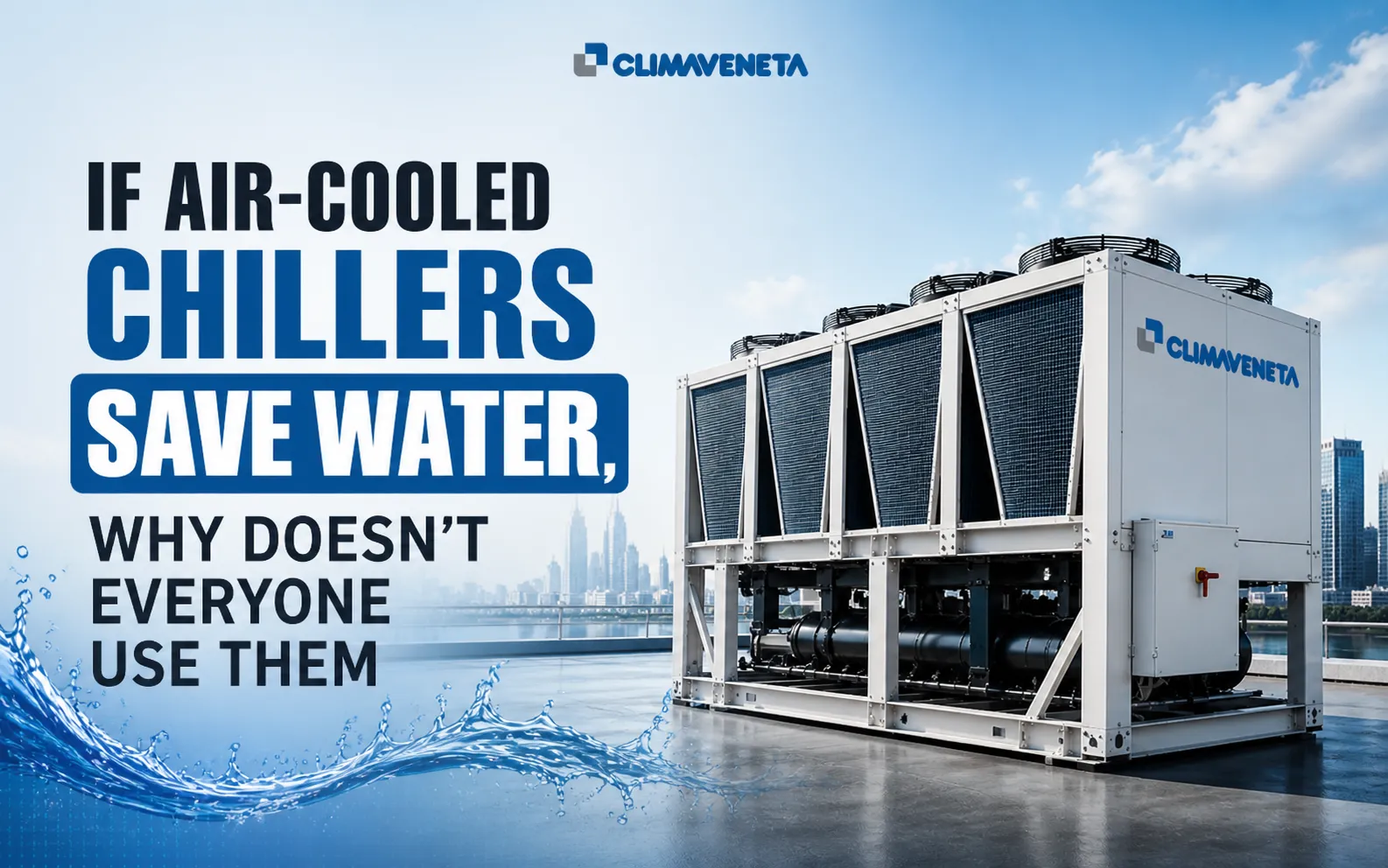
Walk into any modern plant review meeting and this question shows up sooner or later.
Water is scarce. Regulations are tightening. Sustainability targets are no longer optional. So on the surface, air-cooled chillers seem like the obvious answer. No cooling towers. No water treatment. No dependency on a resource that is becoming increasingly unpredictable.
And yet, when you look at large factories, chemical plants, or high-load facilities, many still rely on water-cooled systems.
This isn’t resistance to change. It’s a reflection of how industrial cooling decisions are actually made.
The Real Equation: It’s Not Just Water vs No Water
At a glance, the comparison feels simple:
- Air-cooled chillers → no water usage
- Water-cooled chillers → continuous water consumption
But industrial cooling is rarely about a single variable. The real decision sits at the intersection of:
- Heat load
- Operating hours
- Energy consumption
- Space availability
- Long-term operating cost
Once you factor these in, the picture changes.
Where Air-Cooled Chillers Clearly Make Sense
There are environments where air-cooled chillers are not just suitable—they’re the smarter choice.
Water-Constrained Locations
In regions facing water shortages or strict usage regulations, air-cooled systems remove a major operational risk.
Simpler Infrastructure
No cooling towers. No water pumps. No chemical treatment systems.
This reduces installation complexity and ongoing maintenance.
Smaller to Mid-Sized Loads
For facilities with moderate cooling demands, air-cooled chillers offer a balanced mix of performance and convenience.
Faster Deployment
Without the need for additional water systems, installation timelines are shorter—something that matters when operations need to scale quickly.
So Why Do Large Industries Still Choose Water-Cooled Systems?
Because when scale increases, efficiency starts to outweigh simplicity.
1. Energy Efficiency at Scale
Water is a far more effective medium for heat rejection than air.
In large, continuous operations, water-cooled chillers typically deliver:
- Higher efficiency
- Lower energy consumption per ton of cooling
Over time, this translates into significant cost savings, especially in facilities running 24/7.
2. Stability in Performance
Air-cooled systems depend heavily on ambient temperature.
On a hot summer afternoon, performance can drop, and energy consumption rises.
Water-cooled systems, on the other hand:
- Maintain more consistent performance
- Are less affected by external temperature fluctuations
For industries where even minor temperature variation affects output, this stability is critical.
3. Handling High Heat Loads
As production scales, so does heat generation.
Water-cooled chillers are better suited for:
- Heavy industrial processes
- Continuous high-load operations
- Large infrastructure setups
Trying to meet these demands with air-cooled systems can lead to:
- Higher energy bills
- Larger equipment footprint
- Reduced efficiency
4. Total Cost of Ownership
Air-cooled systems often win on initial cost and simplicity.
But over the lifecycle:
- Energy costs dominate
- Efficiency becomes the deciding factor
For large operations, water-cooled chillers often prove more economical in the long run despite higher setup complexity.
The Hidden Trade-Off: Water vs Energy
This is where the conversation becomes more nuanced.
- Air-cooled chillers save water but consume more energy at scale
- Water-cooled chillers consume water but use less energy for large loads
So the real question isn’t:
“Which one is better?”
It’s:
“What resource is more critical for your operation—water or energy?”
What Smart Facilities Are Doing Today
The most forward-thinking operations are moving away from binary choices.
Instead, they’re adopting hybrid approaches:
- Air-cooled chillers for smaller or independent processes
- Water-cooled chillers for core, high-load operations
This allows them to:
- Reduce water dependency where possible
- Maintain efficiency where it matters most
Looking at Sustainability the Right Way
Sustainability in industrial cooling is often oversimplified.
Saving water is important. But so is:
- Reducing energy consumption
- Lowering carbon emissions
- Improving system efficiency
An air-cooled system in a high-load facility might save water—but increase carbon footprint due to higher energy use.
A water-cooled system might consume water—but significantly reduce electricity demand and emissions.
Neither is inherently “greener.” The context defines the outcome.
So Why Isn’t Everyone Using Air-Cooled Chillers?
Because industrial decisions are rarely made on a single benefit.
Air-cooled chillers are the right choice when:
- Water is limited
- Loads are moderate
- Simplicity is a priority
Water-cooled chillers remain relevant when:
- Efficiency is critical
- Loads are high
- Operations run continuously
Conclusion
The assumption that one solution should replace the other is where most decisions go wrong.
Air-cooled chillers are not a universal upgrade. Water-cooled chillers are not outdated systems.
They are tools—each designed for a specific operational reality.
The businesses that get this right don’t ask:
“Which chiller is better?”
They ask:
“Which system aligns with how we operate, what we consume, and what we need to optimize?”
That’s where the real efficiency lies.
In India’s diverse operating conditions, this is exactly where solutions from Climaveneta India are engineered to align; adapting to real-world constraints of water, energy, and scale rather than forcing a one-size-fits-all approach.

























Sign in to leave a comment.