
In a fast-changing business environment, companies that fail to improve continuously fall behind. A well-structured continuous improvement program helps organizations enhance efficiency, reduce waste, and build long-term competitive advantage.
What is a Continuous Improvement Program?
A continuous improvement program is a structured, ongoing effort to improve processes, products, and performance through incremental changes. It focuses on identifying inefficiencies, implementing improvements, and sustaining results over time.
Unlike one-time transformation initiatives, continuous improvement becomes part of daily operations, ensuring consistent progress.
Why is Continuous Improvement Important?
Organizations that adopt continuous improvement don’t just fix problems—they prevent them.
Key Benefits:
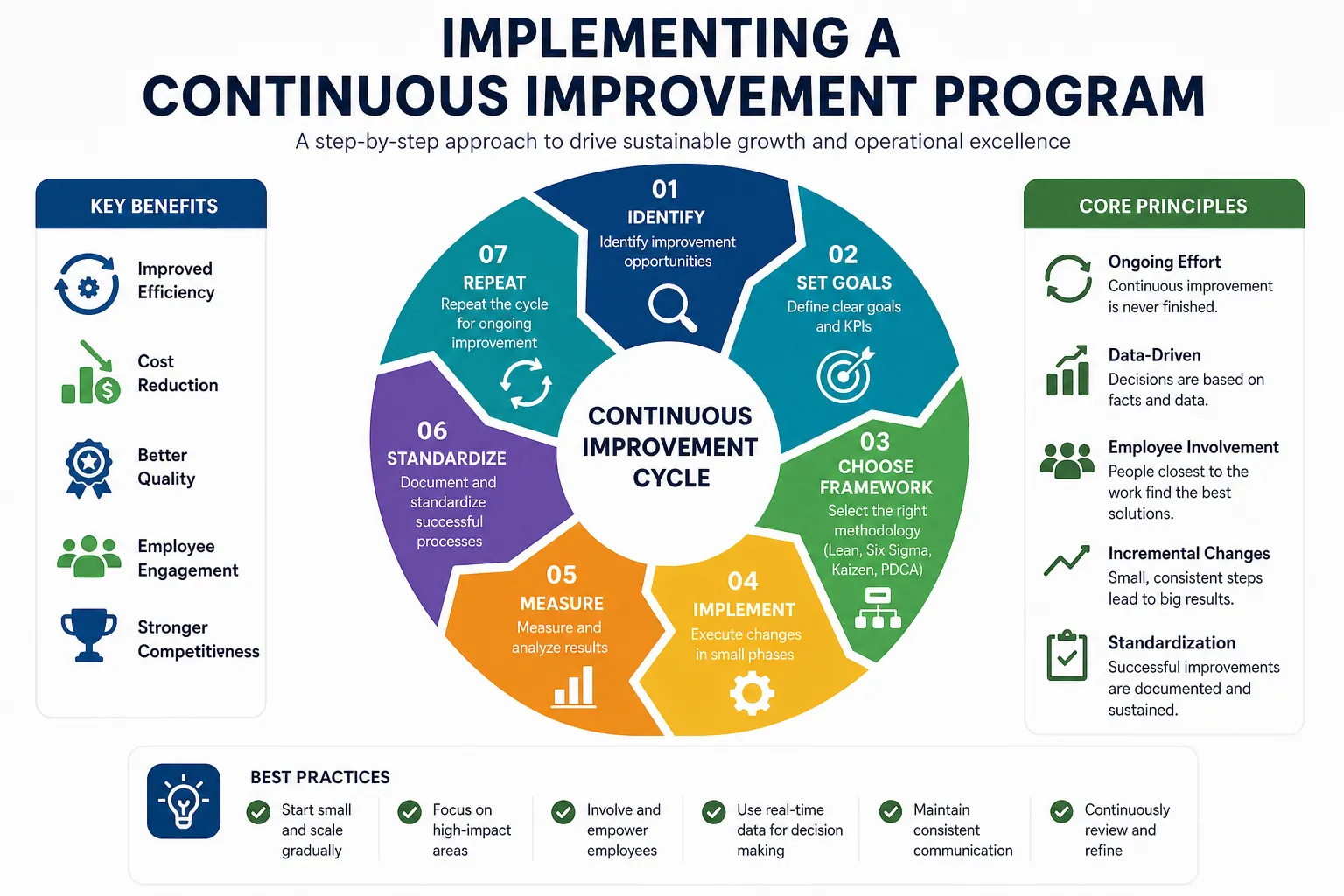
Improved Efficiency: Streamlined workflows reduce delays and increase productivity
Cost Reduction: Eliminating waste lowers operational expenses
Better Quality: Continuous refinement improves outputs and customer satisfaction
Employee Engagement: Teams actively contribute ideas and solutions
Stronger Competitiveness: Businesses adapt faster to market changes
Companies that embed improvement into their culture outperform those relying on reactive strategies.
Core Principles of Continuous Improvement
To implement a successful program, organizations must follow key principles:
1. Ongoing Effort
Continuous improvement is not a one-time project—it’s a long-term commitment.
2. Data-Driven Decisions
Decisions must be based on measurable insights, not assumptions.
3. Employee Involvement
Frontline employees often identify inefficiencies first and should be actively involved.
4. Incremental Changes
Small, consistent improvements are more sustainable than large disruptions.
5. Standardization
Successful improvements must be documented and replicated across the organization.
How to Implement a Continuous Improvement Program
Step 1: Identify Improvement Opportunities
Start by analyzing current operations. Look for:
Process bottlenecks
Repetitive errors
Delays in workflows
Customer complaints
Data analysis and employee feedback are critical at this stage.
Step 2: Define Clear Goals and KPIs
Set measurable objectives such as:
Reduce cycle time by 15%
Improve customer satisfaction by 10%
Decrease operational costs by 8%
Clear goals ensure accountability and focus.
Step 3: Choose the Right Framework
Use proven methodologies like:
Kaizen (continuous incremental improvement)
Lean (waste elimination)
Six Sigma (quality improvement)
PDCA Cycle (structured problem-solving)
These frameworks provide a systematic approach to improvement.
Step 4: Implement Changes
Execute improvements in small phases rather than large-scale transformations.
Test changes
Monitor performance
Adjust strategies based on results
Flexibility is key to success.
Step 5: Measure and Analyze Results
Evaluate outcomes using KPIs:
Did efficiency improve?
Were costs reduced?
Did quality increase?
If results are not satisfactory, refine and retest.
Step 6: Standardize Successful Processes
Once improvements work:
Document new processes
Train employees
Integrate into SOPs
Standardization ensures consistency and long-term impact.
Step 7: Repeat the Cycle
Continuous improvement is ongoing. After one success, identify the next opportunity and repeat the process.
Building a Culture of Continuous Improvement
A program alone is not enough—success depends on culture.
Leadership Commitment
Leaders must actively support and prioritize improvement initiatives.
Employee Empowerment
Encourage teams to share ideas and take ownership of improvements.
Open Communication
Transparency ensures alignment across departments.
Recognition and Rewards
Acknowledging contributions increases engagement and motivation.
Organizations with strong improvement cultures achieve sustainable success.
Common Challenges and How to Overcome Them
1. Resistance to Change
Solution: Communicate benefits clearly and involve employees early
2. Lack of Leadership Support
Solution: Align improvement initiatives with business goals
3. Poor Data Quality
Solution: Invest in accurate data collection and analysis tools
4. Unclear Objectives
Solution: Define measurable KPIs from the start
5. Failure to Sustain Improvements
Solution: Standardize and continuously monitor processes
Best Practices for Long-Term Success
Start small and scale gradually
Focus on high-impact areas first
Train employees in improvement methodologies
Use real-time data for decision-making
Maintain consistent communication
Continuously refine strategies
Frequently Asked Questions (FAQ)
What is a continuous improvement program?
A continuous improvement program is an ongoing approach to enhancing processes, products, and performance through incremental changes.
What are the main benefits of continuous improvement?
It improves efficiency, reduces costs, enhances quality, and increases employee engagement.
Which tools are used in continuous improvement?
Common tools include Lean, Six Sigma, Kaizen, and the PDCA cycle.
How long does it take to see results?
Initial improvements can be seen within weeks, but long-term impact requires ongoing commitment.
Is continuous improvement suitable for all industries?
Yes, it can be applied across manufacturing, healthcare, IT, logistics, and service industries.
Conclusion
Implementing a continuous improvement program is essential for organizations aiming to stay competitive and resilient. By focusing on incremental improvements, data-driven strategies, and employee involvement, businesses can achieve sustainable growth.
The real advantage lies not in adopting continuous improvement—but in consistently executing it. Companies that embed improvement into their daily operations don’t just keep up with change—they lead it.





















Sign in to leave a comment.