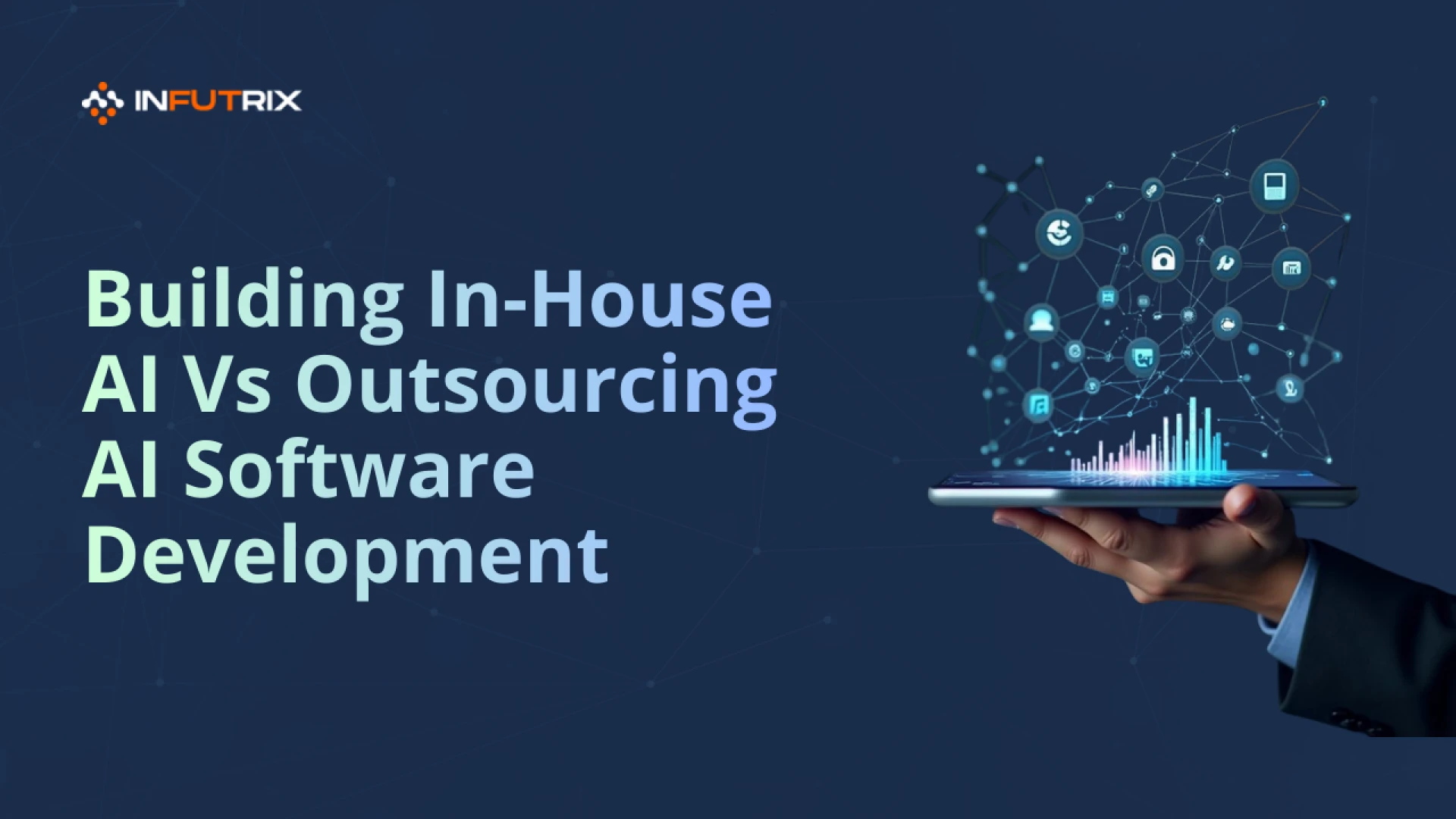

You assembled a tech team, spent countless hours training them, all eager to market test your product and hoping for it to be the next big thing. But your budget ran out, and there’s none left for marketing.
Happens more often than you think.
What might seem like an obvious choice for most companies to build a strong internal tech team and master AI software development can’t necessarily be replicated by startups.
Big companies like Amazon and Microsoft have massive AI development teams and heavy budgets, which is why they opt for in-house AI solutions.
Does that mean you’ll easily fit in the flock too, especially when all your resources are tied up in training and development?
In this article, we’ll discuss why building an AI-house might not be an optimal choice for startups.
Reasons Why Startups Should Reconsider Building AI In-house
When looking for AI solutions for startups, it comes down to: should you build your AI systems internally or partner with an AI development company?
Choosing in-house AI isn’t always the best choice. You can stumble upon:
- High Costs
Building AI systems internally means hiring data scientists and AI engineers, which will cost you a fortune. Training and retaining the staff is a long-term commitment, so is software and infrastructure development.
You’ll have to spend on gathering and cleaning data, training models, testing, and refining them. This could take months, depending on the complexity of your project.
- Limited Expertise in AI tech
AI is a broad field; every specific area requires field expert. Your solution could include elements of deep learning, machine learning, and natural language processing.
Even if you gather a talented team with niche expertise, there is still a risk of lacking real-world applications skills, and these AI trends in B2B startups shift every year.
- Lack of Competitive Edge
There is a possibility that in-house AI systems might fall short when keeping up with innovation in the field of artificial intelligence. There might be plausibility that you may not have the resources to keep up with these advances in AI technology.
In this case, it would be more effective to outsource the project to an AI development company that is at the forefront of AI research and industry trends.
- Issues in Scalability
In-house development of AI systems works well on small projects. When looking for scalability and global reach to meet the company’s growing needs, in-house AI systems prove to be a dead end.
Quick Comparison: Which Approach Fits Right for You?
Working with In-house AI teams is a significant investment, while partnering with an AI development company cuts any ongoing costs but can pose a challenge when you prefer to have total control over your team.
Here’s a breakdown to find which approach fits the best for your AI development for B2B startup journey.
When selecting an AI Development Company
Choosing between the AI development company and in-house teams depends on your budget, project timeline, and team expertise. Here are 5 common grounds for comparison.
- Technical Expertise
AI teams have real-world expertise in their field. They possess the knowledge of building cutting-edge solutions to scale your solutions.
2. Scalability
AI consulting firms are quick to scale; they have large teams that can help with every step of the procedure.
3. Overall Costs
AI consulting fees can be high but not as much as the costs involved in hiring and training internal teams. They prove to be cost-efficient when your team strives to build extensive solutions on short notice.
4. Innovation
AI consultants build on fresh perspectives and innovative solutions. They are familiar with ‘what sells’ and suggest possible ways to approach industry challenges.
5. Control
You’ll miss out on direct control when partnering with an AI consultancy, since these firms handle most decisions, but in exchange you get expert input.
When selecting In-House AI Team
Let’s compare AI teams on the same grounds to track down which one is the way to go for your B2B startup.
- Technical Expertise
To make your internal AI development team stay up to date, they’ll require constant training and development. They might be well-qualified theoretically, but there are chances they lack practical knowledge when building profitable solutions.
2. Scalability
Scaling up with an in-house team is a slow and expensive process. You’ll need to hire and train staff across different domains.
3. Overall Costs
Costs of maintaining in-house AI teams include salaries, training costs, and infrastructure and software development expenses. This can only work in your favour when you have the means to expert guidance.
4. Innovation
In-house teams are familiar with the chain of working of your company, but they might get stuck on old ways of working, with an inability to adapt.
5. Control
In-house teams can be fully controlled from work decentralization to decision-making process. They are easy to manage and guide.
In plain sight, an AI development company fits best when you aim for cost-efficiency, alignment with industry standards, and expert guidance.
In contrast, in-house AI teams are the right approach when your intent is full authorization on a project and monitoring customization to align with the company’s culture.
Final Insights
Don’t stumble into the trap of spending your entire budget on hiring high-tech staff. Whether you decide to build an in-house AI team or partner with an AI development company, begin by clearly understanding your needs, project scope, available resources, and long-term goals.
If you’re still unsure where to start, Infutrix is here to help. We excel at delivering end-to-end AI solutions for startups tailored to your business objectives.
Let us guide you through every step of your AI journey.
Read Relevant Topics on Infutrix Insights.



























Sign in to leave a comment.