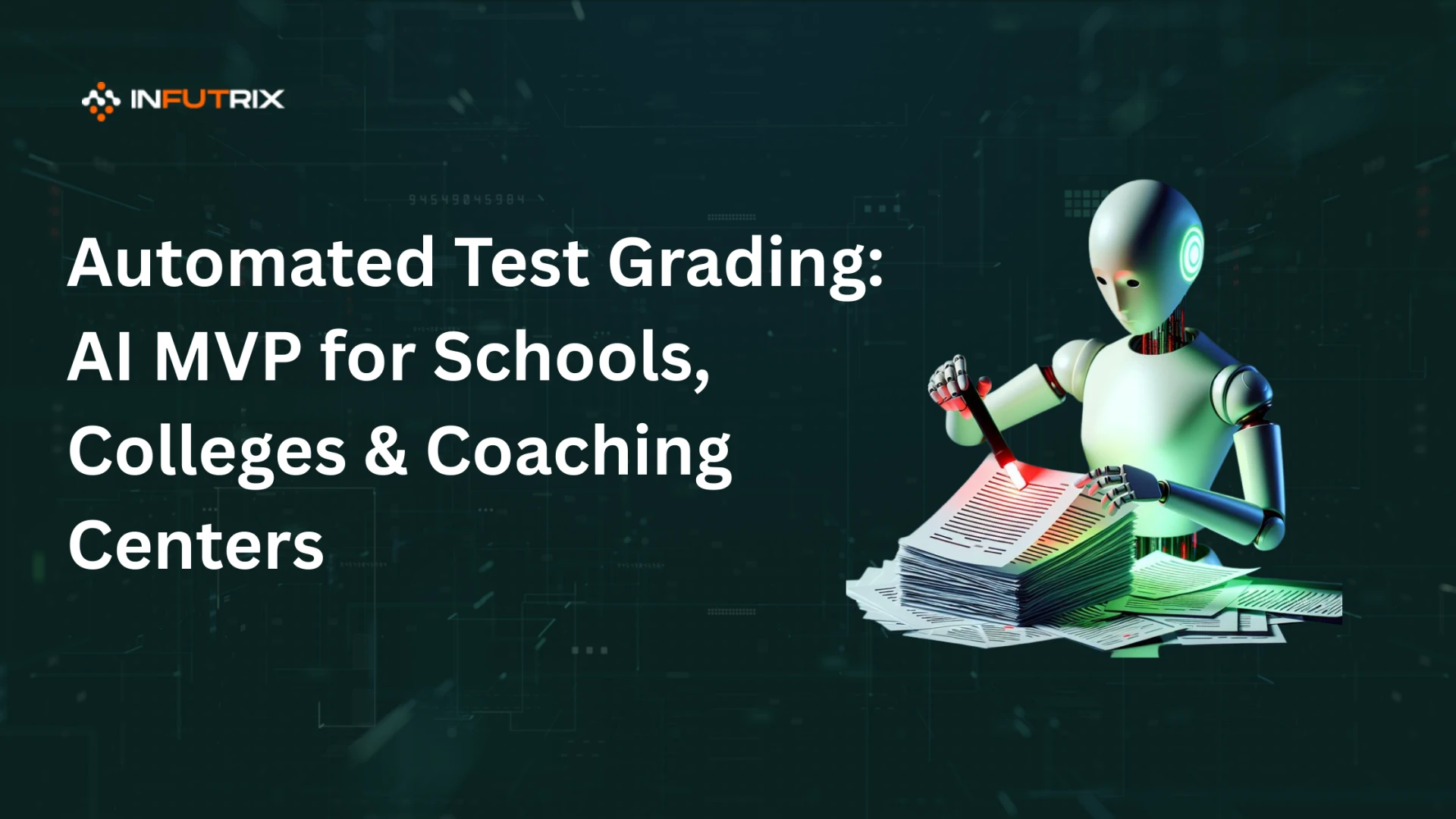

One of the most notable breakthroughs in the e-learning app development field is the emergence of automated grading systems.
AI-integrated grading systems are new teaching assistants. All you have to do is sit back and let AI analyze aspects like grammar, sentence, and structure, allowing educators to focus on higher-level concerns like argumentation and evidence.
However, implementing these new technologies proves to be unsettling for both educators and students. Experimentation and iteration become a priority to help users adapt to new tools.
So, how does one take advantage of artificial intelligence solutions without suffering from its significant consequences? Creating an AI MVP (minimum viable product) is the first step.
Without further ado, let’s explore the crucial components of AI-integrated grading systems and their perks for educational institutions.
Automating Grading with AI-Integrated MVPs: Must-Know Components
Before integrating AI in your MVP, start by understanding the core components of AI grading systems. This will guide you in picking the best use case before implementing it in your AI software.
- Input Assessment
The system gathers user responses, which consist of multiple-choice answers or short answers to further break down text into individual words or phrases. The following action is to organize the data into a structured format to ease the output interpretation.
In this procedure, AI MVPs set the stage to test the accuracy of AI grading systems. In case the input data is faulty, it leads to incorrect evaluations and misinterpretations of user performance. Consider partnering with an AI software development company to steer clear of erroneous data issues.
- Answer Evaluation
This component evaluates student responses for correctness and accuracy. AI grading systems use scoring algorithms to assess user responses. These algorithms can be trained on large datasets of graded responses or a predefined criterion that determines how responses are scored.
All things considered, an AI MVP ensures that the answer evaluation component in AI grading systems provides fair and accurate results.
- Score Compiling
Scoring mechanisms can be qualitative or quantitative, depending on the context. The score compiling component assists in creating a standardised metric for performance comparison assessment.
Integrate this component in your AI-powered MVP to ensure uniformity and fairness in performance review systems.
- Feedback Chain
A user-friendly grading system provides its users with personalised insights into their strengths and potential areas of improvement. It collects feedback from considerable sources, like supervisors and self-assessments, to formulate an across-the-board summary of overall performance.
- Performance Evaluation
Based on empirical data, the performance evaluation component assists test takers in making well-informed decisions. This data is then tailored to create training and development programs based on individual needs.
How Do AI MVPs Benefit Educational Institutions?
AI-based MVPs offer a multitude of potential benefits to educational institutions. These include:
- Resource Optimization
By assigning mundane tasks to automated grading mechanisms, these systems take the burden off educational institutions to focus on training rather than spending on traditional teaching methods. AI MVP saves the day by giving early access to market-test the scalability of these solutions.
- Scalability in Solutions
AI-based systems can handle large datasets without compromising on quality, which makes them ideal for standardised testing. Educational institutions are shifting their gears to automated grading systems, giving your AI MVP an opportunity to seize global scalability.
- Personalized Feedback
In addition to being exceptional at automated grading, these AI systems provide feedback that goes beyond simple scores. Based on predetermined criteria, AI can evaluate student responses and pinpoint their strengths and weaknesses.
- Elimination of Subjectivity
Can online education app development be biased? AI-based grading systems operate on pre-defined notions, thereby reducing the potential risk of subjectivity and bias in the evaluation process.
By guaranteeing a more equitable and uniform evaluation experience for its users, these systems address the drawbacks of conventional grading techniques.
The Path Forward…
Automated grading systems are a valuable tool in the growing landscape of edtech. While these systems prove to be worthwhile, it doesn’t indicate that you should jump right into making solutions.
A scalable AI solution demands credible groundwork. To leverage artificial intelligence in your AI MVP, you need high-end skills and expertise, something that a skilled AI development company like Infutrix is well-equipped to perform.
Read Related Topics: Infutrix Insights






























Sign in to leave a comment.