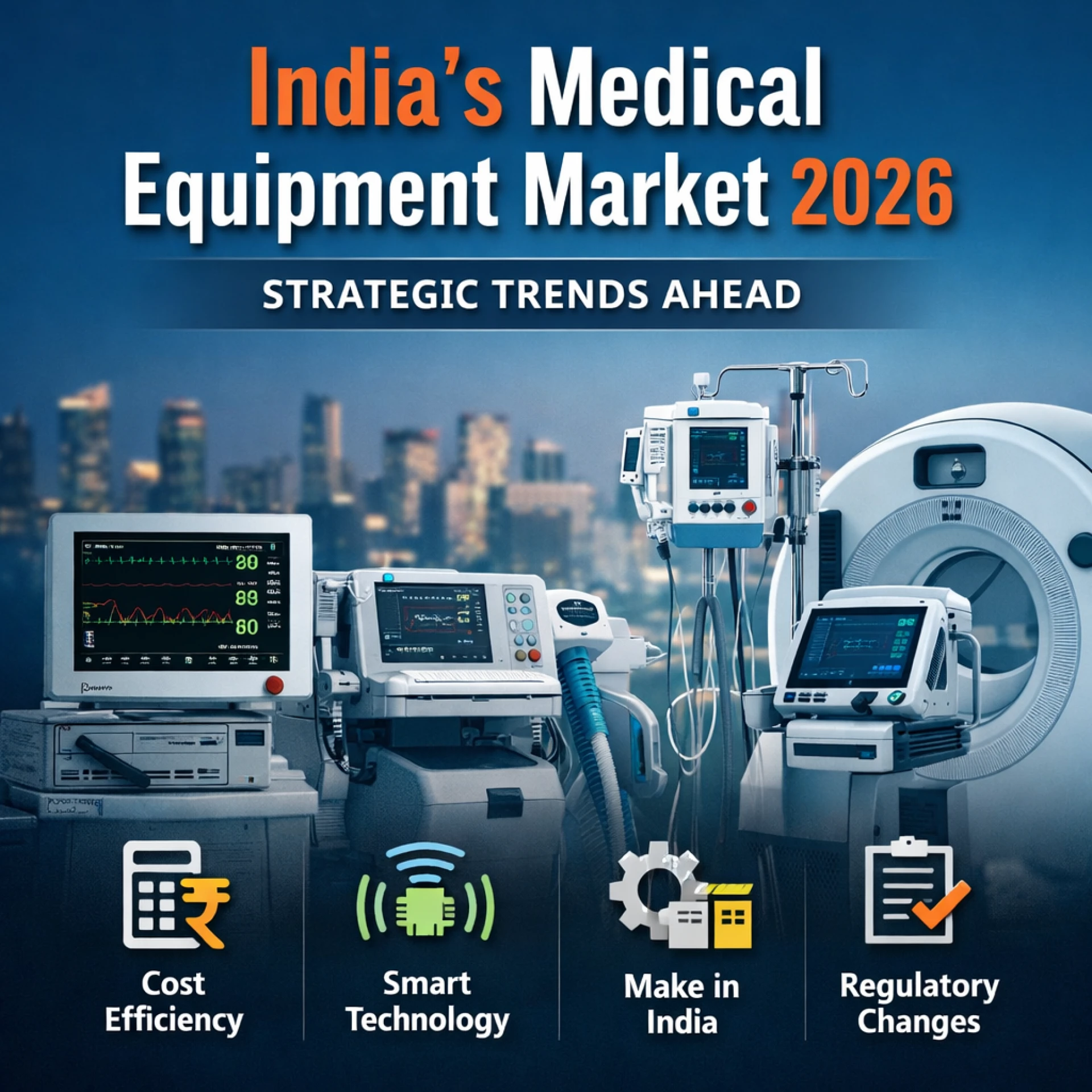

By 2026, medical equipment investment decisions in India will be less about procurement and more about capital strategy. Hospitals are no longer simply buying devices — they are redesigning how infrastructure supports efficiency, compliance, and long-term sustainability.
India’s medical devices market is projected to cross USD 18 billion by 2026, driven by expanding healthcare access, rising chronic disease burden, increasing insurance penetration, and rapid infrastructure growth across tier-2 and tier-3 cities. But growth alone is not the defining factor. The real shift lies in how hospital administrators are approaching equipment planning and financial allocation.
The following strategic trends are reshaping hospital investment decisions across the country.
1. From Capital Expenditure to Capital Efficiency
Traditional procurement models prioritised ownership. Today, hospital leadership teams are evaluating equipment through the lens of total cost of ownership (TCO) rather than upfront purchase price.
Instead of asking, “How much does this machine cost?”, decision-makers are asking:
- What is the lifecycle maintenance burden?
- How often will software upgrades be required?
- What is the projected utilization rate?
- How does it impact cash flow flexibility?
This shift has accelerated the adoption of rental and subscription-based models, particularly for high-value ICU equipment and advanced diagnostic systems. Asset-light strategies allow hospitals to scale capacity without locking capital into depreciating assets. For mid-sized hospitals, this approach preserves liquidity while maintaining competitive clinical capabilities.
2. Digital Integration and Smart Infrastructure
Connected devices are redefining hospital operations. IoT-enabled monitors, centralized dashboards, and predictive maintenance tools are increasingly embedded within critical care environments.
The business impact is tangible:
- Predictive servicing reduces unplanned downtime.
- Integrated dashboards improve response time in ICU settings.
- Data analytics supports more accurate capacity forecasting.
Artificial intelligence is also moving beyond experimentation. AI-enabled imaging tools reduce repeat scans and enhance diagnostic accuracy, directly affecting patient throughput and operational efficiency.
Hospitals that treat technology integration as infrastructure — not add-ons — are building long-term operational resilience.
3. Domestic Manufacturing Momentum
Policy initiatives such as the Production Linked Incentive (PLI) scheme and broader “Make in India” efforts are strengthening domestic manufacturing capabilities in medical devices.
For hospital administrators, this creates three strategic implications:
- Improved supply reliability due to localized production.
- Gradual cost moderation in certain equipment categories.
- Opportunities for vendor collaboration tailored to regional needs.
While high-end imaging devices still rely significantly on imports, the ecosystem is evolving toward greater self-reliance. Procurement teams must now evaluate both global and domestic vendors through performance, compliance, and service reliability metrics rather than legacy brand perception alone.
4. Regulatory Maturity and Compliance-Driven Procurement
India’s regulatory environment for medical devices has become more structured in recent years. Increased compliance requirements under Medical Device Rules and quality certification standards are influencing procurement decisions.
Hospitals are investing more in:
- Certified and traceable equipment
- Digital asset management systems
- Maintenance documentation frameworks
Procurement is becoming governance-driven. Equipment choices are evaluated not only for clinical functionality but also for audit readiness and risk mitigation.
In this environment, strategic alignment between biomedical teams, compliance officers, and finance departments is critical.
5. Financial Pressures and ROI-Oriented Investment
Rising operational costs and competitive pressures are pushing hospitals to adopt ROI-based capital planning models.
Insurance penetration and increasing healthcare awareness are expanding patient volumes. However, reimbursement dynamics and pricing pressures demand careful capital deployment.
Modern procurement committees are focusing on:
- Revenue-generating potential of specialized equipment
- Utilization rate projections
- Long-term service contracts
- Break-even timelines
Equipment investment decisions are increasingly aligned with service-line expansion strategies — such as critical care, oncology, or advanced diagnostics — rather than reactive purchasing.
Hospitals that align capital expenditure with strategic growth areas will achieve stronger financial stability.
6. Infrastructure Expansion Beyond Metro Cities
Healthcare infrastructure growth in tier-2 and tier-3 cities is a defining factor shaping the market. Smaller cities are witnessing increasing private hospital investments, supported by growing middle-class demand and improved insurance coverage.
These facilities are adopting hybrid procurement strategies:
- Leasing high-cost equipment
- Purchasing essential mid-range devices
- Partnering with service providers for technical support
This blended approach balances affordability with capability expansion.
The Strategic Outlook
By 2026, India’s medical equipment market will not just be larger — it will be structurally different. Hospitals that continue treating equipment as isolated purchases risk financial inefficiency and operational strain.
The emerging mindset is clear:
Medical equipment must be viewed as a strategic asset portfolio, not a procurement checklist.
Capital flexibility, digital integration, regulatory alignment, and vendor reliability will define the next phase of hospital competitiveness.
For administrators and healthcare leaders, the challenge is no longer acquiring devices — it is building a sustainable infrastructure model that adapts to technological acceleration and financial realities.
The institutions that succeed will be those that integrate procurement strategy with long-term vision.



























Sign in to leave a comment.