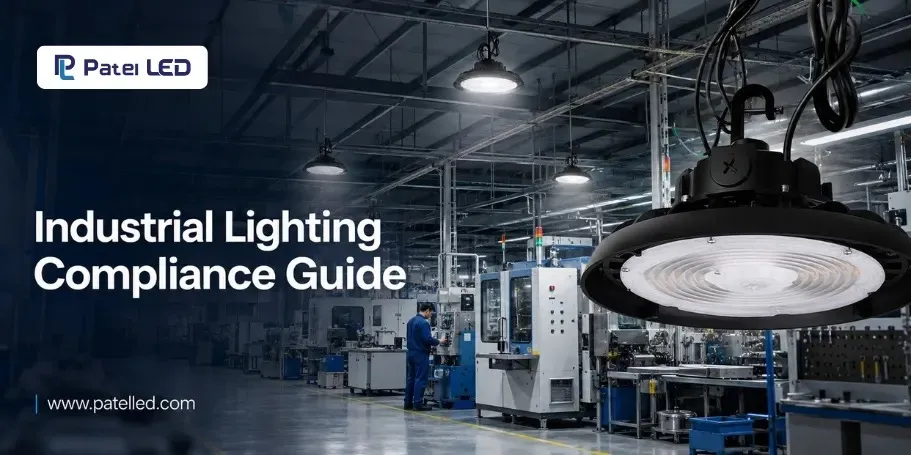

Industrial lighting is not simply about making a warehouse, factory, or manufacturing floor brighter. The lighting system also needs to support workplace visibility, electrical safety, emergency movement, energy efficiency, equipment maintenance, and the specific environmental conditions found throughout the facility.
For U.S. facility managers, contractors, electricians, property owners, and procurement teams, that makes industrial lighting compliance an important part of every retrofit or new lighting project.
A fixture can produce thousands of lumens and still be a poor choice if it has the wrong beam distribution, unsuitable environmental rating, incompatible controls, or inadequate certification for the project.
That is why a successful industrial LED lighting upgrade starts with the requirements of the facility - not simply fixture wattage.
Patel LED provides commercial and industrial LED lighting solutions for warehouses, factories, manufacturing facilities, loading areas, parking lots, offices, and other commercial environments, allowing buyers to build a lighting system around the needs of individual zones.
What Is Industrial Lighting Compliance?
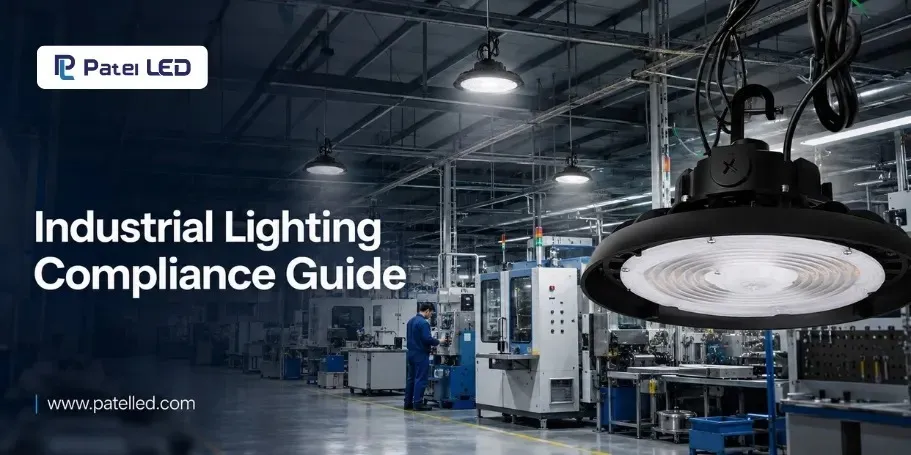
Industrial lighting compliance means designing and installing lighting that satisfies applicable workplace safety requirements, electrical requirements, building and energy codes, emergency and exit-route provisions, lighting-control requirements, product certifications, and environmental conditions. Compliance depends on the entire lighting system and application - not only the LED fixture being installed.
Why Industrial Lighting Compliance Matters
Industrial facilities contain very different working environments.
A warehouse may include:
- High-bay storage areas
- Picking aisles
- Packing stations
- Loading docks
- Electrical rooms
- Offices
- Mechanical areas
- Exterior walls
- Parking lots
- Truck yards
- Emergency exit routes
Each location has different illumination, distribution, mounting, environmental, and control requirements.
Installing one type of light everywhere can therefore create unnecessary brightness in some locations while leaving other areas underlit.
A properly planned industrial LED lighting system can help businesses improve:
- Workplace visibility
- Employee safety
- Equipment identification
- Warehouse navigation
- Task accuracy
- Exterior security
- Energy efficiency
- Maintenance planning
- Emergency preparedness
- Long-term operating costs
The objective should be to create a coordinated lighting system where every fixture performs the correct job in the correct location.
OSHA Industrial Lighting Requirements: What Businesses Need to Know
One of the most common searches among facility managers is OSHA industrial lighting requirements.
However, there is an important distinction to understand.
OSHA does include illumination requirements in several standards, but there is not one universal lighting level that applies to every industrial facility, warehouse, or manufacturing task.
Different OSHA provisions can apply depending on the work activity and environment.
For example, OSHA has illumination provisions addressing construction environments, electrical workspaces, exit routes, and other regulated situations.
Therefore, facility owners should avoid finding a single foot-candle figure online and treating it as the lighting specification for an entire property.
OSHA Minimum Lighting Does Not Automatically Mean Ideal Lighting
Regulatory minimums and good lighting design are not necessarily the same thing.
An area may technically satisfy one applicable minimum while still experiencing:
- Dark corners
- Poor aisle visibility
- Excessive glare
- Uneven illumination
- Dark rack faces
- Difficult label reading
- Insufficient inspection lighting
- Shadows around machinery
- Poor employee visual comfort
A manufacturing inspection station, for example, normally has very different visual requirements from a general storage aisle.
Similarly, forklift traffic areas can require different lighting distribution than offices or packing stations.
Industrial lighting should therefore be designed around both the applicable requirements and the real work being performed.
Electrical Rooms Need Special Lighting Consideration
Industrial facilities commonly contain electrical equipment including:
- Switchboards
- Panelboards
- Motor-control centers
- Distribution panels
- Service equipment
- Electrical cabinets
These areas should never be treated as ordinary storage rooms.
Personnel working around electrical equipment need adequate illumination to identify labels, inspect components, operate switches, perform maintenance, and safely navigate the workspace.
When planning lighting controls in electrical rooms, facility managers should also verify whether the proposed automatic-control strategy satisfies applicable electrical workplace requirements.
Depending on the ceiling height and layout, suitable Patel LED product categories may include:
- LED panel lights
- LED strip fixtures
- LED tube lighting
- Commercial low-profile fixtures
Product selection should still consider voltage, mounting method, light distribution, controls, and the exact application.
Exit Routes and Emergency Lighting Must Be Planned Separately
Industrial buildings frequently operate with employees, forklifts, equipment, racks, machinery, and other potential obstructions.
Clearly illuminated exit routes are therefore an essential component of facility planning.
Businesses should review areas such as:
- Corridors
- Stairways
- Production-floor exits
- Warehouse exits
- Office exits
- Exterior discharge locations
- Emergency exit signs
- Emergency lighting units
One of the biggest mistakes during an industrial LED retrofit is assuming that normal overhead lighting automatically provides the required emergency solution.
It does not.
A powerful LED high bay may illuminate the warehouse perfectly during normal operation but become unavailable if utility power fails.
Emergency lighting needs its own power, runtime, installation, and code considerations.
Energy Codes Are Changing How Industrial Lighting Is Designed
Modern commercial lighting codes increasingly focus on more than fixture efficiency.
Controls have become an important part of reducing unnecessary energy consumption.
Depending on the applicable state or local energy code, an industrial project may need to consider:
- Occupancy sensors
- Automatic shutoff
- Scheduling controls
- Dimming
- Daylight-responsive controls
- Warehouse zoning
- Exterior lighting controls
- Lighting-power limitations
Requirements vary according to jurisdiction, building type, project scope, and the locally adopted code edition.
This means there is no single LED fixture that can simply be labeled as making an entire building “energy-code compliant.”
Compliance depends on how fixtures and controls work together.
Why Lighting Controls Make Sense in Industrial Facilities
Many warehouses and manufacturing facilities operate for extended hours, but every space is not occupied continuously.
Examples include:
- Reserve storage areas
- Secondary aisles
- Mezzanines
- Utility rooms
- Seasonal storage zones
- Maintenance rooms
- Secondary production lines
- Daylit loading areas
Running every fixture at full output throughout the entire operating day can waste significant electricity.
Using compatible controls can allow businesses to reduce output or switch lighting off when the illumination is not required.
For this reason, facility managers should check whether fixtures support technologies such as:
- 0–10V dimming
- Occupancy sensing
- Scheduling
- Daylight sensing
- Zoned controls
before placing a commercial lighting order.
Certifications: Never Assume Every LED Fixture Is the Same
Industrial lighting buyers frequently encounter terminology such as:
- UL Listed
- ETL Listed
- DLC Qualified
- DLC Premium
- IP-rated
- Damp-location rated
- Wet-location rated
These terms serve different purposes.
A safety listing does not mean the same thing as DLC qualification.
DLC qualification does not automatically mean the project satisfies OSHA requirements.
And neither automatically proves that a fixture is suitable for a wet, dusty, or harsh industrial environment.
Always verify the exact fixture model against the project specification before purchasing.
What Does DLC Mean for Industrial LED Lighting?
The DesignLights Consortium, commonly known as DLC, maintains qualified product lists for commercial LED lighting and lighting controls.
DLC qualification can be especially important where:
- Utility rebates are being pursued
- Project specifications require DLC products
- Energy-efficiency programs specify qualified equipment
- Procurement standards require particular performance documentation
However, businesses should verify the specific model number rather than assuming every fixture within the same product family carries identical qualification.
DLC qualification is also different from OSHA compliance.
A DLC-listed high bay may be a strong efficiency choice, but the complete installed lighting system must still satisfy applicable safety, electrical, control, environmental, and local-code requirements.
Environmental Ratings Matter More Than Many Buyers Realize
Industrial environments can expose lighting fixtures to conditions that do not exist in ordinary offices.
Depending on the facility, lighting may encounter:
- Dust
- Humidity
- Water
- Cleaning spray
- Temperature extremes
- Vibration
- Outdoor weather
- Grease
- Industrial contaminants
This makes the fixture's environmental suitability an important buying factor.
IP Ratings
An IP rating indicates a fixture's protection against solids and moisture.
A warehouse office and a washdown production zone, for example, should not automatically use the same fixture merely because both need similar brightness.
Before buying industrial LED lights, check:
- Indoor vs. outdoor use
- Dry-location rating
- Damp-location rating
- Wet-location suitability
- IP rating
- Operating temperature
- Housing construction
- Mounting requirements
Matching the fixture to its environment can help avoid premature product failure and unnecessary maintenance.
Industrial Lighting Should Be Planned Zone by Zone
A strong industrial lighting design treats the facility as several lighting environments rather than one enormous room.
Here is how that strategy can work.
Open Warehouse and Manufacturing Floors
High ceilings and large open areas usually require powerful overhead lighting.
LED high bay lights are commonly used for:
- Warehouses
- Manufacturing plants
- Distribution centers
- Industrial workshops
- Large storage buildings
- Gymnasiums
- Large commercial facilities
Patel LED offers high-bay products designed for high-ceiling commercial and industrial applications.
When selecting high bays, evaluate:
- Ceiling height
- Lumens
- Wattage
- Efficacy
- Beam angle
- Fixture spacing
- Dimming capability
- Voltage
- Environmental rating
- Certification
Do not choose a high bay based on wattage alone.
Warehouse Aisles and Production Lines
Long aisles and rectangular industrial layouts can require a different light distribution from large open spaces.
Linear LED high bay lights are often useful for:
- Rack aisles
- Assembly lines
- Manufacturing lines
- Distribution centers
- Long production areas
Their elongated design can help provide more useful coverage along rectangular work areas.
The correct selection still depends on mounting height, aisle width, shelving configuration, required illumination, and photometric performance.
Harsh Industrial Areas
Locations exposed to dust, moisture, or demanding environmental conditions may need more protective lighting.
Vapor-tight or appropriately rated industrial fixtures may be worth considering for applicable environments.
Before ordering, buyers should verify the exact environmental rating instead of assuming every industrial fixture is moisture- or dust-resistant.
Industrial Offices
Industrial buildings often include administration areas, control rooms, meeting spaces, reception areas, and employee offices.
These spaces generally require different lighting from the production floor.
LED panels and troffers can provide more uniform, comfortable illumination for lower-ceiling office environments.
Loading Docks and Covered Exterior Areas
Covered loading areas require dependable visibility for employees, vehicles, packages, and equipment.
LED canopy lights may be useful for:
- Loading areas
- Covered entrances
- Service stations
- Gas station canopies
- Commercial exterior ceilings
Fixture selection should consider exposure, mounting height, beam distribution, and control requirements.
Building Exteriors
Exterior industrial walls often require lighting for security and employee visibility.
LED wall pack lights are commonly used around:
- Building perimeters
- Exterior entrances
- Loading zones
- Service doors
- Walkways
Buyers should consider light distribution and spill light rather than simply installing the highest-output wall pack available.
Parking Lots and Industrial Yards
Parking areas, truck yards, drive lanes, and large exterior spaces often require LED area lights or parking lot lights.
These applications should consider:
- Pole height
- Fixture spacing
- Beam distribution
- Property boundaries
- Security needs
- Controls
- Light trespass
- Uniformity
A photometric plan is especially valuable for large exterior installations.
Targeted Outdoor Areas
LED flood lights can provide focused illumination for:
- Equipment yards
- Security zones
- Signage
- Building facades
- Loading areas
- Other targeted exterior locations
Flood lighting should be aimed carefully to avoid unnecessary glare and spill light.
UFO High Bay vs. Linear High Bay: Which Is Better?
Neither fixture is universally better.
The right choice depends on the layout.
UFO LED High Bays
UFO high bays are often a strong choice for:
- Open warehouse floors
- Manufacturing spaces
- Workshops
- Large open industrial areas
- High-ceiling rooms
Their compact form makes them practical for many general high-bay applications.
Linear LED High Bays
Linear high bays can be particularly useful for:
- Narrow aisles
- Rack layouts
- Assembly lines
- Rectangular work areas
- Long production zones
The important consideration is not the fixture shape alone.
The best industrial lighting fixture is the one whose photometric distribution supports the actual space.
Lumens vs. Foot-Candles: Know the Difference Before Buying
This distinction is critical.
Lumens measure the total amount of light a fixture produces.
Foot-candles measure the illumination reaching a surface.
That means two fixtures with similar lumen output can perform very differently after installation.
The actual light reaching the work surface depends on:
- Mounting height
- Fixture spacing
- Beam angle
- Optics
- Obstructions
- Rack height
- Aisle width
- Surface reflectance
- Fixture orientation
This is why simply buying the fixture with the largest lumen number does not guarantee better warehouse lighting.
Why Photometric Planning Matters
A photometric lighting plan helps predict how the selected fixtures will perform before installation.
It can help identify:
- Light levels
- Fixture quantity
- Fixture spacing
- Bright spots
- Dark areas
- Uniformity
- Aisle illumination
- Exterior coverage
- Potential glare
For large warehouses, manufacturing plants, distribution centers, and parking facilities, photometric planning can reduce the risk of discovering lighting problems after dozens or hundreds of fixtures have already been installed.
Common Industrial LED Lighting Mistakes to Avoid
1. Buying by Wattage Alone
Watts measure power consumption - not useful illumination at the work surface.
Review lumens, efficacy, distribution, mounting height, and photometric performance.
2. Using One Fixture Everywhere
Factories and warehouses contain many different lighting zones.
The same high bay that performs well over an open production floor may not be suitable for an office, electrical room, loading dock, or parking lot.
3. Ignoring Controls
Selecting fixtures without considering dimming or sensor compatibility can limit the facility's future energy-saving options.
4. Assuming DLC Means Complete Compliance
DLC qualification can support efficiency programs and rebates, but it does not automatically establish OSHA, electrical, building-code, or overall project compliance.
5. Ignoring Environmental Conditions
A fixture designed for a dry indoor space should not automatically be installed in an area exposed to moisture, washdown, dust, or outdoor weather.
6. Forgetting Emergency Lighting
Normal high-bay illumination does not automatically provide lighting during a power failure.
Emergency and exit lighting need separate planning.
7. Skipping Photometric Analysis
Installing fixtures based only on rough spacing can create hot spots, dark areas, glare, or inadequate work-surface illumination.
How to Plan an Industrial LED Lighting Upgrade
Before purchasing fixtures, gather the following information.
Step 1: Document the Facility
Identify:
- Building dimensions
- Ceiling heights
- Rack layouts
- Machinery locations
- Production areas
- Offices
- Electrical rooms
- Loading docks
- Parking areas
- Exit routes
Step 2: Divide the Property Into Lighting Zones
Create separate zones for areas such as:
- Production
- Storage
- Inspection
- Packing
- Electrical equipment
- Offices
- Exterior walls
- Parking
- Loading
- Emergency routes
Step 3: Determine the Lighting Requirement for Each Zone
Consider:
- Work activity
- Required visibility
- Applicable OSHA provisions
- Local codes
- Project specifications
- Environmental conditions
Step 4: Check Electrical Information
Record:
- Existing fixture wattage
- Voltage
- Circuit conditions
- Controls
- Operating hours
Step 5: Select the Fixture Category
Depending on the application, your facility may require:
- UFO LED high bays
- Linear LED high bays
- LED panels
- LED troffers
- Vapor-tight fixtures
- LED wall packs
- LED canopy lights
- LED area lights
- LED parking lot lights
- LED flood lights
- Emergency lighting
Step 6: Verify the Exact Product
Before ordering, check:
- Lumen output
- Wattage
- Efficacy
- Voltage
- Dimming compatibility
- Beam distribution
- Mounting
- Certifications
- DLC status where required
- Environmental rating
- Operating temperature
- Warranty
Step 7: Confirm Controls and Code Requirements
Coordinate lighting controls with applicable energy-code and project requirements.
Step 8: Complete Photometric Planning
For larger projects, validate fixture quantities, spacing, and illumination before installation.
Benefits of Upgrading to Industrial LED Lighting
When properly designed, industrial LED lighting can provide several operational benefits.
Lower Energy Consumption
Modern LEDs can deliver high lumen output while consuming substantially less power than many older HID, fluorescent, and metal-halide lighting systems.
Reduced Maintenance
Long-life LED fixtures can reduce relamping frequency, which is especially valuable in high-ceiling industrial facilities where maintenance may require lifts or production interruptions.
Better Lighting Control
LED fixtures can support dimming, occupancy sensors, scheduling, and other controls depending on the product.
Improved Visibility
Properly distributed LED illumination can improve visibility around machinery, aisles, labels, loading areas, and working surfaces.
Faster Start-Up
Unlike some traditional industrial lighting technologies, LED fixtures provide immediate illumination without extended warm-up periods.
Why Industrial Buyers Choose Patel LED
Patel LED offers multiple commercial lighting categories that can support a complete industrial property rather than a single room.
Businesses, contractors, electricians, and facility managers can explore solutions including:
- UFO LED High Bay Lights
- Linear LED High Bay Lights
- LED Panel Lights
- LED Troffer Lights
- Vapor-Tight Fixtures
- LED Wall Pack Lights
- LED Canopy Lights
- LED Area Lights
- LED Parking Lot Lights
- Outdoor LED Flood Lights
- Commercial lighting fixtures
This makes it possible to select different fixture types for production floors, warehouses, offices, loading areas, exterior walls, parking lots, and other commercial spaces while sourcing from the broader Patel LED commercial lighting range.
The key is still verification.
No fixture should be assumed to satisfy every industrial requirement simply because it is marketed for industrial use. Buyers should confirm the exact model, specification, certifications, environmental rating, and project requirements before purchasing.
Industrial Lighting Compliance Checklist
Before finalizing an industrial LED lighting order, ask:
- What activity takes place in this area?
- What regulation or project specification applies?
- What illumination is required at the actual work surface?
- What is the mounting height?
- What beam distribution is required?
- Are racks or machinery blocking light?
- What voltage is available?
- Does the area require dimming or occupancy sensing?
- Does the fixture need to operate in moisture or dust?
- Is the product appropriately listed or certified?
- Is DLC qualification required for the project or rebate?
- Is emergency lighting being handled separately?
- Are exterior lighting controls required?
- Has fixture spacing been verified?
- Has a photometric layout been completed?
- Have local codes been checked?
Answering these questions before ordering can help prevent expensive changes after installation.
FAQs
What are industrial lighting compliance requirements?
Industrial lighting compliance may involve OSHA workplace requirements, electrical safety provisions, local building and energy codes, emergency and exit-route lighting, controls, safety listings, environmental ratings, and project-specific specifications.
Does OSHA require a specific lighting level for every warehouse?
No single illumination value applies universally to every warehouse or industrial task. OSHA lighting requirements depend on the applicable standard and work activity, while actual facility design should also consider task visibility, uniformity, glare, layout, and local requirements.
What LED lighting is best for an industrial warehouse?
High-bay LED lighting is commonly used in warehouses with elevated ceilings. UFO high bays often work well in open areas, while linear high bays can be useful in rack aisles and long rectangular spaces.
Are LED high bay lights OSHA compliant?
A fixture type alone cannot be considered universally OSHA compliant. Compliance depends on the complete installation, applicable OSHA provision, illumination level, fixture placement, controls, electrical installation, and other project requirements.
Does DLC certification mean an LED fixture is OSHA compliant?
No. DLC qualification primarily addresses commercial LED performance and energy-efficiency program requirements. OSHA requirements relate to workplace safety. They are separate considerations.
Why are IP ratings important in industrial lighting?
IP ratings indicate protection against solids and moisture. They help buyers determine whether a fixture is suitable for the environmental conditions of the installation area.
What is the difference between lumens and foot-candles?
Lumens measure the total light output produced by a fixture. Foot-candles measure the illumination reaching a surface. Industrial lighting should consider both.
Do warehouses need lighting controls?
They may, depending on the locally adopted commercial energy code, project type, and space. Occupancy sensing, automatic shutoff, daylight controls, or zoning may apply in certain projects.
Are LED lights suitable for manufacturing facilities?
Yes. Industrial LED lighting is widely used in manufacturing environments because it can provide high light output, energy efficiency, long service life, instant illumination, and compatibility with lighting controls. The specific fixture must still be selected according to the task and environment.
What lights are commonly used in factory production areas?
UFO and linear LED high bays are commonly used for high-ceiling production areas. Other sections of the facility may require vapor-tight fixtures, panels, wall packs, canopy lights, flood lights, or area lights.
Should I use UFO or linear high bay lights in a warehouse?
Use the fixture whose distribution matches the layout. UFO high bays are often suited to open spaces, while linear high bays can work well in aisles and rectangular layouts.
Can LED industrial lighting reduce energy costs?
Yes. Replacing inefficient legacy lighting with properly selected LED fixtures and controls can substantially reduce lighting energy use. Actual savings depend on existing wattage, new fixture wattage, operating hours, controls, utility rates, and project design.
Final Thoughts: Build Your Industrial Lighting System Around the Facility
Industrial lighting compliance should never begin with the question:
“What is the brightest LED light available?”
A better question is:
“What does this specific area require, and which fixture provides the right illumination, distribution, controls, durability, and documentation?”
A modern industrial property may require several different fixture types working together.
Patel LED gives U.S. commercial buyers access to high bays, panels, troffers, wall packs, canopy lights, area lights, flood lights, parking lot lights, and other commercial LED lighting solutions for building a coordinated system.
Before placing a commercial order, divide your facility into functional zones, identify the requirements for each area, review photometric performance, verify exact product specifications, and confirm applicable local requirements with qualified professionals.
Explore Patel LED industrial and commercial LED lighting solutions and build a lighting system designed for safer visibility, greater energy efficiency, and dependable long-term performance.

























Sign in to leave a comment.