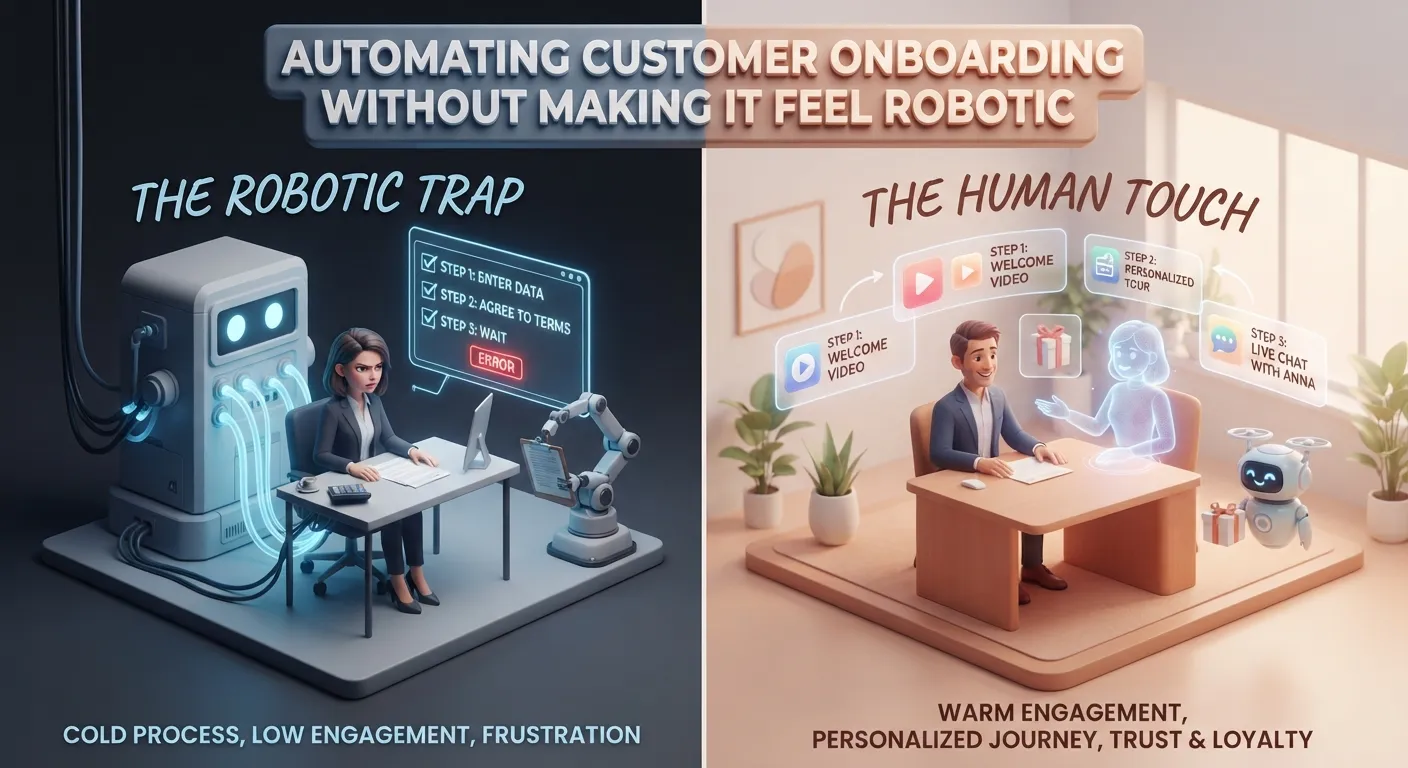

Onboarding is often the first real experience a new customer has with a business beyond the sales conversation, which makes it a strange place to introduce something that feels cold or mechanical. Yet automated onboarding, done poorly, is exactly what a lot of customers experience a business process automation win on paper that quietly damages the first impression it was meant to improve.
The Problem With Onboarding That Feels Automated
A sequence of generic emails, sent on a fixed schedule regardless of what the customer’s actually doing, tends to feel exactly like what it is: automation that wasn’t designed around the individual customer’s actual experience. Customers notice this, even if they can’t articulate exactly why the onboarding felt impersonal.
Automation Should Track Progress, Not Just Time
Rather than sending the next onboarding step purely based on a fixed number of days since signup, well-designed onboarding automation responds to what a customer has actually done triggering the next step once a specific action is completed, rather than assuming everyone moves through onboarding at the same pace regardless of their actual behavior.
Personalization Doesn’t Require Manual Work
A common misconception is that personalized onboarding requires giving up automation and doing things manually. In practice, automation can be personalized based on data what plan the customer chose, what they said they needed during sales, how they’re using the product so far without anyone manually customizing each individual sequence.
Knowing When to Insert a Human Moment
The onboarding sequences that feel genuinely thoughtful, rather than robotic, usually include deliberate points where a real person checks in not everywhere, but at moments that matter, like after a customer seems stuck or hasn’t engaged in a while. Identifying those moments and routing them to a person, rather than automating every single touchpoint, is often what makes the difference.
This Requires Real Data About Customer Behavior
Building onboarding automation that responds to actual behavior, rather than a fixed schedule, requires the underlying systems to actually track and expose that behavior reliably. This depends on solid enterprise software engineering work connecting onboarding automation to real usage data, not assumptions about how customers typically progress.
AI Can Judge When Something’s Off Track
Detecting that a specific customer seems to be struggling, based on subtle behavior patterns rather than an obvious explicit signal, is exactly the kind of judgment call that benefits from AI agent development Interpreting nuanced signals rather than waiting for a customer to explicitly ask for help.
Measuring Whether Onboarding Is Actually Working
Tracking completion rates, time-to-value, and where customers drop off during onboarding, through real data engineering and analytics work, reveals whether the automated sequence is genuinely helping customers succeed, or just moving them through steps without real engagement.
Reliable Delivery Protects the Experience
Onboarding messages or prompts that arrive late, duplicated, or not at all undermine the entire experience regardless of how well the sequence was designed. This is where cloud and DevOps engineering reliability quietly determines whether well-designed onboarding automation actually delivers as intended.
Test the Sequence With Real Customers, Not Just Internally
Onboarding sequences that look reasonable in an internal review can feel very different to an actual new customer experiencing them for the first time. Getting real feedback from recent customers about how onboarding actually felt is one of the most direct ways to catch a sequence that reads well on paper but lands poorly in practice.
Automated Doesn’t Have to Mean Impersonal
The businesses that get onboarding right treat automation as the mechanism for consistency, not the reason it feels cold. Thoughtful design, responsive to actual behavior, is what makes the difference.
Worried your automated onboarding feels more robotic than helpful? Book a strategy call and get an onboarding flow that feels genuinely responsive, not generic.


























Sign in to leave a comment.