
Companies do not buy performance management software because they want another dashboard. They buy it because planning is messy, reporting takes too long, and finance teams are still spending too much time fixing spreadsheets instead of making decisions. That is where Infor EPM starts to make sense.
If you work in finance, operations, or enterprise systems, you already know the pattern. One team has one version of the forecast, another team has a different set of numbers, and leadership wants answers faster than the systems can provide them. In many organizations, this problem gets even bigger when the business is running multiple platforms, including tools such as Oracle ERP for core enterprise processes and a separate layer for planning, consolidation, and analytics.
This is why conversations around Infor EPM have become more practical in recent years. It is not just about budgeting anymore. It is about connecting planning, financial consolidation, operational reporting, and decision support in a way that actually helps managers act on data. When paired correctly with upstream systems, including Oracle ERP, it can give companies a stronger and more usable performance management setup.
What Is Infor EPM and Why Are Businesses Using It?
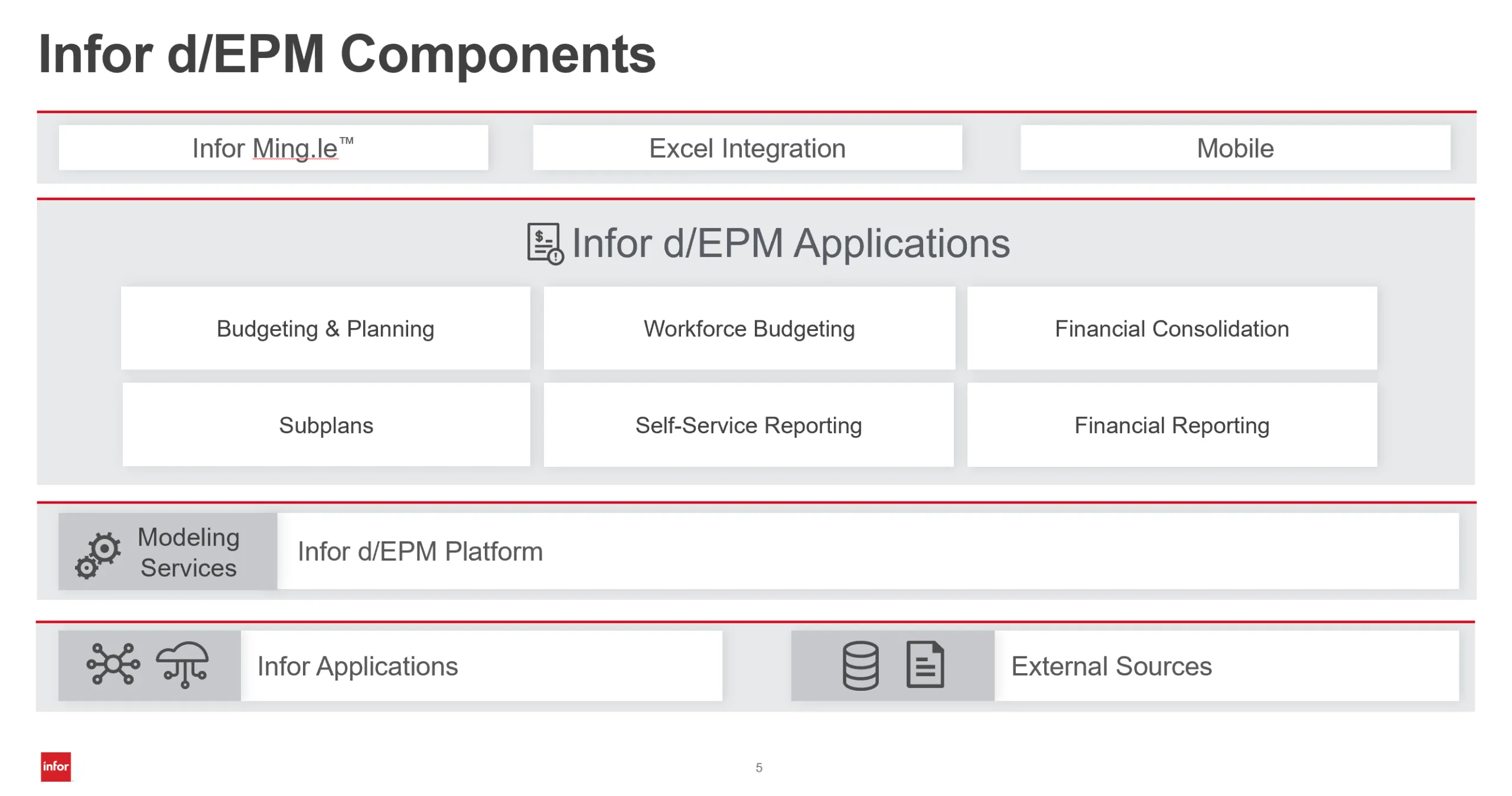
At its core, Infor EPM is an enterprise performance management platform built to support budgeting, forecasting, financial close, reporting, dashboards, and analytics. In plain language, it helps organizations plan better, report faster, and understand performance with more clarity.
That sounds straightforward, but the real value shows up in day-to-day work. A finance team can move from disconnected Excel files to structured planning models. A business unit leader can compare forecast versus actual without waiting days for a manual report. A CFO can review consolidated information from multiple entities with fewer last-minute surprises.
What makes Infor EPM useful is not one flashy feature. It is the fact that it brings several important tasks into one environment. Planning, analysis, reporting, and performance review all sit closer together. That reduces friction. It also reduces the number of times people have to export data, reshape it, and explain why two reports show different results.
For businesses that already run a major transactional platform like Oracle ERP, that distinction matters. Oracle ERP handles the operational backbone of the company. It manages finance transactions, procurement, projects, and core business records. Infor EPM sits in a different but connected role. It helps turn that transactional data into planning and performance insight.
Where Infor EPM Fits in the Enterprise Stack
A common mistake is to compare every enterprise platform as if they do the same job. They do not. Infor EPM and Oracle ERP are often discussed in the same meeting, but they serve different purposes.
Oracle ERP is built for enterprise resource planning. It records transactions, standardizes business processes, and supports functions such as accounting, procurement, supply chain, and project control. It is the system of record for many core activities.
Infor EPM, on the other hand, is designed to help organizations understand and manage performance. That includes:
- budgeting and forecasting
- financial consolidation
- scenario planning
- management reporting
- KPI tracking
- analytics and dashboards
So when someone asks whether a company needs Infor EPM if it already has Oracle ERP, the better question is this: does the business need a stronger planning and performance layer on top of its transactional systems? In many cases, the answer is yes.
That is especially true for growing companies, multi-entity groups, manufacturers, service businesses, and regional enterprises where planning cycles are complex and reporting requirements are tight.
Why Finance Teams Like Infor EPM
Most finance teams are not looking for abstract transformation language. They want three things: speed, control, and trust in the numbers. Infor EPM addresses all three when it is implemented properly.
First, it improves planning discipline. Budget owners can work inside a structured process instead of emailing files back and forth. That alone can save a huge amount of time during annual planning and quarterly reforecasting.
Second, it helps with reporting consistency. When leadership asks for revenue by region, margin by product line, or variance against target, the finance team can produce answers from a governed environment rather than from disconnected personal files.
Third, Infor EPM supports better scenario analysis. This is one of the most practical benefits. A business can model hiring changes, pricing shifts, demand swings, or cost inflation before making a decision. In today’s environment, that matters more than ever.
In organizations using Oracle ERP, this becomes even more useful. Transactional data from Oracle ERP can feed the models and reports in Infor EPM, giving users a more complete picture of actuals versus plan. Instead of forcing ERP to do everything, the company uses each platform for what it does best.
Infor EPM and Oracle ERP: A Practical Relationship
There is a real reason Infor EPM and Oracle ERP often appear in the same discussion. Many enterprises are not working with a single-vendor world. They have different systems for different strengths. That is normal.
A business may use Oracle ERP because it is deeply embedded in finance operations, purchasing workflows, and compliance processes. At the same time, it may use Infor EPM because the planning team needs a better environment for budgeting, consolidated reporting, and executive dashboards.
This is not unusual. In fact, mixed enterprise environments are often more realistic than idealized architecture diagrams.
Here is a simple example. Imagine a company with operations in three countries. It runs core financials and procurement through Oracle ERP. Each month, actuals are pulled into Infor EPM. Finance then uses Infor EPM to compare actual performance against budget, review department forecasts, analyze margin trends, and present board-level reporting. That setup allows Oracle ERP to remain the operational system of record while Infor EPM becomes the performance and planning layer.
When people understand that division of responsibility, system discussions become far more productive.
Key Business Benefits of Infor EPM
The strongest case for Infor EPM is usually built around business outcomes, not software features. Companies adopt it because it helps solve expensive reporting and planning problems.
One major benefit is faster budgeting and reforecasting. Teams spend less time collecting files and more time reviewing assumptions. Another is better visibility. Managers can see performance by unit, geography, customer segment, or cost center with more confidence.
Infor EPM also supports stronger consolidation and financial close processes, particularly for businesses with multiple legal entities or reporting structures. That can reduce manual effort and improve audit readiness.
Then there is executive reporting. Senior leaders rarely want ten tabs of raw data. They want a clean explanation of what changed, why it changed, and what should happen next. Infor EPM is useful because it helps bridge that gap between raw numbers and business decisions.
When connected with Oracle ERP, the value becomes even clearer. The ERP system captures the business activity. Infor EPM helps interpret that activity in a form decision-makers can use.
Common Mistakes Companies Make
Not every enterprise software project delivers value quickly. With Infor EPM, the biggest issues are usually not technical. They are organizational.
One common mistake is trying to rebuild every spreadsheet process exactly as it existed before. That usually creates a heavy and confusing model. A better approach is to simplify planning logic where possible and design around how decisions are actually made.
Another mistake is poor ownership. Infor EPM should not live only with IT. Finance, operations, and business leadership need to define what good reporting and planning look like.
Companies also run into problems when they treat integration with Oracle ERP as an afterthought. Data definitions, chart of accounts mapping, period controls, and reporting hierarchies need careful attention. If those pieces are weak, even a strong Infor EPM setup will struggle.
Who Should Consider Infor EPM?
Infor EPM is worth serious consideration for companies that have outgrown spreadsheet-based planning or need more disciplined performance reporting. It is especially relevant for businesses with complex structures, recurring forecast cycles, multi-entity reporting needs, or a growing demand for management insight.
It also makes sense for organizations already using strong transaction systems such as Oracle ERP but still lacking a dedicated performance management layer. In those cases, Infor EPM is not replacing ERP. It is complementing it.
That distinction is important. A lot of software buying mistakes happen because teams expect one platform to solve every problem. In practice, businesses get better results when they understand the role each system plays.
Final Thoughts
The case for Infor EPM is not based on hype. It is based on a familiar business need: better planning, clearer reporting, and more useful analysis. That is why it continues to matter in enterprise environments.
For companies running Oracle ERP, the conversation is not about choosing one system and ignoring the other. It is about building a setup where transactional processing and performance management work together. Oracle ERP handles core enterprise operations. Infor EPM helps turn those operations into insight, accountability, and better decisions.
That is the real value. Not more software for the sake of it, but a more reliable way to plan, measure, and respond. In a business environment where timing and visibility matter, that is not a small improvement. It is often the difference between reacting late and acting early.






























Sign in to leave a comment.