You landed the interview. Your resume impressed them enough to call you in. Now comes the hard part. Sitting across from a hiring manager, trying to prove you're the right fit while nervously wondering what they'll ask next. Will you freeze up? Ramble? Accidentally trash-talk your former boss?
Here's the truth that changes everything. According to career experts, winging it is never a good strategy for answering interview questions. You may feel confident before meeting with a hiring manager, but once you're in the interview hot seat, you could struggle to provide solid answers to even the most standard queries. Preparation is the key to ensuring you can field common interview questions with ease.
The good news? Most interviews follow predictable patterns. Hiring managers ask similar questions across companies and industries because they work. They reveal how you think, how you handle challenges, and whether you'll fit their team. Research from Robert Half shows that preparing answers to common questions dramatically improves your performance, helping you come across as confident and qualified.
You don't need to memorize scripts or fake enthusiasm. You need to understand what interviewers actually want to know, prepare honest examples that showcase your strengths, and practice delivering them naturally. Tools like the avua resume builder help you prepare materials that lead to interviews, but your answers during those conversations determine whether you get offers.
This guide walks you through the most common interview questions, explains what hiring managers are really asking, and shows you how to craft compelling answers that land jobs.
Why Interview Preparation Actually Matters
You might think your qualifications speak for themselves. They don't. Everyone interviewing for the same role has comparable experience and skills. Hiring managers want to gain more insight into your ability to do the job you're vying for and succeed in the organization's corporate culture. Interviews determine who stands out.
Preparation shows respect for the opportunity and the interviewer's time. It demonstrates you're serious about the role and willing to put in effort. Career experts note that preparation can help keep you from unintentionally saying something negative about yourself or a former employer, protecting you from self-sabotage.
More importantly, preparation builds genuine confidence. When you've thought through your stories and practiced articulating your value, you can focus on connecting with the interviewer rather than scrambling for answers. This authentic confidence makes better impressions than trying to wing it with charisma alone.
Interview Preparation Impact
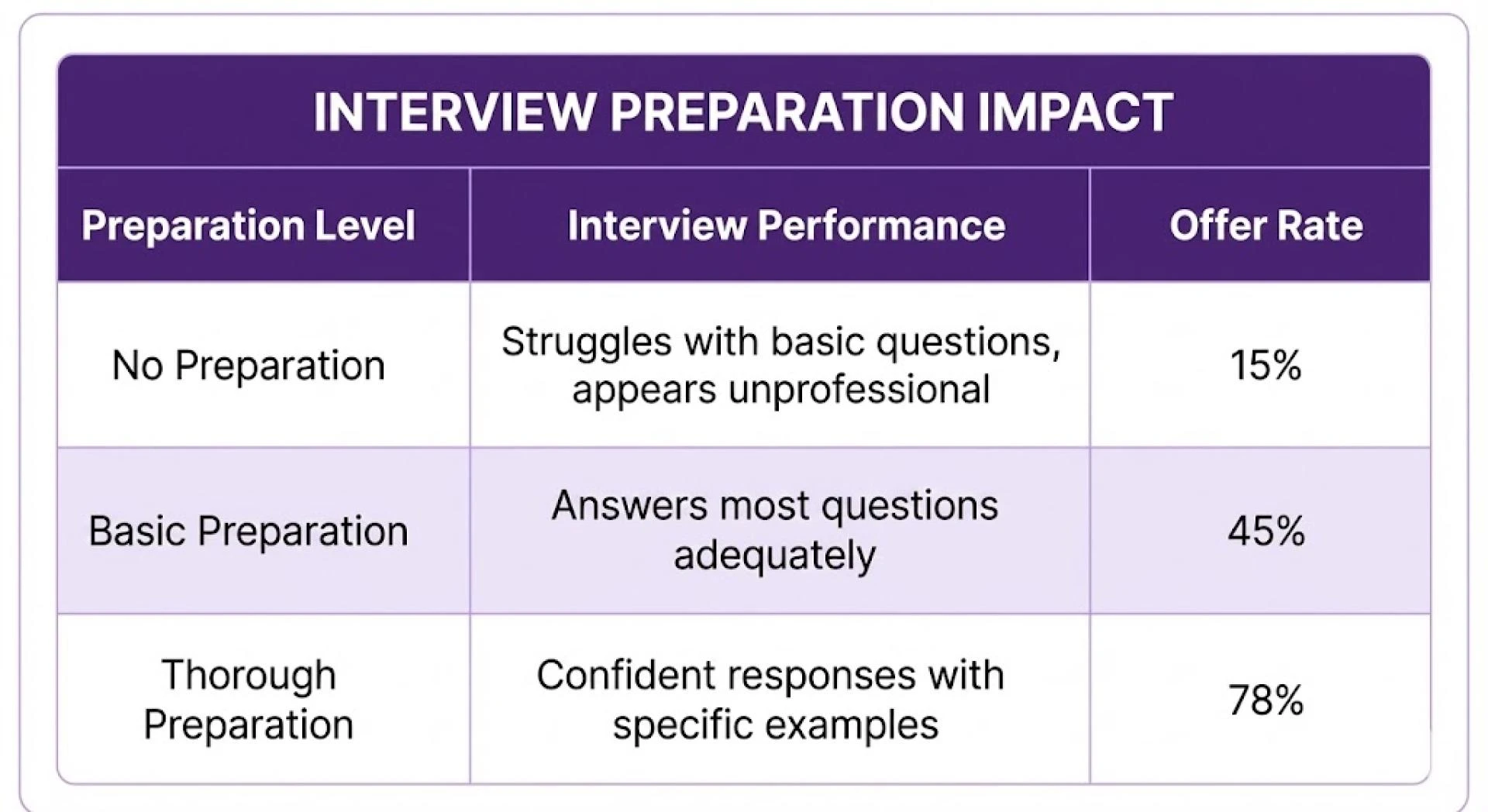
When combining interview preparation with strategic job searching through platforms like the avua job search platform, you create comprehensive approaches where strong materials open doors and solid interview skills close deals.
The Most Common Interview Questions and How to Answer Them
These questions appear in virtually every interview regardless of industry or role. Master them and you'll handle most interview situations confidently.
Tell Me About Yourself
This question wants you to introduce yourself with a brief summary of your career trajectory and relevant experience. It's usually the first question, setting the tone for everything that follows.
The biggest mistake people make? Treating this like a life story. Interviewers don't care about your childhood or hobbies unless they're directly relevant. They want your professional elevator pitch.
Structure your answer in three parts covering your current role and recent accomplishment, relevant background that led you here, and why you're interested in this specific opportunity. Keep it to 2-3 minutes maximum.
Example: I'm currently a marketing manager at a mid-size SaaS company where I lead digital campaigns. Most recently, I increased our qualified lead generation by 47% through a targeted content strategy. Before this, I spent five years in agency work managing campaigns for technology clients, which taught me how to work fast and adapt to different industries. I'm excited about this opportunity because your company's focus on AI-powered solutions aligns perfectly with where I see marketing heading, and I'd love to bring my experience scaling digital programs to your team.
This answer demonstrates current capability, shows career progression, and connects your background to their needs without overwhelming them with unnecessary details.
What Are Your Strengths?
At the interview stage, all candidates are qualified, so this question helps employers determine who might be the strongest fit for the position. They want to know what makes you uniquely valuable.
Choose 2-3 strengths directly relevant to the role. Back each one with a specific example proving you actually possess that strength. Avoid generic claims like hardworking or team player without evidence.
Example: My biggest strength is probably data analysis combined with clear communication. At my last role, I noticed our customer retention metrics were declining but nobody understood why. I dove into the data, identified that customers who didn't complete onboarding within the first week had 60% higher churn, and presented this finding to leadership with specific recommendations. We implemented an early engagement program that improved retention by 23%. I'm good at finding insights in numbers and translating them into action plans that non-technical teams can implement.
This answer names a specific strength, provides concrete evidence, and demonstrates business impact rather than just claiming capability.
What Are Your Weaknesses?
Nobody enjoys this question, but it appears in most interviews. Interviewers want to see self-awareness and honesty, not perfection. The key is choosing a real weakness while showing you're actively working to improve.
Avoid fake weaknesses like I work too hard or I'm a perfectionist. Interviewers see through these instantly. Also avoid critical weaknesses that would prevent you from doing the job well.
Structure your answer by naming a genuine weakness, explaining what you're doing to improve, and showing progress you've made.
Example: I tend to take on too much myself rather than delegating effectively. Early in my management career, I wanted to ensure everything was done right, so I'd handle tasks myself even when my team was capable. I realized this created bottlenecks and prevented my team from developing their skills. Now I intentionally identify tasks that are good development opportunities for team members, provide clear instructions and support, and focus my time on work only I can do. It's still something I watch for, but my last performance review specifically mentioned improvement in this area, and my team has grown significantly as a result.
This answer shows self-awareness, demonstrates proactive improvement, and proves the weakness isn't preventing your success.
Why Do You Want This Job?
Employers want to hire someone who will be happy with and stay in the position, so they want to gauge your interest level. Generic answers about great opportunities signal you haven't done your homework.
Research the company thoroughly before your interview. Understand their products, challenges, culture, and recent news. Connect specific aspects of the role to your career goals and interests.
Example: Three things really attract me to this role. First, you're expanding into healthcare technology, which is where I want to build my expertise after seeing how much impact good software can have on patient outcomes. Second, the role involves leading a team of five, which is the right next step for me after managing two people for the past year. And third, your company's emphasis on work-life balance and professional development aligns with what I'm looking for long-term. I want to grow with a company that invests in its people, and everything I've learned about your culture suggests that's how you operate.
This answer demonstrates research, connects the role to career goals, and shows cultural alignment beyond just wanting any job.
Where Do You See Yourself in Five Years?
This question helps interviewers understand if the position aligns with your career trajectory and whether you're likely to stay if hired. They want to ensure you're not overqualified and using this as a stepping stone.
Avoid saying you want their boss's job or that you plan to start your own company. Also avoid claiming you haven't thought about the future. Strike a balance showing ambition while demonstrating interest in growing with their company.
Example: In five years, I'd like to have deepened my expertise in product marketing while taking on more strategic responsibilities. I see myself leading major product launches and mentoring junior team members. What excites me about this role is that it seems like a place where those goals are achievable. I've noticed your company promotes from within, and several people on LinkedIn have been here for five-plus years in progressively senior roles. That's the kind of growth path I'm looking for rather than constantly job-hopping.
This answer shows ambition without threatening your interviewer, demonstrates you've researched the company, and signals loyalty.
The avua resume analysis helps ensure your work history supports the career trajectory you describe in interviews, creating consistency between your materials and your verbal responses.
Behavioral Questions Using the STAR Method
Behavioral interview questions are designed to assess how you handled specific situations in the past. The assumption is that past behavior predicts future performance. These questions typically start with phrases like tell me about a time when or describe a situation where.
The STAR method provides a framework for answering these questions effectively. STAR stands for Situation, Task, Action, and Result. This structure ensures your answers are complete, specific, and compelling.
Interview Question Types Distribution

Common Behavioral Questions
Here are behavioral questions that appear frequently across industries and how to structure responses.
Tell me about a time you faced a challenge at work
Situation: Briefly set the context for what was happening. Task: Explain what you needed to accomplish. Action: Describe the specific steps you took. Result: Share the outcome and what you learned.
Example: Last year at my retail job, we had a major supply chain disruption right before the holiday shopping season. Our top-selling products were delayed by three weeks, and customers were frustrated. I was responsible for managing customer expectations while finding alternative solutions. I created a system to proactively contact customers who had pre-ordered affected items, offered them comparable alternatives at the same price point, and implemented a notification system for when original items arrived. We maintained a 94% customer satisfaction rate during a period when it easily could have tanked, and I got employee of the month recognition for the approach.
This answer shows problem-solving, initiative, and quantifiable results while staying focused and concrete.
Describe a time you disagreed with a coworker or manager
This question assesses your conflict resolution skills and professionalism. Never trash-talk former colleagues or bosses. Focus on how you handled disagreement constructively.
Example: My manager wanted to launch a new feature without user testing because we were behind schedule. I understood the pressure but felt strongly that releasing something users didn't want would hurt us more long-term than a short delay. I requested a 15-minute meeting, brought data showing how user feedback had improved our previous launches, and proposed a lightweight testing approach that would take just three days. She agreed to the compromise. The testing revealed significant usability issues we fixed before launch, and the feature ended up exceeding adoption targets by 35%. My manager later thanked me for pushing back constructively.
This answer shows you can disagree respectfully, back positions with data, offer solutions rather than just problems, and maintain good relationships even during disagreements.
Tell me about a time you went above and beyond
Going above and beyond can mean many things, and you should prepare an answer that draws attention to reasons why you're a good fit for the job.
Example: Last summer, our team was preparing for a major client presentation when our project manager had a family emergency and had to leave suddenly. I wasn't the most senior person, but I volunteered to step up and coordinate the final preparation. I worked late consolidating everyone's sections, rehearsed the presentation multiple times, and even created backup slides for potential questions. The presentation went smoothly, we won the contract worth $1.2 million, and the experience gave me confidence to pursue project management responsibilities. My manager mentioned it in my year-end review as a defining moment that showed my leadership potential.
This shows initiative, capability under pressure, and willingness to take ownership beyond your job description.
The avua resume maker helps you identify accomplishments worth highlighting during behavioral interviews, ensuring consistency between your resume and your interview stories.
Questions to Ask the Interviewer
According to Resume Genius research, there's only one wrong answer when asked if you have questions, and that's saying no. Always prepare questions because it shows you're interested in the company and did your research.
Questions That Impress
Strong questions demonstrate genuine interest while gathering information you need to evaluate the opportunity. Ask about the role itself including what does success look like in the first 90 days, what are the biggest challenges facing the team right now, and how does this role contribute to the company's larger goals?
Ask about team and culture such as can you describe the team I'd be working with and how would you describe the company culture? Ask about growth and development like what opportunities for professional development does the company offer?
Avoid questions about salary, benefits, or time off during initial interviews unless the interviewer brings them up. Save those for later rounds or after receiving an offer. Also avoid questions easily answered by looking at the company website, as these signal you didn't prepare.
When to Ask Your Questions
Most interviewers leave time at the end for your questions. However, you can also ask relevant questions throughout the interview when topics naturally arise. This creates more conversational flow and shows you're actively engaged rather than passively answering.
For example, if the interviewer mentions a recent company initiative, you might ask how long have you been working on this project and what have been the biggest learnings so far? This shows genuine interest while gathering useful information.
Common Interview Mistakes to Avoid
Even well-prepared candidates make errors that cost them offers. Watch for these pitfalls.
Badmouthing Former Employers
No matter how terrible your last job or boss was, never trash-talk them during interviews. Career experts warn that preparation helps keep you from unintentionally saying something negative about former employers.
When explaining why you left previous roles, stay professional and focus on what you're seeking rather than what you're escaping. Instead of my manager was impossible to work with, say I'm looking for an environment where there's more clarity around priorities and strategic direction.
Not Having Specific Examples Ready
Vague answers undermine your credibility. When asked about your strengths or accomplishments, providing specific stories with concrete details makes your claims believable. Generic statements like I'm a hard worker sound empty without proof.
Before interviews, prepare 5-7 stories from your work history demonstrating different skills and qualities. Practice telling them concisely using the STAR method. Having these ready prevents you from freezing when behavioral questions come up.
Failing to Research the Company
Researching the company is an important part of preparing for an interview. Not only will it help provide context for your conversations, but it will also help when preparing thoughtful questions.
Spend at least 30 minutes reviewing the company website, recent news articles, their LinkedIn page, and reviews on sites like Glassdoor. Understanding their products, challenges, and culture helps you tailor your answers and ask intelligent questions.
Arriving Unprepared
Arriving late, dressing inappropriately, or lacking necessary documents all signal disorganization. Plan to arrive 10-15 minutes early, dress professionally for the company culture, and bring extra copies of your resume, a list of references, and a notepad.
For virtual interviews, test your technology beforehand, ensure proper lighting and background, and eliminate potential distractions. Technical problems during video interviews create poor impressions even when they're not your fault.
Not Following Up
Sending a thank-you email within 24 hours of your interview demonstrates professionalism and continued interest. Reference specific topics you discussed, reiterate your enthusiasm for the role, and briefly reinforce why you're a strong fit. This small step sets you apart from candidates who skip it.
The avua cv analysis tool ensures your materials align with the positioning and stories you present during interviews, creating consistency that strengthens your candidacy throughout the hiring process.
Also Read - LinkedIn Profile Optimization 2026: Get Recruiters to Notice You
Frequently Asked Questions
1. How early should I arrive for an in-person interview?
Arrive 10-15 minutes early. This shows punctuality without making the interviewer feel rushed to accommodate you earlier than scheduled. Use the extra time to collect your thoughts, review your notes, and observe the office environment. If you arrive more than 15 minutes early, wait in your car or a nearby coffee shop rather than entering the building. Never arrive late unless absolutely unavoidable, and if running behind, call immediately to explain and apologize.
2. What should I wear to an interview?
Research the company culture and dress one level more formal than typical employees. For corporate environments, wear business professional attire. For startups and creative industries, business casual often works. When in doubt, err on the side of being slightly overdressed rather than too casual. Your appearance should help you feel confident while not distracting from your qualifications. The avua AI resume builder helps you present professional materials that match the polished impression your appearance creates.
3. How long should my answers be?
Aim for 1-3 minutes for most questions. Provide enough detail to fully answer without rambling. For simple questions like why are you interested in this role, 1-2 minutes suffices. For behavioral questions requiring STAR method stories, 2-3 minutes is appropriate. Watch for interviewer cues. If they're checking their watch or seem distracted, wrap up. If they're leaning in and asking follow-up questions, they want more detail.
4. What if I don't know the answer to a technical question?
Be honest rather than trying to fake knowledge. Say something like I haven't worked with that specific technology, but I have experience with similar tools and I learn new systems quickly. Then provide an example of when you successfully learned something new. Alternatively, if you understand the concept generally but lack specifics, explain your understanding and ask if they'd like you to elaborate on related experience. Honesty about gaps combined with demonstration of learning ability works better than bluffing.
5. Should I negotiate salary during the first interview?
Generally no. Let the employer bring up compensation first, which typically happens in later rounds or when they're ready to make an offer. If pressed for salary expectations early, provide a range based on research rather than a specific number, and emphasize that you're flexible depending on the full compensation package. Focus initial interviews on proving your value rather than discussing price. Once they want you, negotiation becomes easier and more productive.
Conclusion: Turning Preparation Into Performance
Interview preparation isn't about memorizing scripts or becoming someone you're not. It's about understanding what hiring managers want to know, organizing your thoughts around compelling examples, and practicing until your delivery feels natural rather than rehearsed.
Start by mastering the most common questions that appear in virtually every interview including tell me about yourself, what are your strengths and weaknesses, why do you want this job, and where do you see yourself in five years. Prepare honest, specific answers that connect your experience to the role's requirements.
Use the STAR method for behavioral questions. Identify 5-7 stories from your work history demonstrating different skills and qualities. Practice telling these concisely, focusing on specific actions you took and measurable results you achieved.
Prepare thoughtful questions to ask interviewers. This demonstrates genuine interest while gathering information you need to evaluate the opportunity. Questions about team dynamics, success metrics, and growth opportunities show you're thinking seriously about joining their organization.
Avoid common mistakes like badmouthing former employers, arriving unprepared, or providing vague answers without specific examples. These errors undermine otherwise strong candidacies and cost you offers you deserved based on qualifications alone.
Remember that preparation dramatically improves performance. The more you practice, the more confident and authentic you'll appear during actual interviews. Confidence comes from knowing you're ready, not from winging it and hoping for the best.
Tools like the avua resume analysis ensure your written materials align with the verbal stories you tell during interviews, creating consistency that strengthens your positioning. Combined with opportunities from the avua job search platform, thorough preparation transforms interviews from nerve-wracking ordeals into conversations where you genuinely connect with potential employers.
Your qualifications got you the interview. Your preparation determines whether you get the offer. Invest the time to prepare properly, practice until you feel confident, and approach interviews as opportunities to showcase your value rather than tests you might fail. That mindset shift, combined with solid preparation, consistently generates better outcomes than relying on charisma or hoping for the best.
























Sign in to leave a comment.