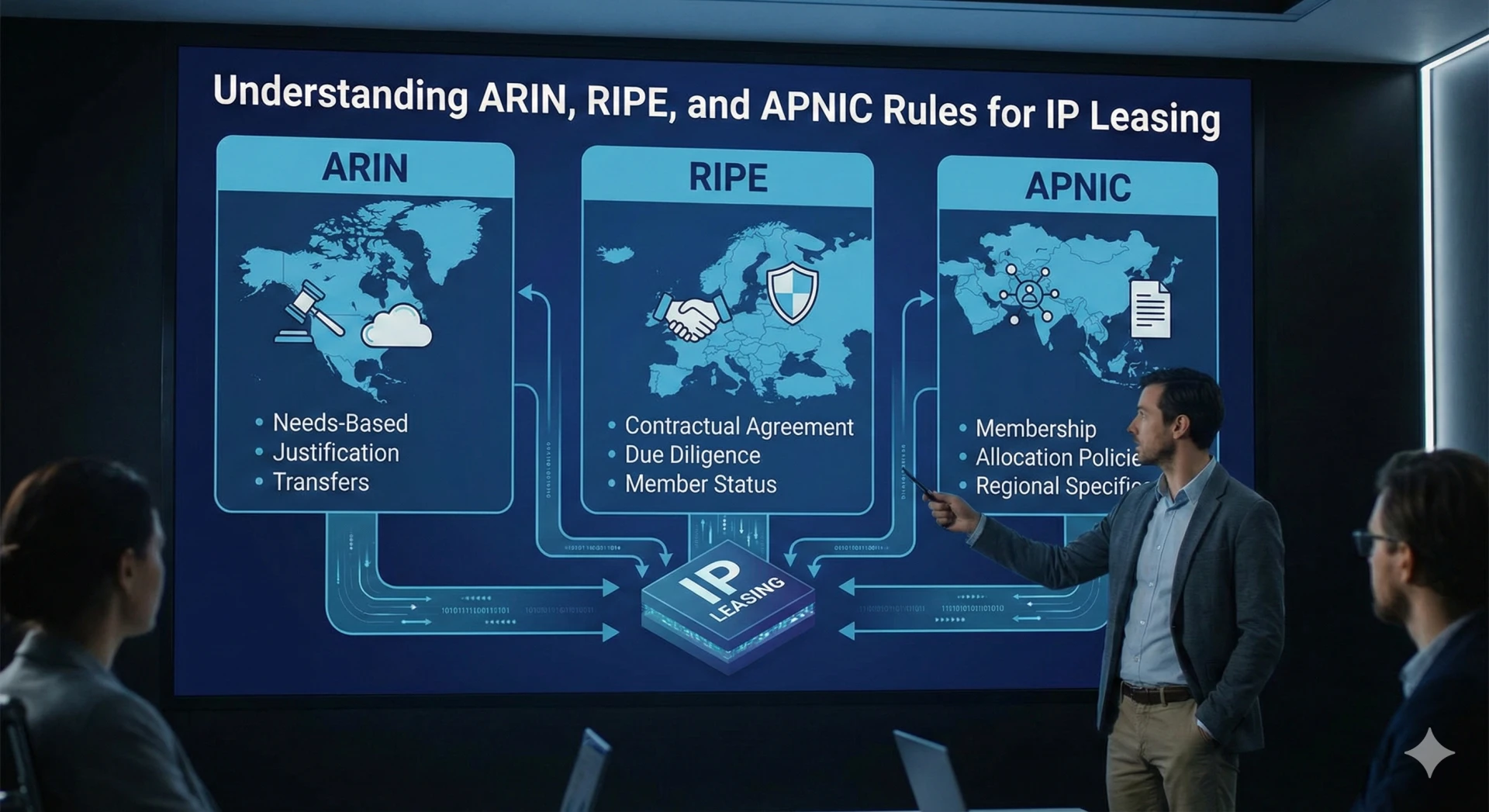

In today’s digital landscape, IP addresses are a critical resource for organizations of all sizes. As the internet continues to expand, companies often need additional IP addresses to support web services, cloud infrastructure, or virtual networks. One way to meet this demand is through IP leasing—a process where organizations temporarily acquire IP addresses from holders or brokers. However, leasing IP addresses is not a simple matter; it requires a careful understanding of the rules and regulations established by regional Internet registries (RIRs). The three major RIRs governing IP allocation and leasing are ARIN, RIPE, and APNIC.
ARIN (American Registry for Internet Numbers)
ARIN oversees IP address management for North America, parts of the Caribbean, and sub-Saharan Africa. The organization’s policies for IP leasing are designed to maintain accurate records and ensure efficient use of IP space. Under ARIN rules, IP leasing is generally permitted but must comply with documented agreements. Lessees must maintain registration information for each IP address and ensure that usage aligns with ARIN’s “Justification for Resources” policies.
One key ARIN requirement is that the primary holder of the IP block retains control and responsibility for the addresses. This means that any organization leasing IPs must work transparently with the original registrant. ARIN also expects that all IPs are returned or properly reassigned when the lease expires, preventing orphaned or untracked IP resources. Violating these policies can result in revocation of IP addresses or restrictions on future allocations.
RIPE NCC (Réseaux IP Européens Network Coordination Centre)
RIPE NCC manages IP resources for Europe, the Middle East, and parts of Central Asia. Compared to ARIN, RIPE’s approach to IP leasing is slightly more flexible, provided that transparency and proper registration are maintained. RIPE allows subleasing, but only if both parties—the lessor and the lessee—report the lease in the RIPE database.
RIPE emphasizes accurate and up-to-date registration data. Organizations leasing IP addresses must update the RIPE Whois database to reflect the current usage and contact information. Failure to maintain accurate records can lead to penalties or revocation of IP resources. Additionally, RIPE requires that any leased IP addresses be used in compliance with local policies regarding routing and abuse management. This ensures that IP leasing does not inadvertently facilitate spamming or other malicious activities.
APNIC (Asia Pacific Network Information Centre)
APNIC serves the Asia-Pacific region, including countries such as China, India, Australia, and Japan. APNIC’s rules for IP leasing are detailed and closely aligned with its “Resource Management Policies.” Organizations leasing IP addresses must ensure that the lessor maintains registration records in APNIC’s Whois database, and the lessee must be able to demonstrate legitimate use.
APNIC distinguishes between temporary and long-term leases. Temporary leases, often used for project-based deployments, require proper notification to APNIC, including the intended duration and scope of usage. Long-term leases must comply with APNIC’s justification requirements, ensuring that IP resources are not being hoarded or misused. Transparency, accountability, and adherence to APNIC policies are central to IP leasing compliance in this region.
Key Considerations Across RIRs
While ARIN, RIPE, and APNIC have regional differences, some common principles apply:
- Transparency: All IP leasing arrangements must be recorded and visible in the respective RIR database.
- Legitimate Use: IP addresses should only be used for genuine operational purposes, not for spam, fraud, or other abuses.
- Return or Reassignment: At the end of a lease, IP addresses must be properly returned or reassigned to avoid orphaned allocations.
- Coordination with the Original Holder: The primary registrant remains responsible for the IP block, ensuring compliance with RIR policies.
Understanding and adhering to these rules is critical for organizations looking to expand their network resources safely. IP leasing, when managed correctly, offers flexibility without violating regional internet governance standards. Organizations should consult with the relevant RIR and ensure proper documentation to maintain compliance and avoid potential penalties.






















Sign in to leave a comment.