
As IPv4 address availability continues to tighten globally, organizations that rely on stable internet connectivity face a critical decision: should they lease IPv4 addresses or buy them outright?
Both options are widely used in today’s secondary IPv4 market, but they serve different operational, financial, and risk profiles. Understanding the trade-offs between leasing and buying IPv4 addresses is essential for making a sustainable, compliant, and cost-effective decision.
This article compares cost, risk, and flexibility to help network operators, cloud providers, and enterprises choose the right approach.
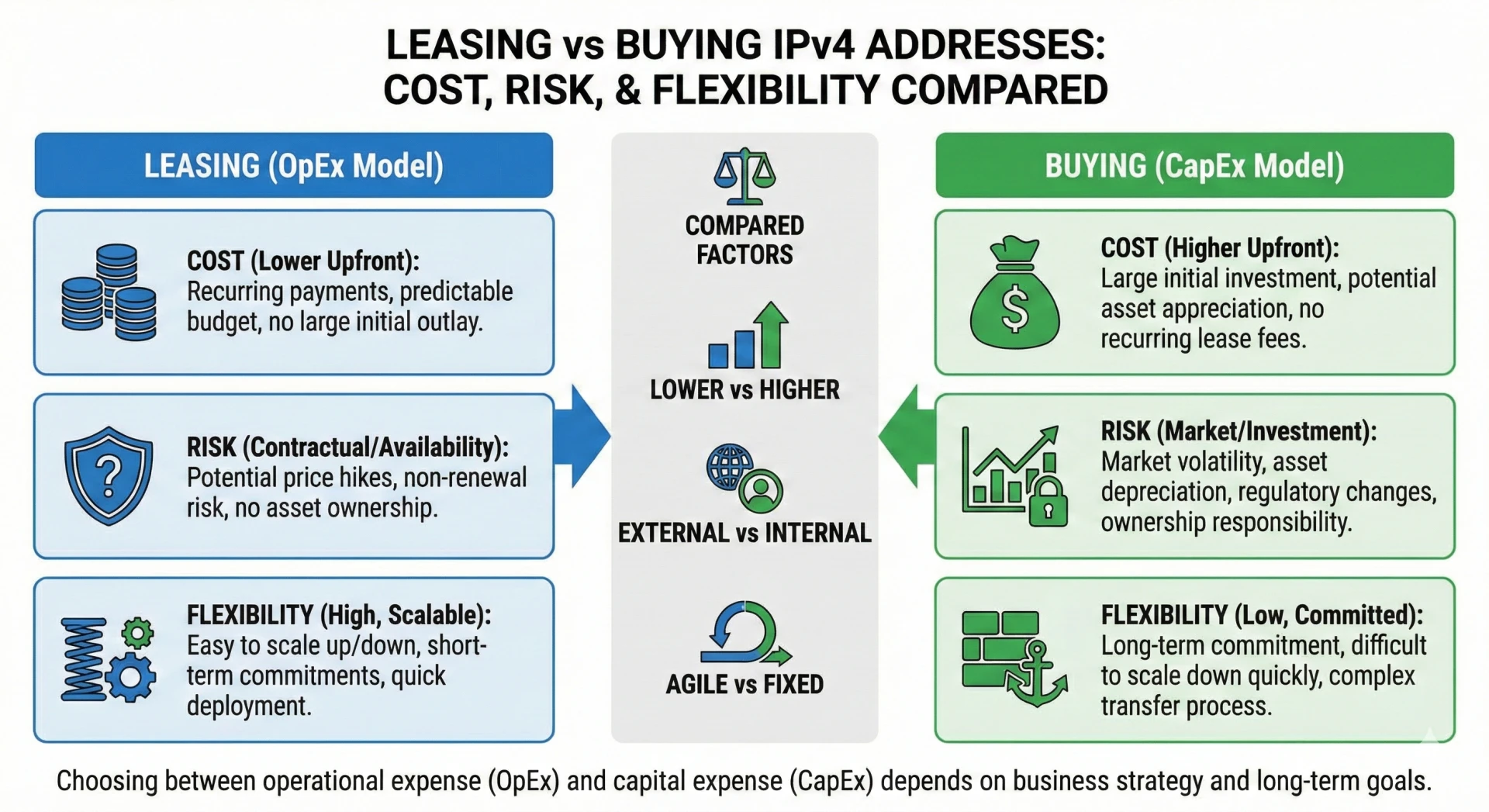
1. Cost Considerations: Upfront Capital vs Operating Expense
Buying IPv4 addresses typically requires a significant upfront investment. Prices in the secondary market vary by region, block size, and registry policy, but ownership often ties up capital that could otherwise be deployed for infrastructure, expansion, or R&D. From an accounting perspective, IPv4 purchases are usually treated as capital expenditures (CapEx).
Leasing IPv4 addresses, on the other hand, spreads costs over time. Leasing fees are generally predictable monthly or annual operating expenses (OpEx), which can be easier to budget and justify internally. For businesses with fluctuating demand or short-to-medium planning horizons, leasing can significantly reduce financial strain.
Key takeaway:
- Buying favors long-term stability and balance-sheet assets
- Leasing favors cash flow efficiency and financial flexibility
2. Risk Exposure: Ownership Does Not Mean Zero Risk
A common assumption is that owning IPv4 addresses eliminates risk. In reality, ownership comes with its own set of governance and compliance responsibilities.
When you buy IPv4 space, you assume:
- RIR policy compliance obligations
- Ongoing registry accuracy requirements
- Potential exposure to future policy changes (e.g. stricter usage justification or transfer rules)
- Reputation risk if address history includes abuse or poor routing hygiene
Leasing shifts much of this burden to the lessor. Reputable IPv4 leasing providers typically manage:
- RIR membership alignment
- Registration accuracy
- Routing legitimacy (RPKI, IRR, clean history)
That said, leasing introduces counterparty risk. Poorly structured leases or unreliable providers can lead to sudden withdrawal of address space, impacting services.
Key takeaway:
- Buying concentrates policy and governance risk on the owner
- Leasing reduces operational risk but requires careful provider selection
3. Flexibility: Scaling Up, Down, or Changing Strategy
Flexibility is where leasing clearly stands out.
Leased IPv4 addresses allow organizations to:
- Scale address usage up or down based on demand
- Enter new markets without permanent commitments
- Support temporary workloads, migrations, or peak traffic periods
- Transition toward IPv6 without locking in long-term IPv4 assets
Purchased IPv4 blocks are far less flexible. While they can be resold or leased out, transfers take time, involve regulatory processes, and may be affected by market conditions or policy constraints.
For fast-growing cloud platforms, hosting providers, or regional ISPs, this rigidity can become a bottleneck.
Key takeaway:
- Leasing supports agility and evolving network strategies
- Buying suits stable, predictable, long-term address requirements
4. Strategic Use Cases: When Leasing or Buying Makes Sense
Leasing is often preferred when:
- IPv4 demand is uncertain or seasonal
- The organization is IPv6-forward but still needs IPv4 compatibility
- Capital preservation is a priority
- Rapid deployment is required
Buying is often preferred when:
- IPv4 usage is stable and long-term
- The organization wants full control over address policy decisions
- IPv4 addresses are treated as strategic assets
- There is internal expertise to manage compliance and routing hygiene
Many mature operators adopt a hybrid approach, owning a core block while leasing additional space to handle growth or temporary demand.
Conclusion: There Is No One-Size-Fits-All Answer
The choice between leasing and buying IPv4 addresses is not purely financial. It is a balance of cost structure, risk tolerance, and operational flexibility.
Leasing offers agility, lower upfront cost, and reduced administrative burden. Buying offers long-term control and asset ownership but requires deeper policy awareness and capital commitment.
For most organizations operating in today’s constrained IPv4 environment, the optimal strategy is not “leasing vs buying,” but how to combine both intelligently to ensure continuity, compliance, and scalability.





























Sign in to leave a comment.