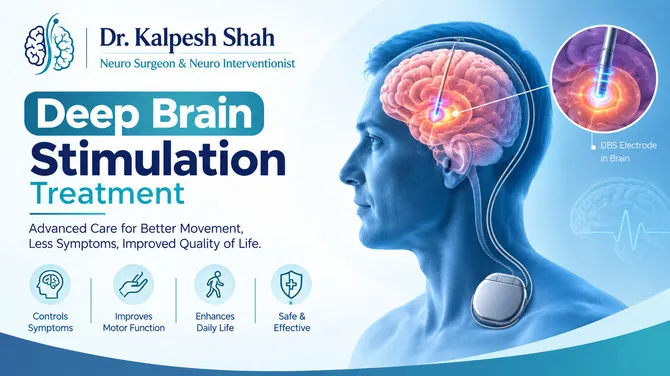

For patients living with Parkinson's disease, essential tremor, or dystonia, medication can only do so much before its effects start to fade or side effects become harder to manage. This is often the point where families start researching deep brain stimulation treatment in Ahmedabad, and one question comes up almost every time: is it actually safe to use for years, not just months?
Dr. Kalpesh Shah works closely with patients considering this therapy, helping them understand exactly what long-term use looks like before they make a decision.
What Causes Doctors to Recommend Deep Brain Stimulation?
Deep brain stimulation, often shortened to DBS, is typically considered when movement disorders no longer respond well enough to medication alone. It's not a first-line treatment — it's usually recommended when:
- Medication effects become unpredictable or wear off too quickly
- Side effects from higher medication doses become difficult to tolerate
- Tremors, stiffness, or involuntary movements significantly affect daily life
- Symptoms fluctuate sharply between "on" and "off" periods despite adjusted dosing
DBS works by delivering gentle electrical pulses through a thin electrode placed in a specific area of the brain, helping to regulate the abnormal signals that cause movement symptoms.
What Symptoms Improve With This Treatment?
Patients considering DBS often experience:
- Tremors that interfere with eating, writing, or daily tasks
- Muscle stiffness or rigidity
- Slowness of movement that worsens over time
- Involuntary muscle contractions, as seen in dystonia
- Motor fluctuations that medication can no longer smooth out
DBS doesn't cure the underlying condition, but for the right candidates, it can meaningfully reduce these symptoms and improve quality of life.
Who Is a Good Candidate for This Treatment?
- Patients with Parkinson's disease who still respond to medication but experience unpredictable fluctuations
- Individuals with essential tremor that hasn't improved with medication
- Patients with dystonia affecting daily function
- Those in generally good overall health, without certain unrelated conditions that raise surgical risk
- Patients who have realistic expectations about what DBS can and cannot achieve
A thorough evaluation, including detailed testing, helps determine whether someone is truly a good fit for this therapy.
Is Deep Brain Stimulation Safe for Long-Term Use?
This is the heart of the concern for most families, and the reassuring answer is that DBS has been used worldwide for decades, with a well-established long-term safety record for appropriately selected patients.
- The device itself is designed for years of continuous use, with batteries that are either replaced periodically or rechargeable
- Settings can be adjusted over time as symptoms or needs change, without further brain surgery
- Long-term studies show sustained benefit for many patients, particularly with tremor and stiffness
- Like any implanted device, it requires regular follow-up to monitor battery status and fine-tune settings
- Risks are generally low but are discussed individually, since every patient's situation differs
Ongoing communication with your treating specialist is what keeps long-term use both safe and effective.
What Does Recovery and Adjustment Look Like?
- Initial recovery after the procedure typically involves a short hospital stay and gradual return to normal activity
- Programming sessions in the weeks after surgery fine-tune the stimulation settings to each patient's needs
- Regular follow-ups ensure the device continues working as intended
- Patience during adjustment, as it can take a few sessions to find the ideal settings
- Continued medication, often at a reduced dose, alongside DBS in many cases
How Can Patients Get the Most Out of Long-Term DBS Therapy?
- Attend all scheduled follow-up and programming appointments
- Report any new or changing symptoms promptly
- Keep track of battery replacement schedules if using a non-rechargeable device
- Maintain overall health through regular exercise and a balanced diet
- Stay in close contact with your neurosurgical team for any concerns
A Reassuring Final Word
Deciding on deep brain stimulation is a significant step, and it's completely natural to want reassurance about its long-term safety. With decades of clinical use behind it and careful, ongoing follow-up care, DBS has helped many patients regain a level of daily function that once felt out of reach.
If you or a loved one is considering this option, Dr. Kalpesh Shah offers expert deep brain stimulation treatment in Ahmedabad to guide you through every step.
























Sign in to leave a comment.