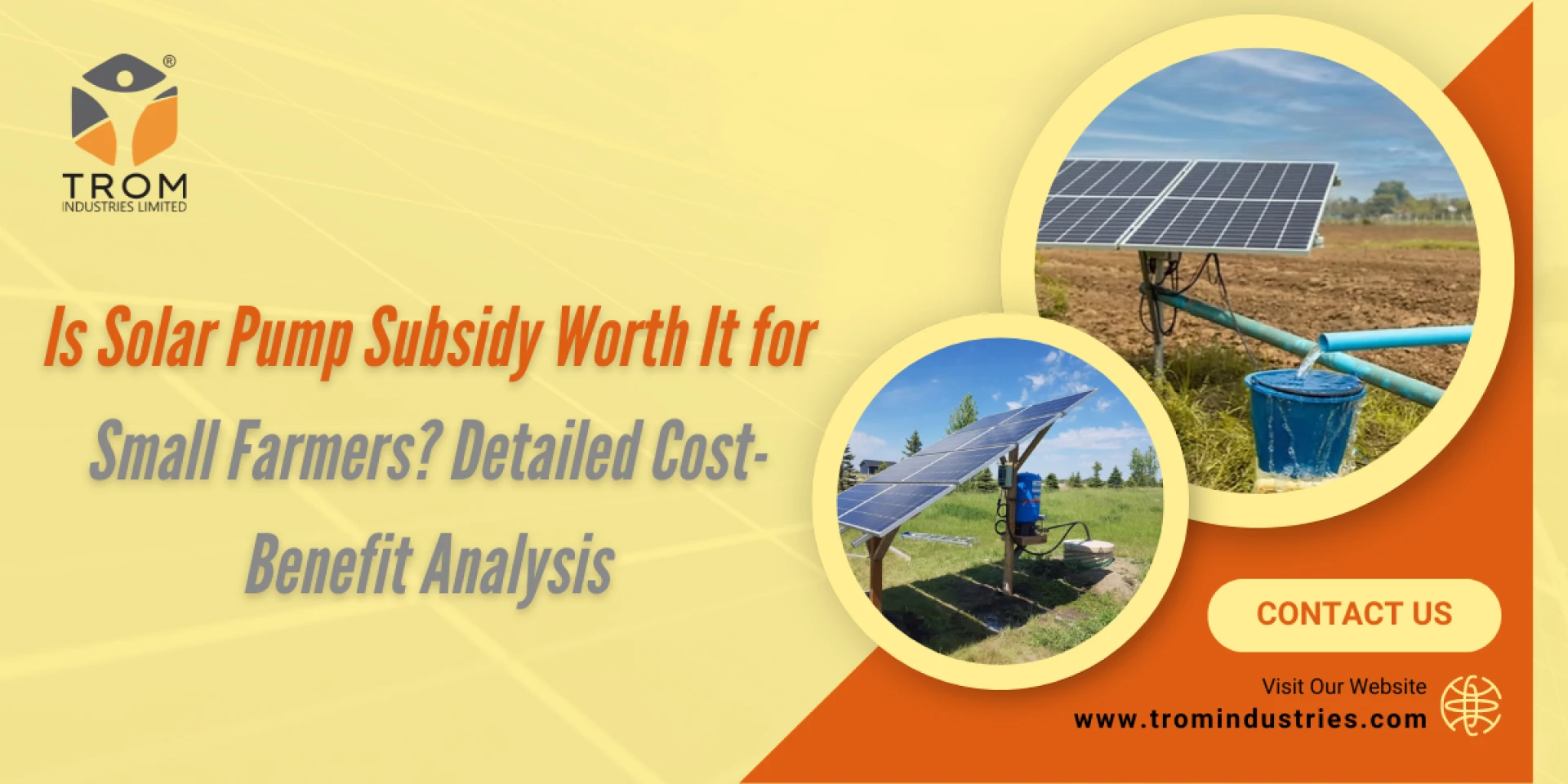

For many small farmers in India, electricity and diesel cost have become the biggest obstacles in running a profitable farm. Rising diesel prices, irregular electricity supply, and high maintenance charges often reduce their income significantly. This is where Solar Subsidy For Farmers comes into the picture—an opportunity to shift towards a clean, reliable, and cost-saving irrigation solution.
But a genuine question arises:
“Is a solar pump subsidy really worth it for small farmers?”
As Trom Industries Limited, one of India's leading solar EPC companies and trusted providers of high-efficiency Solar Water Pumps (1 HP to 5 HP), we work closely with farmers every day. We’ve seen how subsidies, solar technology, and long-term savings can transform a farmer’s livelihood.
This article breaks down the real numbers, benefits, and practical considerations in a simple, human-friendly way—so you can make the right decision.
Why Farmers Are Choosing Solar Pumps Over Diesel & Electric Pumps
Imagine this:
Rameshbhai, a small farmer from Gujarat, spent more than ₹1,20,000 each year just on diesel for irrigation. During summer, he waited long hours for electricity supply. Sometimes the electricity came at midnight; sometimes it didn’t come for two days.
Switching to a solar water pump changed his life completely.
This is the story of thousands of farmers across India who now prefer solar pumps because they are:
- Zero electricity bill
- Zero diesel cost
- Low maintenance
- Reliable even in remote areas
- Supported by government subsidy
With power becoming costlier and agriculture becoming unpredictable, farmers now look at solar energy as a long-term asset.
What Is Solar Subsidy For Farmers in India?
The Government of India is aggressively promoting clean energy through schemes like:
- PM Kusum Yojana
- State Solar Pump Subsidy Programs
- MNRE Solar Water Pump Subsidy
Under these schemes, farmers receive subsidies for installing solar pumps—making the total cost significantly lower.
Most states offer:
- 40% to 70% subsidy on solar water pumps
- Easy application process under government portals
- Support for both surface and submersible pumps
Because of these subsidies, a pump that costs ₹2,00,000 may cost only ₹60,000–₹1,00,000 to the farmer.
Cost Breakdown: Solar Pump With vs Without Subsidy
Let’s compare the real numbers.
➤ Case 1: Without Subsidy
A standard 3 HP solar pump (including panel + controller + sensors) costs:
| Item | Cost |
| Solar Pump (3 HP) | ₹2,00,000 – ₹2,50,000 |
| Installation + Wiring | ₹15,000 – ₹20,000 |
| Total | ₹2,20,000 – ₹2,70,000 |
➤ Case 2: With Solar Subsidy For Farmers
If the subsidy is 60%, your cost becomes:
| Cost Factor | Amount |
| Government Subsidy | 60% |
| Farmer Contribution | 40% (₹80,000 – ₹1,10,000) |
A ₹2.2 lakh pump becomes only ₹88,000 for the farmer.
🌟 Savings Compared
The farmer saves ₹1.3 lakh to ₹1.6 lakh upfront because of subsidy.
Yearly Savings for Small Farmers: Realistic Estimate
Let’s calculate annual savings for a small farmer using a solar pump:
1. Diesel Pump Replacement
- Average diesel cost per season: ₹90,000 – ₹1,20,000
- Maintenance: ₹10,000 annually
👉 Total Annual Saving = ₹1,00,000+
2. Electric Pump Replacement
- Electricity bill: ₹25,000 – ₹35,000
- Maintenance + motor repairs: ₹5,000 – ₹8,000
👉 Total Annual Saving = ₹30,000 – ₹45,000
3. Total Lifetime Saving (10+ years)
Solar pumps run for 15–20 years.
Lifetime saving can reach:
₹8 lakh – ₹12 lakh, depending on usage.
Is a Solar Pump Subsidy Worth It for Small Farmers? — Final Verdict
✔ Yes, because small farmers benefit the most.
Solar pumps eliminate:
- Diesel expenses
- Electricity bills
- Long waiting hours
- Repair costs
- Irrigation delays
And with subsidies reducing the investment by more than 50%, the payback period becomes very short.
Simple Example:
If you spend ₹90,000 on a subsidized solar pump and save ₹1,00,000 every year…
👉 Your payback period is less than 1 year.
After that, all savings go directly into your pocket.
Why Trom Industries Limited Is the Best Choice for Solar Water Pumps
At Trom Industries Limited, we are not just selling solar products—we are helping farmers transition to smarter, cleaner irrigation systems.
What Makes Our Solar Water Pumps Unique?
✔ Efficiency 3× higher than traditional pumps
✔ Available in 1 HP to 5 HP
✔ Equipped with upper and lower water sensors
✔ Long lifespan with minimal maintenance
✔ Reliable even in remote agricultural fields
✔ Pocket-friendly pricing
✔ Supports agricultural irrigation, desertification treatment, grassland restoration, and land salinization control
✔ Environment-friendly with zero carbon emissions
Our pumps are carefully engineered by experienced solar EPC professionals and backed by end-to-end support—from design to installation and servicing.
Government Support Makes It Even Better
Most state governments actively promote:
- Solar Pumping System Subsidy
- PM Kusum Solar Pump Yojana
- On-grid and off-grid solar installation
- Solar solutions for irrigation and drinking water
This support ensures farmers get high-quality systems with financial benefits.
Conclusion:
For small farmers, irrigation should not be a burden—it should be a tool for growth. With rising fuel costs and inconsistent electricity supply, solar pumps supported by government subsidies offer a permanent solution in Trom industries.




























Sign in to leave a comment.