
Introduction: Why Solar Subsidy Matters in India
India is rapidly moving towards a clean energy future, and solar power stands at the heart of this transformation. The government has launched Central Solar Subsidy schemes to make solar panels more affordable for residential, commercial, and industrial users. These subsidies not only reduce the upfront installation costs but also encourage wider adoption of renewable energy.
At Trom Industries Limited, we believe solar energy should be accessible to everyone—homeowners, businesses, and industries alike. With government-backed solar industry subsidies, investing in solar power has never been more cost-effective.
What is Central Solar Subsidy?
The Central Solar Subsidy is a financial incentive provided by the Government of India to promote solar power adoption across sectors. Under this scheme, eligible users can get a percentage of their installation cost reimbursed, significantly lowering their expenses.
For example:
- A homeowner installing a 3kW rooftop solar system can get up to 40% subsidy under the PM Surya Ghar Muft Bijli Yojana.
- Commercial and industrial users benefit through accelerated depreciation, tax rebates, and solar subsidy for commercial projects, making large-scale adoption profitable.
This initiative is part of India’s commitment to achieving 500 GW renewable energy capacity by 2030.
Benefits of Central Solar Subsidy
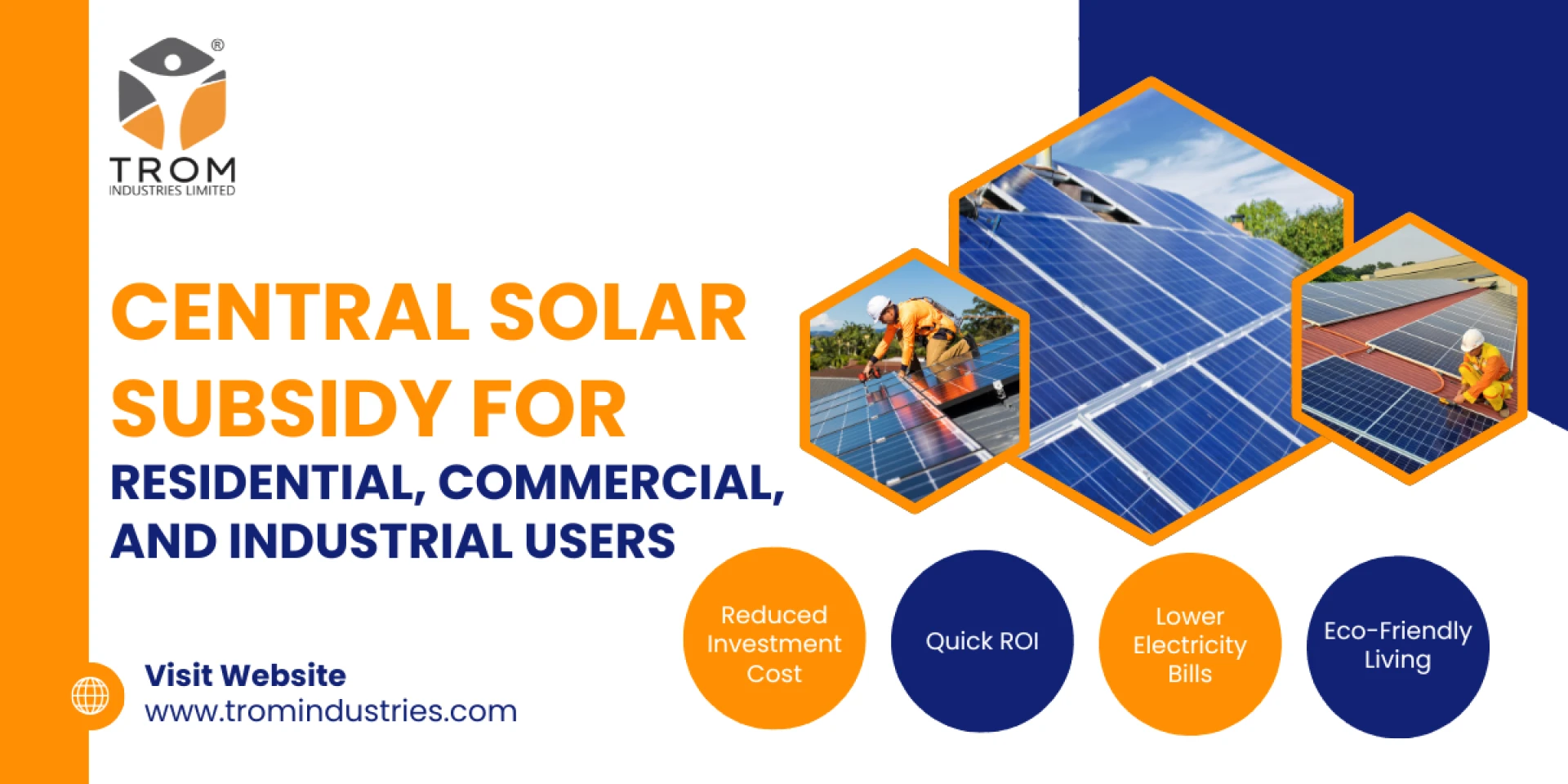
- Reduced Investment Cost – Subsidies make solar more affordable for families, businesses, and industries.
- Quick ROI – With subsidies, the payback period reduces drastically. Residential users often recover their investment in 3–4 years.
- Lower Electricity Bills – Solar panels cut dependence on costly grid power.
- Eco-Friendly Living – Switching to solar helps reduce carbon footprint.
- Nationwide Adoption – From solar subsidy for commercial projects to household rooftop panels, subsidies are driving adoption across India.
Central Solar Subsidy for Residential Users
Residential users are the biggest beneficiaries of solar subsidies. The government is actively encouraging homeowners to install rooftop solar systems by covering a large portion of installation costs.
Example: Under the PM Surya Ghar Yojana, homeowners can get subsidies ranging from ₹18,000 to ₹78,000 depending on system capacity.
With this, a middle-class household can enjoy free electricity of up to 300 units per month, making solar not just sustainable but also financially rewarding.
Central Solar Subsidy for Commercial Users
For businesses, energy costs often eat into profits. Here’s where solar subsidy for commercial projects comes into play. While residential subsidies are straightforward, commercial establishments get benefits through:
- Capital Subsidies (State-Level Schemes) – Some states like Gujarat and Maharashtra provide additional financial aid.
- Accelerated Depreciation (AD) – Businesses can write off up to 40% of solar investment costs under tax benefits.
- GST Benefits & Net Metering – Reduces effective cost and improves savings.
Example: A small factory installing a 100kW solar system can recover costs in less than 4 years with subsidies and savings.
Central Solar Subsidy for Industrial Users
Industrial users, who consume the most electricity, benefit enormously from solar. While direct subsidy for very large-scale industrial projects may be limited, the government encourages industries through:
- Renewable Energy Certificates (RECs)
- Capital Subsidy in Specific States
- Tax Rebates & Exemptions
- Green Energy Open Access Policy 2022
With solar industry subsidies and policies, large industries reduce costs, achieve sustainability targets, and improve brand image.
State vs Central Subsidies – What’s the Difference?
- Central Solar Subsidy: Managed by the Ministry of New and Renewable Energy (MNRE), applicable across India.
- State Subsidy Programs: Many states run their own solar yojana schemes, which can be combined with central subsidies.
For example:
- Gujarat offers additional support on rooftop solar.
- Rajasthan provides state-level incentives for rural adoption.
This dual benefit makes solar highly affordable across India.
The Hidden Advantage: Net Metering
Alongside subsidies, the net metering system allows users to sell excess electricity generated by solar panels back to the grid.
- Residential Users: Can offset electricity bills to almost zero.
- Commercial & Industrial Users: Generate surplus power during non-peak hours and sell it, creating an additional revenue stream.
This, combined with solar subsidy, makes solar one of the smartest investments today.
Why Choose Trom Industries Limited?
At Trom Industries Limited, we specialize in delivering turnkey solar solutions. Whether you are a homeowner, a shop owner, or a large factory, we guide you through every step of the solar subsidy process.
Our expertise includes:
- Helping you apply for Central Solar Subsidy schemes
- Designing customized solar systems for residential, commercial, and industrial use
- Offering end-to-end EPC services (design, installation, and maintenance)
- Ensuring maximum savings through subsidies, net metering, and tax benefits
We are not just solar installers—we are partners in your clean energy journey.
Conclusion: Solar Subsidy is the Key to a Brighter Future
The Central Solar Subsidy has transformed the way India looks at renewable energy. Whether it’s a small household saving on monthly bills or a large industry cutting energy costs, subsidies make solar affordable and practical.
At Trom Industries Limited, we believe in making this journey smooth for every user. With solar industry subsidies supporting the growth of clean energy, now is the perfect time to switch to solar and enjoy long-term savings with zero environmental guilt.


























Sign in to leave a comment.