
Most people never think about elastic. It does its job quietly — stretching, holding, snapping back — and nobody notices it until it fails. But spend a little time in the world of textiles and garment manufacturing, and you quickly realise that not all elastic is the same. And among the many types available today, jacquard elastic stands in a category of its own.
It is not just functional. It is designed. It is finished. It tells you something about the product it is part of — and about the brand that chose to use it.
If you work in garment manufacturing, lingerie, sportswear, accessories, or any kind of textile production, understanding jacquard elastic properly can help you make better sourcing decisions, better product decisions, and ultimately better products.
This article walks you through everything — what jacquard elastic is, how it is made, where it is used, what to look for when buying it, and why the quality of your elastic supplier matters more than most people realise.
What Is Jacquard Elastic?
Let's start from the beginning.
Elastic, in its most basic form, is a woven or knitted fabric with rubber or spandex threads running through it. These threads give the material its stretch. When you pull it, it extends. When you let go, it returns to its original shape.
Standard elastic is plain — uniform in colour, flat in texture, unremarkable to look at. It works, but it adds nothing to the visual quality of a garment.
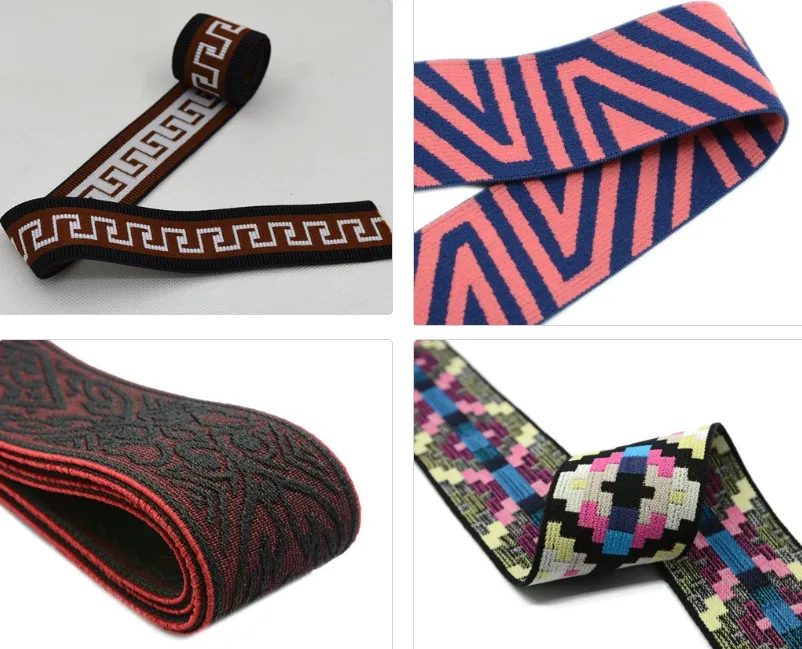
Jacquard elastic is different. It is produced on a jacquard loom — a specialised weaving machine that controls individual threads independently to create complex patterns and designs directly within the fabric structure. The result is an elastic band that has a pattern, a texture, or a design woven into it — not printed on top, not embroidered afterward, but actually built into the weave itself.
This makes jacquard elastic more durable than printed alternatives, because the design cannot peel, fade, or crack. It also makes it more refined, because woven patterns have a depth and precision that surface printing cannot replicate.
When you see an elastic waistband on a pair of premium underwear with the brand name woven into it, or a sports bra with a decorative patterned band at the hem, or a high-end swimwear piece with an intricate border elastic — that is almost certainly jacquard elastic.
How Elastic Jacquard Is Made
Understanding the production process helps you understand why quality varies between manufacturers — and why it matters.
Jacquard elastic begins like any elastic — with a combination of base yarns (polyester, nylon, or cotton) and elastic threads (rubber or spandex). These are fed into a jacquard loom, which is controlled by a digital program or — in older machines — a punched card system that tells each individual needle what to do.
The loom weaves the base fabric and the pattern simultaneously. This is what makes jacquard weaving technically demanding: the machine must maintain consistent tension across hundreds of individual threads while executing complex pattern commands, all while the elastic threads are being incorporated to maintain stretch.
The result, when done correctly, is a finished elastic band with:
- A crisp, precise pattern that holds its shape over time
- Consistent stretch and recovery along the entire length
- Uniform width and edge finish
- Colourfastness that resists washing and wear
When done poorly — with inferior machinery, wrong yarn tensions, or low-quality elastic threads — you get a product that looks acceptable in the packet but disappoints in use: patterns that blur, edges that fray, stretch that weakens after washing, or width that varies along the roll.
This is why the manufacturer behind the elastic matters as much as the design on it.
Where Jacquard Elastic Is Used
The applications are broader than most people expect. Once you start noticing jacquard elastic, you see it everywhere.
Lingerie and Innerwear This is the most visible application. Premium bra straps, waistbands on briefs and boxer shorts, edge trims on bodices — jacquard elastic is the standard in mid-to-high-end lingerie manufacturing. The branded waistband on a quality pair of underwear is almost always a jacquard woven piece with the brand name or logo built into the pattern.
Sportswear and Activewear Sports bras, compression shorts, leggings, and athletic wear use jacquard elastic both functionally and decoratively. The elastic needs to perform under physical stress — stretch without distorting, recover without sagging — while also contributing to the overall design of the garment.
Swimwear Swimwear elastic must resist chlorine, saltwater, and repeated wetting and drying. Jacquard elastic used in swimwear is typically manufactured with chlorine-resistant yarns, and the woven pattern adds a premium finish to the edges and straps.
Children's Clothing Waistbands in children's trousers, shorts, and skirts frequently use patterned elastic — fun prints or soft textures that make the garment more appealing while maintaining the comfort that children's wear requires.
Accessories and Fashion Hair bands, headbands, bag straps, belts, and decorative trims in fashion garments all use jacquard elastic for its aesthetic quality. A well-designed elastic band can be as much a design element as any fabric or trim.
Medical and Orthopaedic Products Some medical support garments, bandages, and orthopaedic braces use jacquard elastic for its precise stretch control and durability. In these applications, consistency is critical — the elastic must perform the same way every time.
What to Look for When Buying Jacquard Elastic
Whether you are buying for a small production run or sourcing at scale, the same quality markers apply.
Pattern clarity Hold the elastic up and look at the design closely. The lines should be sharp, the repeats should be consistent, and the colours should be even across the width of the band. Blurry or uneven patterns suggest poor loom calibration or inferior yarn.
Stretch and recovery Stretch the elastic to about twice its resting length and release it. It should snap back cleanly and completely without any bagging or looseness. Do this several times. If the elastic feels weak or sluggish in recovery, it will behave the same way in a garment — especially after washing.
Edge finish The edges of jacquard elastic should be cleanly finished — no fraying, no loose threads, no uneven trimming. Clean edges mean quality weaving and proper finishing.
Colourfastness Rub the elastic firmly against a white cloth or tissue. If colour transfers significantly, the dyes are not properly fixed and will bleed onto garments or skin during wear or washing.
Width consistency Unroll a length of elastic and check that the width stays uniform. Variation in width across a roll suggests inconsistent tension during weaving — a manufacturing quality problem that will cause headaches during garment production.
Wash performance If possible, wash a sample before committing to a large order. Good jacquard elastic retains its pattern, width, and stretch performance after repeated washing. Inferior elastic loses shape, colour, or recovery within a few cycles.
Why the Right Supplier Changes Everything
In textile manufacturing, the quality of your raw materials is the ceiling of your product's quality. You cannot make a premium garment with inferior components — and elastic is one of those components that affects both how a garment looks and how it performs in daily use.
Working with a reliable jacquard elastic supplier means consistent quality batch to batch, accurate lead times, flexibility in custom pattern development, and someone who understands your production requirements rather than just taking your order.
Jai Roop Textile Pvt. Ltd. has built its reputation in exactly this space — manufacturing jacquard elastic that meets the demands of serious garment producers. With a range covering multiple widths, colours, and pattern complexities, and the technical capability to develop custom designs, they serve manufacturers who understand that the details in a product are what separate good from great.
Custom Jacquard Elastic: When Standard Isn't Enough
Many brands — especially in lingerie, premium sportswear, and fashion accessories — want their own logo, pattern, or signature design woven into their elastic. This is custom jacquard elastic, and it is more accessible than most small and mid-sized manufacturers realise.
Custom elastic requires a minimum order quantity (typically between 500 to 2000 metres depending on the supplier), a design file, and a few weeks for sampling and approval. Once the sample is confirmed, production runs are consistent and repeatable.
For brands building a recognisable identity, a custom woven waistband is one of the most cost-effective branding investments available. It adds a premium feel without a premium price increase — and it is visible every time a customer wears the product.
Final Thoughts
Jacquard elastic is one of those details that most end consumers never consciously notice — but always subconsciously feel. It is the difference between a waistband that looks finished and one that looks afterthought. Between a garment that feels premium and one that just feels functional.
For manufacturers, designers, and brands that care about the quality of what they make, elastic jacquard is not a minor decision. It is part of the signature of your product. Choose it carefully, source it from people who make it well, and it will quietly elevate everything it touches.


























Sign in to leave a comment.