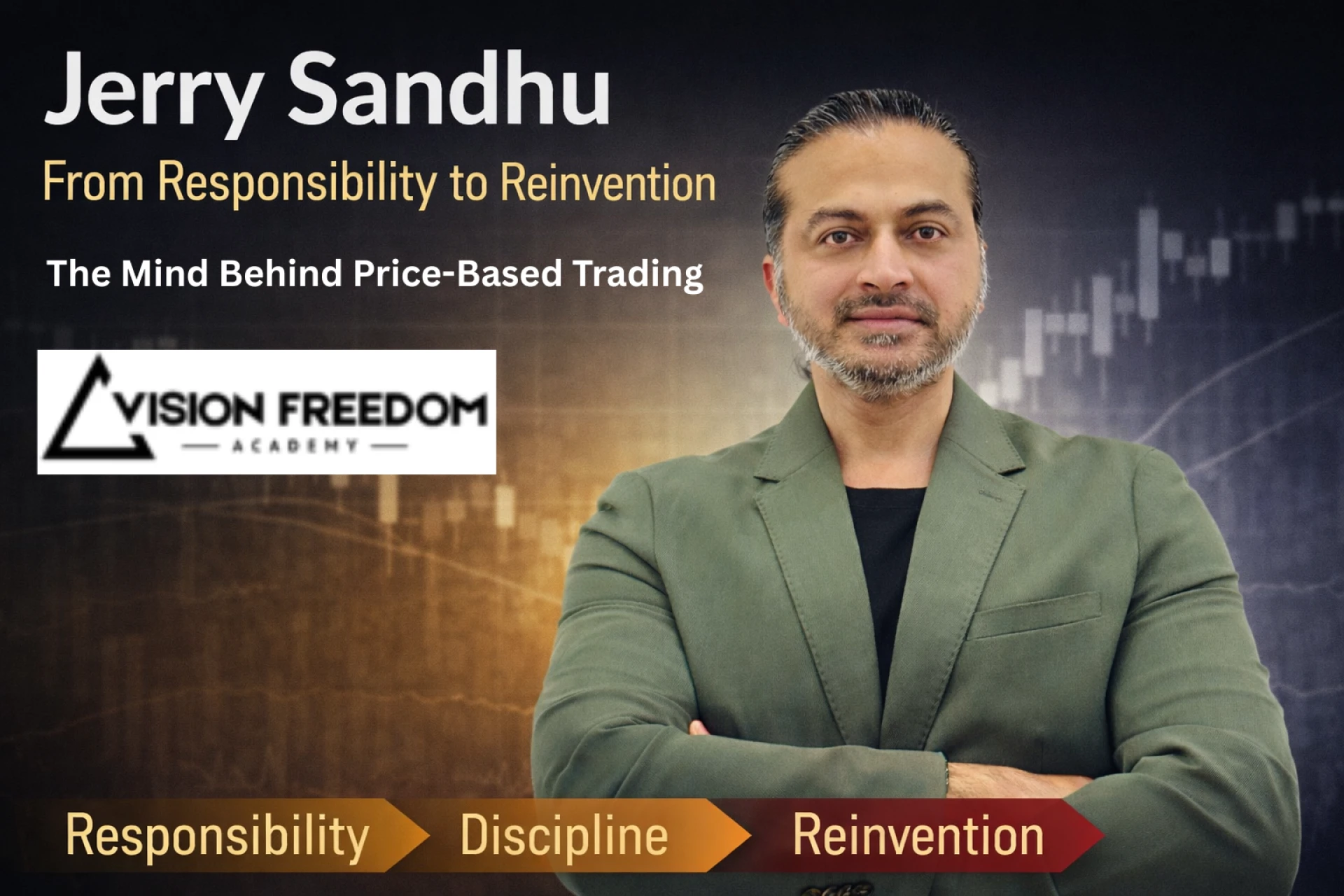

Ambition is the starting point for most stories in the trade industry. Few people start with accountability. Because Jerry Sandhu's journey was based on accountability, pressure, and the need to think clearly under uncertainty rather than markets, it stood out. Long before Vision Freedom Academy came to be linked with price-based trading instruction and institutional-style thinking, his career was molded by a mindset that valued comprehension over prediction and structure over excitement.
This distinction matters, because the philosophy he later developed did not come from theory it came from life experience.
Early Mindset: Discipline Before Trading
Many traders search for strategies.
Jerry searched for reasoning.
Before entering trading education, his approach toward decision-making was rooted in observing consequences. Responsibility forced him to evaluate risk carefully rather than emotionally. Instead of reacting quickly, he learned to pause, assess, and act with intention a habit that would later define his teaching methodology.
He realized something fundamental:
Chaos outside requires clarity inside.
This perspective became the foundation of his professional outlook. Where others sought opportunity, he first sought stability. Where others chased speed, he emphasized control.
That mindset later translated perfectly into financial markets environments defined by uncertainty, pressure, and constant noise.
Discovering the Problem in Trading Education
When Jerry began studying markets deeply, he noticed a pattern:
- Traders depended on indicators
- Systems relied on predictions
- Education emphasized outcomes instead of behavior
The result was predictable inconsistency.
Rather than blaming traders, he questioned the structure of learning itself. Why did people understand concepts but fail in execution? Why did profitable strategies collapse under emotional pressure?
His conclusion was simple but powerful:
Most trading failures are not technical they are cognitive.
This insight shifted his focus away from strategy development toward decision-making behavior.
The Birth of Price-Based Thinking
Instead of building another strategy, Jerry centered his work around the only element markets cannot manipulate:
Price itself.
He argued that charts are not random visuals but reflections of intent expressions of participation, liquidity, and pressure between buyers and sellers.
From this perspective:
- Indicators interpret price
- Predictions assume price
- But professionals read price
That distinction became the philosophical backbone of his teaching.
Rather than asking “Where will the market go?”
He taught traders to ask “What is the market doing right now?”
This shift replaced anticipation with observation and observation with execution.
Reinvention: From Trader to Educator
Over time, his role evolved.
He moved from practitioner to mentor, and eventually to institutional educator.
Through Vision Freedom Academy, he began structuring learning into progressive stages. The goal was not just teaching trades but shaping decision-makers capable of operating independently.
The focus changed from:
| Traditional Approach | Sandhu’s Approach |
| Strategy first | Understanding first |
| Profit focus | Process focus |
| Prediction | Reaction |
| Motivation | Discipline |
He believed traders fail because they try to control markets instead of controlling themselves.
So the training emphasized behavioral mastery patience, risk alignment, emotional neutrality, and consistency.
Trading as a Psychological Discipline
One of Jerry Sandhu’s defining beliefs is that trading success is a personal transformation before it is a financial achievement.
He emphasized three principles:
1. Stability Over Excitement
Profits built on adrenaline collapse under pressure. Stability builds longevity.
2. Process Over Outcome
A good trade can lose. A bad trade can win. Only process determines survival.
3. Identity Over Strategy
A trader’s behavior determines performance more than the system used.
Under this framework, students were not trained to predict markets but to operate professionally within them.
Leadership Through Structure
As his influence grew, Jerry focused on building a structured ecosystem rather than personality-driven mentorship.
The aim was sustainability.
Instead of creating followers, the system aimed to produce independent thinkers traders capable of making decisions without dependence on signals or external opinions.
The academy’s philosophy reflected this:
Education should remove dependency, not create it.
This institutional mindset distinguished his work from conventional trading courses, which often rely on constant guidance.
A Philosophy Rooted in Responsibility
At its core, Jerry Sandhu’s journey is less about markets and more about thinking.
His transformation from responsibility-driven individual to educator mirrors the philosophy he teaches clarity emerges when noise is removed.
He did not attempt to simplify markets artificially.
He simplified the trader’s perception.
And in doing so, he reframed trading:
- Not as a gamble
- Not as a prediction game
- But as a structured decision process under uncertainty
Conclusion
Jerry Sandhu’s story is ultimately about reinvention not of career, but of perspective.
He didn’t create a method to beat the market.
He created a framework to understand it.
By shifting attention from signals to behavior and from prediction to observation, his work emphasizes professional thinking over emotional reaction.
In an industry filled with promises of fast profits, his philosophy stands on a quieter principle:
Consistency is not achieved by knowing more it is achieved by reacting better.
If you wanna read more about the full feature coverage and detailed insights, Go through this Article: “Jerry Sandhu: From Responsibility to Reinvention The Mind Behind Price-Based Trading”
And that idea continues to influence traders seeking clarity in one of the world’s most uncertain environments.






























Sign in to leave a comment.