
The edible oils market will show a volume growth of 5.1% in 2024 and reach over 7.26 billion kilograms by 2027 in India. It is because India will become the most populated country in 2023, with an expected edible oil average volume per person of 4.47 kg in the same year. Hence, with such huge consumption, the need for refining edible oil has become important in India. Deodorization of oil is vital to refining to remove the odoriferous compounds present after neutralization and bleaching processes. There are many deodorization processes to remove any impurities that cause bad odour, like a deodorant spray used to overcome the bad smell in a room.
Hence, this article will discuss the many steps in the deodorization process using a stripping like steam at high temperature in a high vacuum to purify the edible oil to be suitable for consumption.
What is the deodorization process?
People use many deodorizers daily, like arms spray, to reduce sweat and other smells from armpits or room sprays, bathroom sprays and others. Hence deodorizers spraying a strong smell will replace the bad odour with lasting for a specific time. It is the same principle applied to the deodorization process for edible oils. Even after neutralization and bleaching, the refined oil has impurities like odoriferous compounds. And it is the deodorization of oil that could remove such compounds that could affect the flavour, odour, colour, and stability of the edible oil to be suitable for commercial distribution and consumption.
A deodorization process is a form of steam distillation to remove FFA, free fatty acids, and other volatile compounds remaining in the crude oil after neutralization and bleaching. It includes passing a specific amount of stripping agent like steam at a high temperature above 200 C under a high vacuum. Many deodorizing machines like continuous deodorizers for removing FFAs, packed column deodorizers to remove the impurities using physical processes, and semi-continuous deodorizers for removing specialty fats.
What is a continuous deodorizer for high FFA oils?
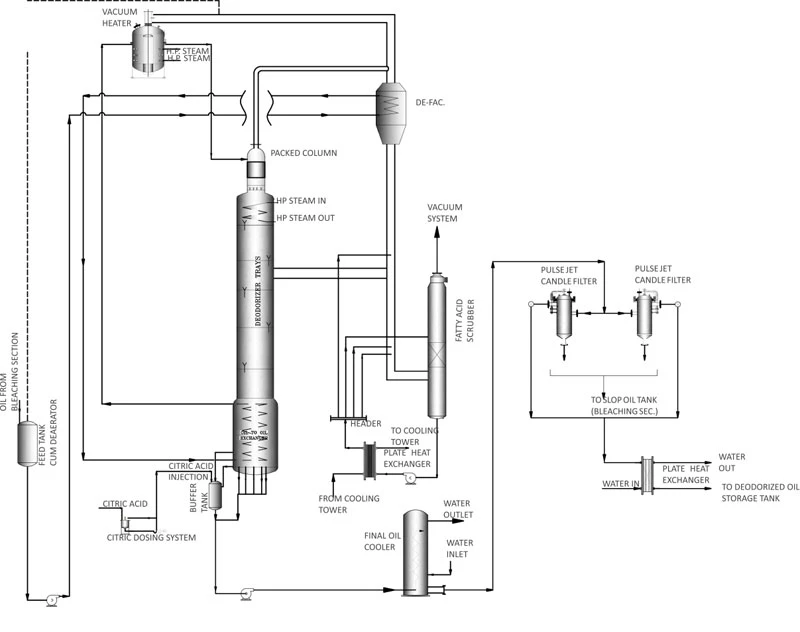
Pre-treated and bleached edible oils have FFAs of free fatty acids to spoil the end product's odour, colour, and stability. Hence the deodorization process is essential to remove them to become ready for commercial packaging with long shelf life. It is here that the reputed manufacturers offer multi-compartment vacuum heaters or deodorizer machines to remove odoriferous impurities in the following steps.
First is the heating of the bleached oil at the required temperature in a multi-compartment vacuum heater with high-pressure steam or thermic fluid.
Pre-heating should be systematic and gradual for the oil to encounter the sparging system to expose it to a vacuum at the free surface.
Provide packed columns with large surface parking areas on the deodorized top to reduce FFAs to the required levels.
Avoids loss of heat because of fatty acids' evaporation by providing an additional top heating tray below the packed column
The deodorization process forms many bubbles with 5 to 10 diameters to burst and discharges the water vapor to get collected by the stripping tray to remove the FFAs and odoriferous compounds.
What is a semi-continuous deodorizer for specialty fats?
The continuous deodorizer with a packed column removes the various volatile components by applying a specific quantity of stripping agent, mostly steam, for a given time. But the semi-continuous deodorizer is heat recovered from the hot oil after the bleaching process by thermos siphon arrangement. It is done by changing the feed oil of the existing oil at regular short intervals without mixing new feed oil under deodorization.
Mectech, the pioneer in oil refining in India, offers the best equipment for continuous deodorizing of oil to save costs by reducing the consumption of heat energy and no carryover of the fatty acid scrubbing condenser and with specially defined heating coils to prevent oil charring during deodorization process.



























Sign in to leave a comment.