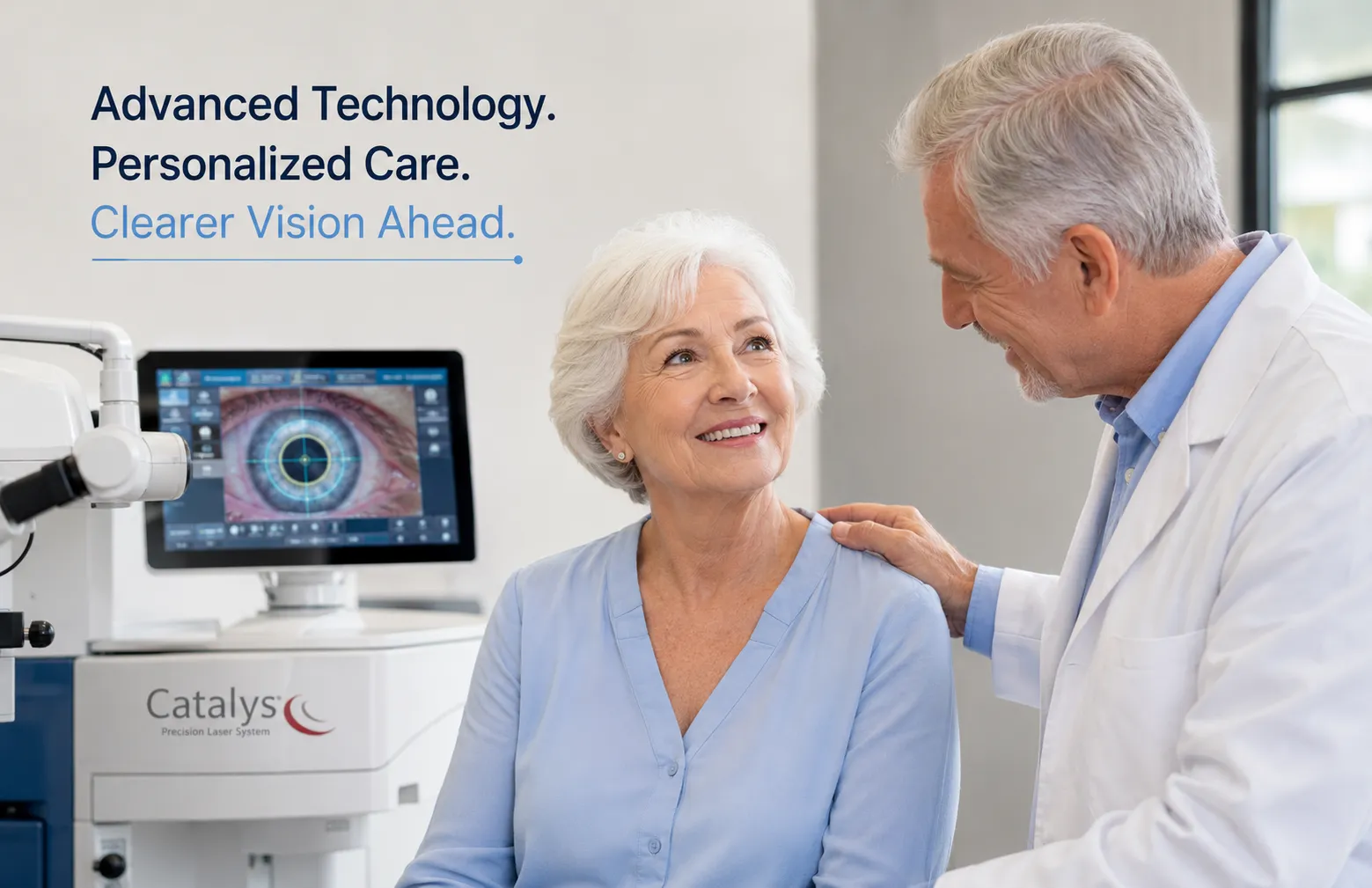

Cataracts can make everyday tasks harder. Reading a menu, driving at night, recognizing faces, or enjoying a walk can become frustrating as the eye’s natural lens becomes cloudy. For many older adults, cataract surgery can restore clearer vision and make daily activities easier.
Today, patients may hear about laser cataract removal as an alternative to traditional cataract surgery. While both approaches remove the cloudy lens and replace it with an artificial intraocular lens, laser-assisted surgery uses a femtosecond laser to perform some of the early surgical steps with computer-guided precision.
The important question is not simply whether laser surgery is newer. It is whether its specific advantages make sense for your eyes, vision goals, and cataract.
How Does Laser Cataract Surgery Differ From Traditional Surgery?
The main difference is how certain steps of the procedure are performed.
Traditional cataract surgery, usually called phacoemulsification, uses a small incision and an ultrasound instrument to break up the cloudy lens. The surgeon then removes the fragments and places an artificial lens inside the eye. It is a well-established procedure with a strong safety record.
Laser-assisted surgery uses a femtosecond laser for selected steps. These can include creating corneal incisions, opening the lens capsule, and softening or fragmenting the cataract before the surgeon completes the removal.
| Feature | Laser-Assisted Surgery | Traditional Cataract Surgery |
|---|---|---|
| Corneal incision | Created with a femtosecond laser | Created manually |
| Lens fragmentation | Laser can soften or fragment the cataract | Primarily uses ultrasound |
| Astigmatism management | Laser can create precise arcuate incisions | Can use manual techniques or other methods |
| Capsulotomy | Computer-guided laser | Surgeon-created opening |
| Surgeon involvement | Laser assists selected steps; surgeon completes surgery | Surgeon performs the surgical steps manually |
| Overall safety | Comparable in routine cases | Established safety record |
The laser does not replace the surgeon. It is a tool that can assist with specific parts of the operation.
What Advantages Can Laser Cataract Removal Offer Older Adults?
For some older adults, the value of laser-assisted surgery comes from precision rather than simply using newer technology.
Can laser technology improve surgical precision?
Yes, in selected steps. The femtosecond laser can create highly precise tissue planes and repeatable incisions. It can also create a consistently sized and positioned opening in the lens capsule.
This precision may be useful when lens positioning and centration are especially important. It can also help with certain types of astigmatism correction.
For an older adult who already has astigmatism or is considering an advanced-technology intraocular lens, these details may matter during surgical planning.
Can laser treatment reduce the amount of ultrasound energy?
One potential advantage is that the laser can soften or fragment the cataract before the surgeon removes it. This may reduce the amount of ultrasound energy needed during the procedure.
That can be particularly relevant when the cataract is dense or when the cornea needs extra consideration. Johns Hopkins notes that laser softening may reduce ultrasound energy and potentially lessen corneal swelling and inflammation.
Pro Tip: Ask your surgeon whether the density of your cataract or the condition of your cornea makes reduced ultrasound energy clinically useful in your particular case.
Can laser surgery help manage astigmatism?
It can, in appropriate patients. The femtosecond laser may create precise arcuate or relaxing incisions designed to reduce certain levels of corneal astigmatism.
This can be helpful when the goal is to improve the quality of vision after cataract removal. However, laser treatment does not guarantee that all astigmatism will disappear. The amount and type of astigmatism, corneal shape, and chosen lens all affect the result.
Is Laser Cataract Surgery in SC a Better Choice for Every Older Adult?
No. This is one of the most important points to understand.
Recent evidence does not show that femtosecond laser-assisted cataract surgery is automatically safer or produces better long-term vision than well-performed conventional cataract surgery. A 2025 meta-analysis of 46 randomized controlled trials involving 8,871 eyes found no significant difference in overall complications or most longer-term visual outcomes.
So, the right question is not simply, “Is laser better?”
A better question is:
“Would laser assistance provide a meaningful advantage for my particular eyes?”
That answer depends on factors such as:
• Cataract density
• Corneal health
• Astigmatism
• Pupil size
• Lens selection
• Previous eye procedures
• Overall eye health
• Visual goals
• Surgeon evaluation
When Might Laser Cataract Surgery Be Especially Useful?
Laser assistance may have a role when certain surgical details require additional precision.
1. Dense cataracts: A harder or denser cataract may require more ultrasound energy during traditional removal. Laser-assisted fragmentation can soften the lens before removal, potentially reducing the energy required.
2. Astigmatism: Patients with certain amounts of corneal astigmatism may benefit from precise laser-created incisions as part of a broader astigmatism-management plan.
3. Advanced-technology lenses: Precise capsulotomy and lens centration can be important when an advanced intraocular lens is being considered. The laser may assist with these steps, although lens selection remains an individualized decision.
Note: Laser assistance does not mean that glasses will never be needed after cataract surgery. Cataract surgery replaces the cloudy natural lens, but the final need for glasses depends on the implanted lens, the eye’s prescription, and other vision factors.
What Should Older Adults Consider Before Choosing Laser Surgery?
Cost and expected benefit should be part of the conversation.
Laser-assisted cataract surgery can involve additional expenses that may not be covered in the same way as medically necessary standard cataract surgery. The potential benefit should therefore be weighed against the patient’s individual needs.
A consultation should also look beyond the cataract itself. Conditions such as macular degeneration, advanced glaucoma, corneal disease, or severe dry eye can affect the visual result regardless of the surgical technique.
A laser cataract surgery specialist can evaluate the complete picture and explain whether laser assistance is appropriate.
How Can Charleston, SC Older Adults Decide Between the Two Options?
Start with your vision goals, not the technology.
If cataracts are affecting driving, reading, hobbies, or other daily activities, discuss how surgery could address those problems. Then ask what role laser assistance could play.
Useful questions include:
• Is my cataract dense?
• Do I have significant astigmatism?
• Would laser assistance benefit my cornea?
• Which intraocular lens options fit my vision goals?
• What results can I reasonably expect?
• Will I still need glasses?
• What additional costs should I expect?
• Is traditional phacoemulsification equally appropriate for my eyes?
• This approach keeps the decision focused on your individual eye health rather than on
whether one technique sounds more advanced.
Key Takeaways
• Laser-assisted cataract surgery uses a femtosecond laser for selected surgical steps.
• It can provide precise incisions, capsulotomy, and cataract fragmentation.
• It may be useful for certain dense cataracts and astigmatism-management plans.
• Laser surgery is not automatically safer or better for every patient.
• Traditional cataract surgery remains an effective and well-established option.
• The best approach depends on eye health, cataract characteristics, lens choice, and visual goals.
Endnote:
For older adults in Charleston, choosing between traditional and laser-assisted cataract surgery should be an individualized medical decision. Laser technology can offer meaningful advantages in selected cases, especially when precision, astigmatism management, or cataract density is a concern. But those benefits do not make it the right choice for everyone.
FAQs
Is laser cataract surgery safer than traditional cataract surgery?
Not necessarily. Current evidence suggests that overall complication rates are comparable. The potential benefit of laser assistance is more closely related to precision in selected surgical steps.
Does laser cataract surgery eliminate the need for glasses?
No. The need for glasses after surgery depends on factors such as the intraocular lens selected, the eye’s prescription, and other eye conditions.
How long does laser-assisted cataract surgery take?
The procedure itself is generally brief. Johns Hopkins reports that FLACS typically takes less than 30 minutes, although the total time at the surgical facility can be longer because of preparation and recovery.
Is laser treatment for cataract appropriate for people with astigmatism?
It may be. The laser can create precise corneal incisions to assist with certain types and amounts of astigmatism. A surgeon must determine whether this approach fits the patient’s corneal measurements and treatment plan.
A detailed eye evaluation can help determine whether laser assistance offers a meaningful benefit in your situation. To review the procedure and the factors that may influence candidacy, read about laser cataract surgery.
























Sign in to leave a comment.