
There are manufacturing problems that seem straightforward until you actually try to solve them. Putting a 0.3mm hole through the wall of a turbine blade made from Inconel, at a 25-degree compound angle, with a wall thickness barely thicker than a credit card, while maintaining tight positional tolerance across a pattern of 400 such holes on a single part. Try that with a drill bit and the conversation ends very quickly.
Laser drilling is what makes problems like that solvable. Not just solvable in a laboratory sense either, but solvable in production, reliably, repeatably, at the volumes that aerospace programs demand. It is one of those technologies that sits quietly in the background of products you depend on every day, from the jet engine that keeps your flight airborne to the fuel injector that fires in your car thousands of times per minute.
Understanding how it works, where it applies, and what controls the quality of the results gives you a genuine edge whether you are specifying parts, sourcing suppliers, or evaluating whether laser drilling is the right answer for a problem you are trying to solve.
The Core Concept Behind Laser Drilling
1. How a Laser Creates a Hole Without Any Physical Contact
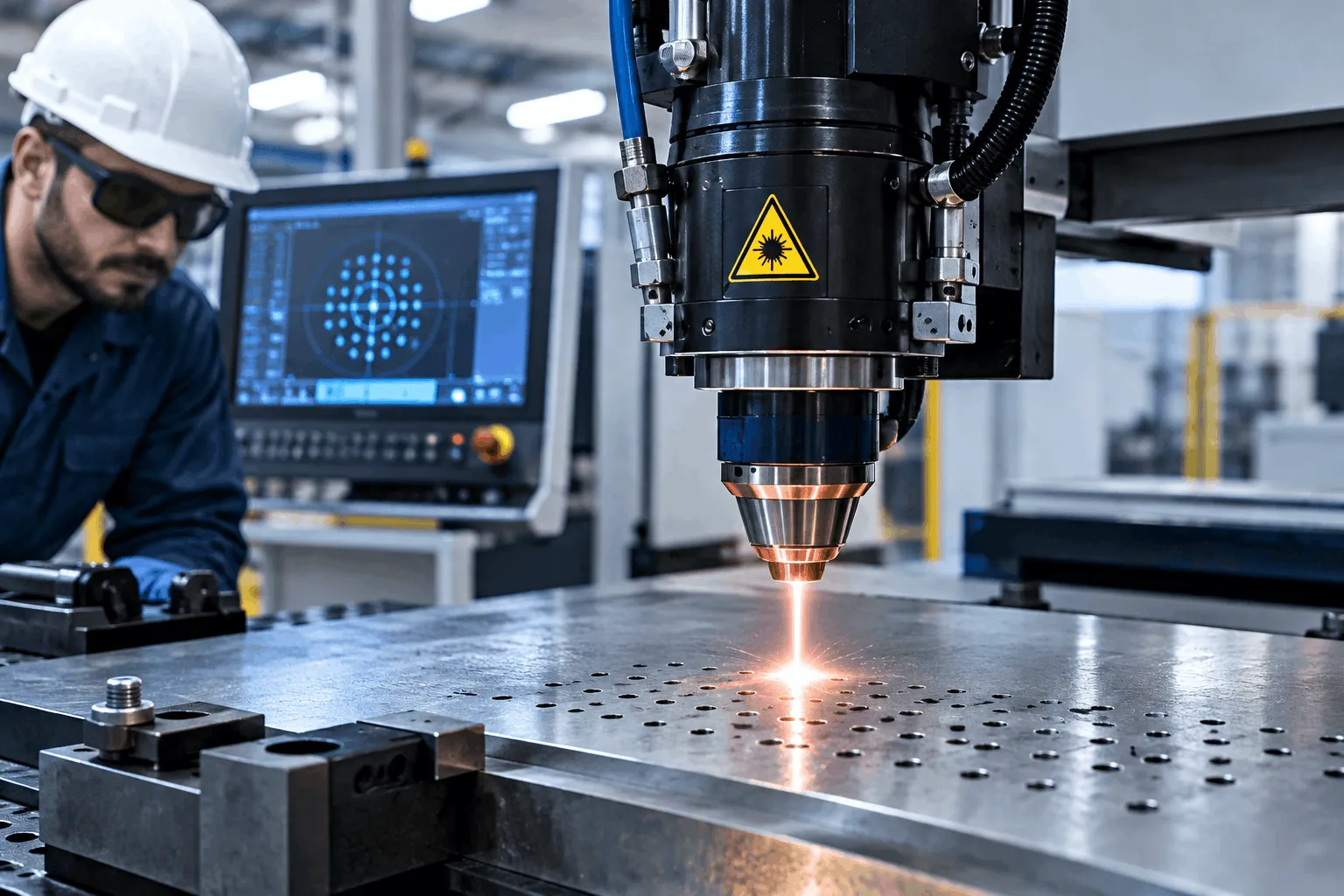
A laser drilling system focuses a high-intensity beam of light onto a precise point on the material surface. The energy density at that focal point is intense enough to heat the material far beyond its melting and vaporization temperatures in an extremely short time. The material at the focus point converts to vapor and plasma, which is expelled from the forming hole by the pressure of the vaporization itself and by assist gas directed coaxially with the beam.
What is left behind is a hole. No cutting tool touched the material. No mechanical force was applied. The only thing that interacted with the workpiece was photons, and the result of that interaction is a precisely positioned, dimensionally controlled opening that no mechanical process could have created under the same constraints.
2. The Fundamental Difference Between Laser Drilling and Conventional Drilling
Conventional drilling is a mechanical process. A rotating tool with cutting edges physically scrapes and shears material away as it advances through the workpiece. That works brilliantly within a well-defined range of materials, diameters, and depths. Push outside that range and the problems compound quickly. Very small diameters produce fragile tools that snap under the cutting forces. Very hard materials wear tools rapidly and produce poor hole quality. Compound angles are geometrically awkward or impossible to approach with a rotating spindle. Thin walls flex and chatter under cutting forces.
Laser drilling has none of those constraints. The material's hardness is irrelevant because no cutting edge interacts with it. The hole diameter is limited by beam focus, not tool fragility. Compound angles are handled by programming the motion system, not by re-fixturing the workpiece around a spindle. Thin walls experience no cutting forces that could cause deflection or cracking.
3. Why Non-Contact Material Removal Changes Everything
The non-contact nature of laser drilling is not just a technical curiosity. It is the reason the process exists as a distinct manufacturing category. Every limitation of mechanical drilling traces back to the physical contact between tool and workpiece. Remove that contact and you remove those limitations simultaneously. What you gain is the ability to drill materials, geometries, and feature sizes that are simply not accessible any other way at production volumes and costs.
The Laser Drilling Process Step by Step
1. Beam Generation, Focusing, and Energy Delivery
The laser source generates a coherent beam that is directed through a series of optical elements to a focusing lens or objective. The focusing optic concentrates the beam to a spot at the workpiece surface. Spot sizes for industrial drilling applications range from under 0.05mm to about 0.5mm depending on the laser wavelength, the focusing optic specification, and the beam quality of the source.
Pulse duration, peak power, pulse repetition rate, and pulse energy are the controllable parameters that determine how energy is delivered to the material. Short, high-peak-power pulses concentrate energy delivery in time, minimizing heat spread into the surrounding material. Longer pulses deliver more total energy per pulse but allow more time for heat conduction away from the focal zone, which affects the heat-affected zone size and the recast layer characteristics on the finished hole walls.
2. The Three Primary Drilling Methods: Single Pulse, Percussion, and Trepanning
Single pulse drilling fires one high-energy pulse at the target location and creates the entire hole in a single shot. It is the fastest possible approach, making it attractive for high-volume applications on thin materials where the resulting hole geometry and quality are acceptable for the application. The holes produced by single pulse drilling tend to have more taper and less controlled geometry than other methods because all the energy is delivered at once.
Percussion drilling fires multiple sequential pulses at the same location, progressively deepening the hole with each pulse and expelling material progressively. This produces holes with better aspect ratios, more controlled geometry, and cleaner walls than single pulse because each pulse removes a controlled layer rather than trying to do everything at once. Most production aerospace turbine blade drilling uses percussion drilling for exactly these reasons.
When Trepanning Produces Results That Other Methods Cannot
Trepanning moves the focused beam in a small circle or contour around the intended hole perimeter, cutting out a disk of material rather than drilling straight through the center. For holes larger than about 0.5mm in diameter, trepanning produces significantly better roundness, edge quality, and positional accuracy than percussion drilling can achieve, because the cut path defines the hole boundary precisely rather than relying on the ablated zone to define it.
Trepanning is also the natural method for producing non-circular holes, slots, or shaped apertures through the same basic drilling operation. The beam path defines the shape, so any closed contour the motion system can trace becomes a drillable feature.
3. Assist Gas Selection and Why It Shapes Hole Quality
Assist gas flows through the nozzle assembly coaxially with the laser beam, entering the forming hole and performing several critical functions simultaneously. It expels molten and vaporized material from the hole during drilling, preventing redeposition on the hole walls. It protects the focusing optic from contamination by spatter and vapor. And it influences the chemical reactions occurring at the cut front through its composition.
Oxygen assist gas adds exothermic energy to the process through reaction with heated metals, which can speed material removal but also increases oxide formation. Nitrogen and argon are inert options that prevent oxidation on reactive materials like titanium, where surface contamination during drilling can degrade material properties and surface finish. The right gas choice depends on the material, the required surface condition, and the downstream application requirements.
Materials That Laser Drilling Handles Best
1. Metals, Superalloys, and Hard Engineering Materials
Laser drilling handles essentially the full range of engineering metals, from common mild steel and stainless steel through aluminum alloys, titanium, copper, and the most demanding aerospace superalloys. Nickel-based alloys like Inconel 625 and Inconel 718, cobalt alloys, and refractory metals like molybdenum and tungsten are all drilled in production environments where mechanical processes would destroy tooling immediately.
The hardness and high-temperature strength that make superalloys so valuable in service and so difficult to machine conventionally are completely bypassed by laser drilling. The process does not care about hardness. What matters is the material's thermal properties: its absorption of the laser wavelength, its melting and vaporization temperatures, and how quickly it conducts heat away from the focal zone.
A laser engraver configured for metal work uses the same fundamental beam delivery technology that industrial laser drilling systems scale up to production requirements. The beam interacts with metal in the same physical way regardless of whether the application is a decorative surface mark or a precision through-hole in a turbine component.
2. Ceramics, Composites, and Difficult Non-Metals
Drilling CFRP and Kevlar Without the Delamination Problem
Carbon fiber reinforced polymer composites present a specific set of problems for mechanical drilling. The carbon fibers and polymer matrix have very different mechanical properties, which creates differential cutting resistance that causes drills to push layers apart rather than cut through them cleanly. Delamination at hole entry and exit is the characteristic failure mode, and it requires additional finishing operations to produce acceptable holes.
Laser drilling on CFRP, particularly with ultrashort pulse systems that minimize thermal input, ablates material from both fiber and matrix without the mechanical forces that drive delamination. The resulting holes have clean entry and exit conditions without the interlaminar damage that plagues mechanical drilling on these materials. Technical ceramics, zirconia, alumina, and silicon carbide, are similarly well suited to laser drilling because their hardness, which destroys mechanical tooling, is irrelevant to a photon-based removal process.
3. Thin Films, Foils, and Precision Substrates
At the opposite end of the thickness scale from turbine blades sit applications involving extremely thin materials where the drilling challenge is controlling the process precisely enough not to damage material that is measured in microns. Laser drilling on metal foils, thin polymer films, ceramic substrates for electronics, and precision membranes requires pulse parameters optimized for minimum thermal impact and maximum dimensional control.
The best laser engravers for precision work on thin substrates offer the pulse energy control and stability at low power levels that these applications demand. Consistency from pulse to pulse is critical when the total material being removed per hole is measured in micrograms.
Where Laser Drilling Shows Up in Real Industry Applications
1. Aerospace Turbine Blade Cooling Holes
Turbine blades in modern jet engines operate at temperatures that exceed the melting point of the blade material itself. The only reason those blades survive is a network of precision cooling holes, typically 0.3mm to 0.8mm in diameter, drilled at compound angles through the blade wall to direct cooling air across the external surface and maintain a protective boundary layer.
A single turbine blade may contain hundreds of these holes, all at tight positional tolerances, in nickel superalloy that would destroy a carbide drill in seconds. Laser percussion drilling is the production-viable process for this application, and it has been refined over decades by aerospace manufacturers and their suppliers to deliver the consistency, accuracy, and traceability that engine certification demands.
2. Medical Devices and Surgical Instrument Drilling
Medical device manufacturing uses laser drilling for features that must be clean, burr-free, and produced without contaminating the part. Catheter tube side holes, drug delivery orifices, orthopedic implant drainage features, and surgical instrument working channels all require precision holes in stainless steel, titanium, and medical-grade polymers that meet cleanliness standards incompatible with mechanical drilling's chips and cutting fluids.
3. Electronics Manufacturing and PCB Microvia Drilling
How Laser Drilling Transformed High-Density Circuit Board Production
Printed circuit board manufacturing underwent a fundamental shift when laser drilling made it possible to create microvias, holes under 150 microns in diameter, that connect copper layers in multilayer boards at densities impossible for mechanical drills to achieve. High-density interconnect boards used in smartphones, medical electronics, and aerospace systems rely entirely on laser drilled microvias for their layer-to-layer connections.
CO2 and UV laser systems drill these microvias at rates of thousands of holes per minute on automated production lines, delivering the hole quality and positional accuracy that soldering and plating processes downstream require. Without laser drilling, the compact, powerful electronics that define modern technology would simply not be manufacturable.
4. Fuel Injectors, Filters, and Precision Fluid Control Components
Fuel injectors in modern diesel and gasoline direct injection engines contain orifice holes in the 0.1mm to 0.3mm diameter range that meter fuel delivery with microsecond timing precision. The hole size, shape, and edge condition directly affect spray pattern, atomization quality, and combustion efficiency. Laser drilling produces these orifices with the dimensional consistency and edge sharpness that injection system performance requires.
Precision filters, flow restrictors, and fluid control components in medical, analytical instrument, and industrial applications similarly rely on laser drilled orifices where the hole geometry is a functional specification, not just a clearance feature.
Accuracy, Quality, and the Variables That Control Both
1. Hole Diameter Precision and Repeatability Across Production Runs
Diameter accuracy in laser drilling depends on focused spot size, pulse energy consistency, and the number of pulses applied in percussion drilling. On a stable, well-calibrated system with consistent assist gas delivery, hole diameter repeatability across a production run of hundreds or thousands of holes is achievable in the range of plus or minus 0.01mm to 0.03mm depending on material and hole size. This level of repeatability requires active monitoring of beam quality and pulse energy, not just setting parameters at the start of a run and walking away.
2. Taper, Recast Layer, and Heat-Affected Zone Management
Laser drilled holes are not perfectly cylindrical. The beam diverges slightly as it penetrates deeper into the material, and energy delivery decreases with depth, producing an entry diameter slightly larger than the exit diameter. This taper is a fundamental characteristic of the process and must be accounted for in design when hole cylindricity is a functional requirement.
The recast layer is the thin zone of re-solidified material on the hole wall that forms when molten material expelled from the forming hole partially re-deposits before being cleared. Recast layer thickness varies from a few microns to tens of microns depending on parameters, material, and drilling method. For applications where the recast layer affects part performance, ultrashort pulse lasers dramatically reduce its thickness by minimizing the liquid phase during material removal.
3. How Machine Quality and Calibration Affect Every Hole
A laser drilling result is only as good as the machine producing it. Beam quality, expressed as M-squared, determines how tightly the beam can be focused and how consistent the focal spot is across the work envelope. Pulse energy stability determines whether every hole in a production run receives the same energy as the first. Motion system positioning accuracy determines whether holes land where the CNC program specifies.
Shops that maintain their laser systems rigorously, with calibrated measurement of beam parameters, regular optics inspection, and documented preventive maintenance, produce consistent results across long production runs. Shops that treat their laser equipment as a black box that either works or does not produce variable results that show up in dimensional inspection and, eventually, in customer feedback.
Laser Drilling vs. Laser Engraving: Understanding the Technology Overlap
1. When the Same Equipment Serves Both Functions
Laser drilling and laser engraving share the same fundamental technology platform. Both use a focused laser beam to remove material from a workpiece under CNC control. The distinction lies in the intent and geometry of the removal: drilling creates a through-hole or blind hole with a defined diameter and depth, while engraving removes material from the surface to create marks, textures, or shallow features.
Many industrial laser systems are configurable for both operations. The beam delivery hardware, the motion system, and the control software are common. What changes between applications is the parameter set: the pulse duration, peak power, repetition rate, and scan strategy that optimize the beam-material interaction for the specific outcome desired.
2. Selecting the Right Configuration for Your Specific Application
Choosing the right configuration for a combined drilling and engraving application requires understanding the requirements of both. Drilling demands tight positional accuracy, controlled pulse energy, and often specific assist gas delivery that engraving may not require. Engraving demands scan speed and mark contrast optimization that may conflict with the parameter optimization for drilling.
Shops that handle both operations on the same parts understand these trade-offs and configure their systems accordingly, sometimes using different parameter sets on the same machine for different features on a single part.
3. What to Look for in a Precision Laser Drilling and Engraving Partner
A serious precision laser drilling and engraving partner brings more than equipment to the table. They bring documented process development capability, the ability to qualify procedures for your specific application, inspection methods appropriate to the feature sizes and tolerances required, and quality system credentials that match the demands of your industry. AS9100D and ISO 9001 certifications are baseline indicators for aerospace and general precision manufacturing. Medical device suppliers should hold ISO 13485.
Beyond certification, ask about their specific experience with your material, your hole size range, and your application environment. A shop that has been drilling superalloy turbine components for decades understands process nuances that no amount of equipment investment alone can substitute for.
Conclusion
Laser drilling is one of the clearest examples of a technology that exists not because engineers preferred a more exotic solution, but because the problems it solves genuinely had no other answer. Turbine blades, microelectronics, medical devices, and precision fuel systems all depend on laser drilled features that mechanical processes cannot produce. Understanding the physics, the process variables, and the quality considerations that govern laser drilling gives engineers and buyers the foundation to specify it correctly, source it intelligently, and get results that match what their applications actually require from the very first production run.
Frequently Asked Questions
1. What is the smallest hole laser drilling can produce?
Specialized laser systems produce holes below 25 microns in diameter in thin materials. Industrial production drilling routinely achieves 0.1mm to 0.3mm holes in metals and composites with good positional accuracy.
2. Does laser drilling work on hardened steel?
Yes. Material hardness does not affect laser drilling performance because the process removes material thermally, not mechanically. Hardened tool steels drill as readily as annealed material.
3. What causes taper in laser drilled holes?
Beam divergence and energy attenuation with depth both contribute to taper. Trepanning strategies and beam shaping optics reduce taper for applications where tight cylindricity is required.
4. How is laser drilling different from laser cutting?
Laser cutting moves the beam continuously along a path to separate material. Laser drilling concentrates the beam at a fixed or small-circle location to create a hole feature rather than a separation cut.
5. Can laser drilling replace EDM for small precision holes?
In many cases yes. Laser drilling is faster, requires no electrode fabrication, and handles non-conductive materials that EDM cannot touch. EDM retains advantages for very deep holes in conductive materials where HAZ must be essentially zero.




















Sign in to leave a comment.