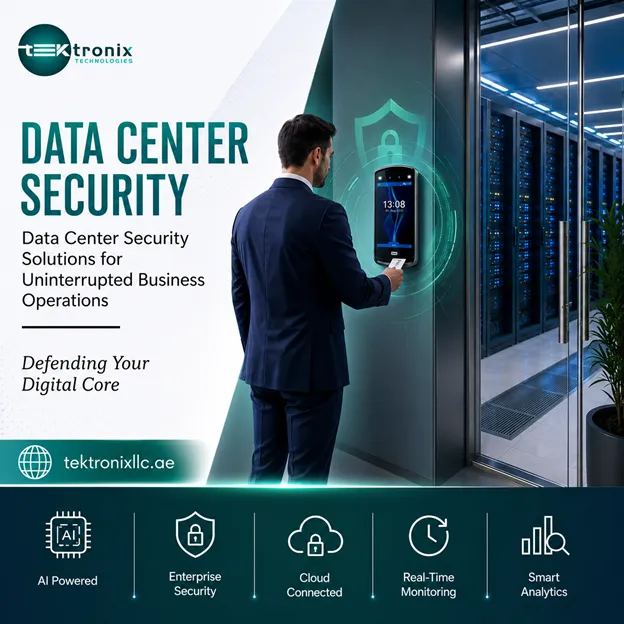

Introduction to Data Center Security
Data Center Security has become a board-level priority for UAE operators as facilities scale to support cloud, AI, and financial workloads that cannot tolerate downtime or a compromised perimeter. Enterprises across Dubai and Abu Dhabi are investing in a layered perimeter and access security framework that spans physical barriers, credentialed entry, and continuous monitoring, rather than relying on any single control to protect the facility.
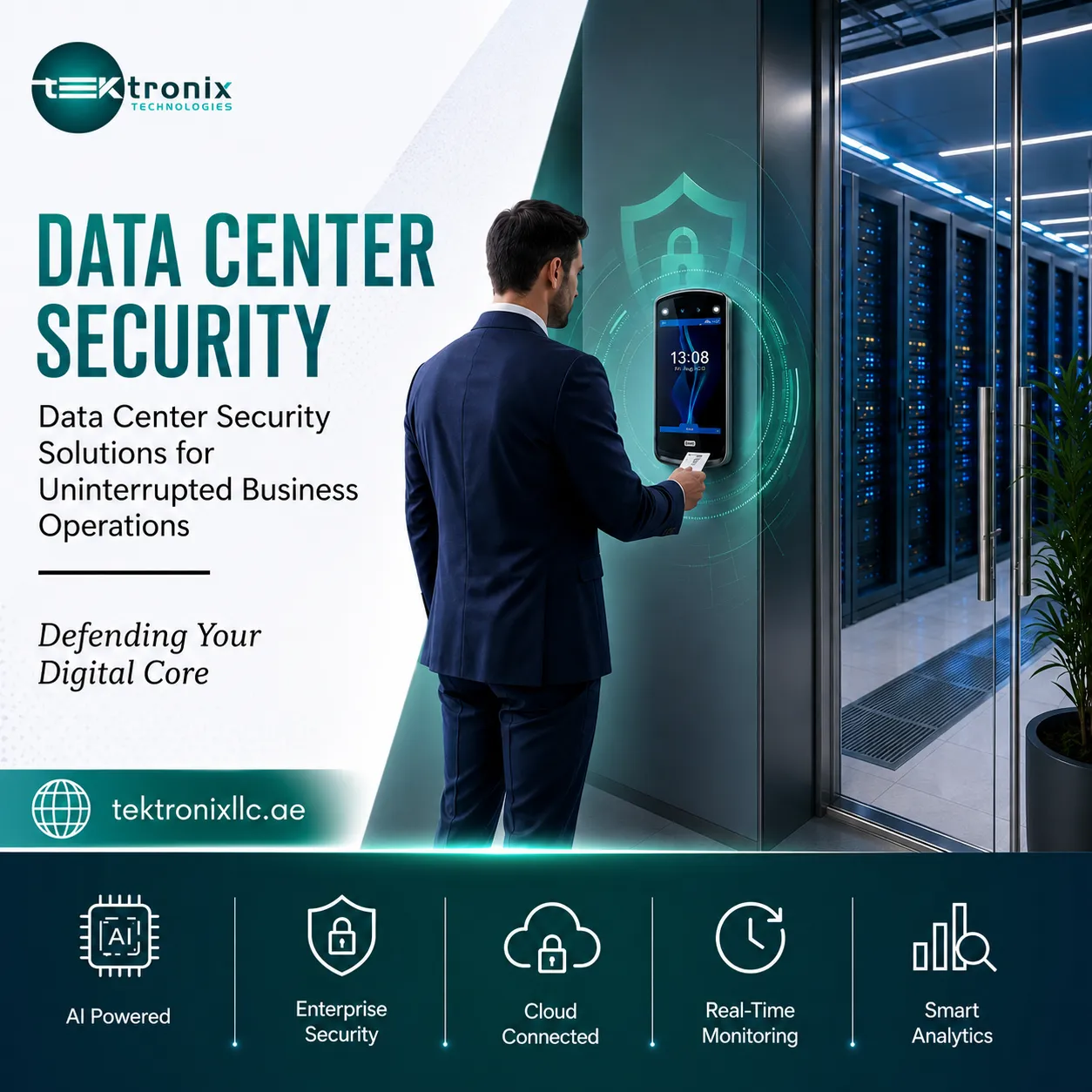
A modern data center is not defended by a fence and a security guard alone. Operators now need to coordinate physical access control, video surveillance, intrusion detection, and network-facing protections as one integrated program, because a gap in any single layer can undermine the rest. This article walks through what a complete UAE data center security deployment looks like, the technology choices involved at each layer, and why Tektronix has become a trusted implementation partner for facility operators across the Emirates.
Why UAE Data Centers Need a Layered Security Approach
Data centers sit at the intersection of physical security and information security in a way few other facility types do. A breach of the physical perimeter can be just as damaging as a network intrusion, since direct access to server racks bypasses firewalls, encryption, and every other digital control entirely. This is why serious operators design physical and digital protections together rather than treating them as separate budgets and separate teams.
UAE facilities hosting regulated workloads — banking infrastructure, government cloud tenancy, healthcare data, or multinational enterprise systems — face an added layer of scrutiny. Clients and regulators increasingly require documented evidence of physical security controls as part of vendor due diligence, and a facility that cannot produce a clear access log or incident history struggles to win or retain that business regardless of how strong its network security posture looks on paper.
Uptime commitments add further pressure. A single unauthorized entry event, even one that causes no direct damage, can trigger an incident response process that disrupts operations and damages client confidence. Facility operators increasingly treat physical security investment as directly tied to uptime SLA performance rather than a separate line item.
Insurance underwriters covering data center facilities have also become more specific in their requirements, often asking for documented evidence of layered controls — perimeter detection, access tiering, and surveillance retention periods — as a condition of coverage or a factor in premium calculation. Facility operators that can produce this documentation quickly, rather than assembling it under pressure after an incident, are in a materially stronger position both operationally and commercially.
Cybersecurity for Data Center Facilities: Where Physical Meets Digital
Cybersecurity for Data Center operations increasingly overlaps with physical security infrastructure. Access control logs, surveillance footage, and intrusion alerts all now feed into the same security operations center dashboards used to monitor network activity, giving analysts a single timeline that correlates a badge swipe or an unrecognized face at the door with any corresponding network event happening at the same moment.
This convergence matters because sophisticated attackers increasingly combine physical and digital tactics — for example, gaining brief physical access to plant a rogue device on the network rather than attempting a purely remote intrusion. Facilities that monitor physical and digital signals together are far better positioned to catch this kind of blended attack than those running the two disciplines in isolation.
Data Center Encryption: Protecting Information at Every Layer
Data Center Encryption protects data at rest on storage systems and in transit across the facility's internal and external network links, ensuring that even if a physical security layer were somehow bypassed, the information itself remains unreadable without the correct keys.
Key management is the part of an encryption strategy most often overlooked. Strong encryption paired with poorly controlled key storage or access provides little real protection, so mature UAE data centers pair their encryption program with the same strict, logged access control principles applied to the physical facility — keys are treated with the same rigor as the server racks themselves.
Encryption key rotation policies and hardware security module placement also deserve physical security consideration, not just a cryptographic one. Facilities storing key material on dedicated hardware security modules typically house that equipment in its own restricted-access zone within the server hall, applying the same tiered access principles used for the most sensitive tenant cabinets rather than treating key infrastructure as ordinary server equipment.
Data Center Firewalls: The Network Perimeter's First Line of Defense
Data Center Firewalls filter and inspect traffic moving between the facility's internal network segments and the outside world, enforcing the rules that determine which connections are permitted and which are blocked before they ever reach a hosted server.
Modern deployments segment the network into isolated zones — management traffic, tenant workloads, and out-of-band administrative access are typically kept on separate paths so that a compromise in one zone cannot move laterally into another. This segmentation strategy mirrors the physical security tiering applied to the building itself, where not every visitor with lobby access is automatically granted access to the server hall.
Firewall policy management for a facility hosting multiple tenants adds further complexity, since each tenant's traffic rules typically need to remain logically isolated from every other tenant's configuration while still being centrally auditable by the facility operator. Getting this balance right — tenant autonomy over their own rules alongside operator-level oversight — is one of the more demanding design decisions in a colocation-style deployment.
Data Center Access Control: Managing Every Entry Point
Data Center Access Control governs physical entry through every layer of the facility, from the perimeter gate through the mantrap and into individual server cabinets, with each layer requiring progressively stronger verification than the one before it.
Multi-Factor Verification at the Server Hall
Card access alone is rarely sufficient at the server hall entrance. UAE facilities typically pair a card or mobile credential with a biometric check — fingerprint or facial recognition — so that a single lost or shared credential cannot grant access to the most sensitive zone in the building.
Mantraps and Anti-Tailgating Enforcement
A mantrap interlock ensures only one verified person passes through at a time, closing the tailgating gap that a standard door can never fully prevent. Combined with weight or presence sensors, the system can detect and alert if more than one person attempts to pass on a single valid credential.
Cabinet-Level Locking
For colocation facilities hosting multiple tenants within the same server hall, individual rack or cabinet locks add a final layer of separation, ensuring one tenant's authorized staff cannot physically access another tenant's equipment even after clearing every prior security layer.
Visitor and Vendor Access Workflows
Data centers routinely host third-party maintenance vendors, auditors, and client staff conducting site visits, none of whom should share the same access profile as full-time operations personnel. A structured visitor workflow — pre-approval by the sponsoring tenant, time-boxed credentials, and mandatory escort for anyone entering the server hall itself — keeps this necessary traffic from becoming a security gap.
Data Center Surveillance: Continuous Visual Verification
Data Center Surveillance provides the visual record that ties every access event to a verified image, covering perimeter fencing, parking areas, loading docks, mantraps, and the server hall itself with overlapping camera coverage that leaves no blind spots at critical checkpoints.
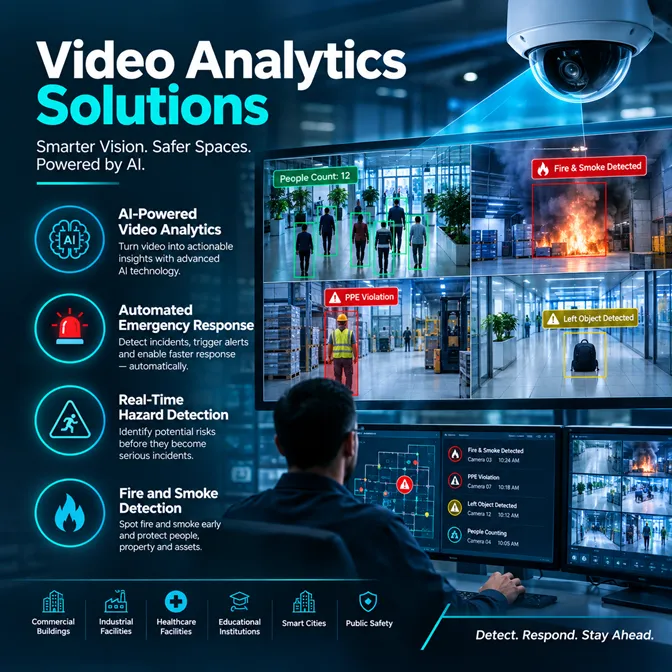
Video analytics have become standard rather than optional in newer deployments. Automated alerts for loitering near the perimeter fence, an object left unattended near a loading dock, or motion detected in a server hall outside scheduled maintenance hours let a small security team monitor a large facility effectively, flagging genuine anomalies instead of requiring staff to watch dozens of static feeds continuously.
Data Center Intrusion Detection: Catching Breaches Early
Data Center Intrusion Detection covers both the physical perimeter — fence-mounted vibration sensors, buried cable detection, and beam-break systems along the fence line — and the facility's internal network, where intrusion detection systems monitor for unauthorized access attempts and unusual traffic patterns.
Perimeter intrusion sensors are particularly valuable for UAE facilities with a standalone building and open ground surrounding it, where an attempted breach may begin well before anyone reaches a door or gate. Early detection at the fence line gives security teams time to respond before an intruder gets anywhere near the building itself, rather than relying solely on door alarms as the first line of warning.
False-alarm management is a practical concern that shapes how effective perimeter intrusion detection actually is in daily operation. Wind, wildlife, and heavy rain can all trigger poorly tuned fence sensors, and a system that generates frequent false positives quickly trains security staff to deprioritize its alerts. UAE deployments typically invest in a proper commissioning and tuning period after installation, adjusting sensitivity thresholds against real site conditions before the system is relied upon for genuine incident response.
Data Center Threat Detection: Proactive Risk Identification
Data Center Threat Detection combines signals from physical sensors, access logs, surveillance analytics, and network monitoring into a single risk picture, using correlation rules to flag patterns that any single system would miss on its own — a badge used at an unusual hour combined with an unrecognized vehicle in the parking area, for example.
Facility operators running a dedicated security operations center typically define escalation tiers for different threat signatures, so a minor anomaly generates a logged note for later review while a confirmed multi-signal alert triggers an immediate response from on-site security staff. This tiered approach prevents alert fatigue while still ensuring genuine threats are never buried under routine notifications.
Predictive elements are increasingly built into threat detection platforms as well, flagging gradually developing risks — a credential used at slightly unusual times over several consecutive days, for instance — rather than waiting for a single dramatic anomaly. This shift from purely reactive alerting to pattern-based risk scoring gives security teams earlier visibility into situations that might otherwise only be noticed after a serious incident has already occurred.
Data Center Security UAE: Trusted Deployment Across Dubai and Abu Dhabi
Tektronix LLC designs and integrates Data Center Security UAE programs for enterprise, colocation, and government-adjacent facilities across the Emirates. Our team has delivered perimeter and access security for critical infrastructure sites supporting Data Center Security Dubai operators in Business Bay and Dubai Silicon Oasis, alongside Data Center Security Abu Dhabi deployments referencing infrastructure standards used by G42-affiliated smart-building programs. Vehicle and pedestrian access flow planning for larger campuses is aligned with RTA Dubai guidance, and the high-throughput verification patterns refined during major public deployments around EXPO 2020 Dubai continue to inform how Tektronix designs layered security for mission-critical facilities today.
Every deployment includes site risk assessment, layered design across perimeter, access, and surveillance systems, and integration with the facility's existing network security posture. You can review the full solution scope on our Tektronix data center perimeter security page or request a site assessment for your facility.
Planning a Layered Data Center Security Deployment
A comprehensive risk assessment should precede any hardware order, mapping every entry point, sensitivity tier, and existing control gap across the facility. Facility and security leads typically walk the site together with network security stakeholders included from the start, since perimeter and access decisions increasingly need to account for how physical events will be correlated with network monitoring rather than being planned in isolation.
Redundancy planning deserves particular attention for mission-critical facilities. Power backup for every security system component, failover connectivity for surveillance and access control servers, and clearly defined manual fallback procedures for a full system outage all need to be designed in from the start rather than added as an afterthought once the primary systems are already specified.
Vendor coordination is another factor that shapes deployment timelines more than facility teams often expect. A layered security program typically involves separate specialists for perimeter fencing and sensors, access control hardware, surveillance camera networks, and network security infrastructure, and aligning their installation schedules against the facility's own construction or fit-out timeline avoids the rework that comes from, for example, running surveillance cabling before the final camera mounting positions have been confirmed with the access control layout.
Common Rollout Pitfalls to Avoid
The most frequent gap in early-stage deployments is treating physical and network security as entirely separate procurement tracks, which leads to systems that technically function but never share data with each other. The second common pitfall is under-resourcing the security operations center that monitors the resulting alerts — sophisticated sensors and cameras deliver limited value if nobody is properly trained to interpret and act on what they report.
A third pitfall specific to data centers is underestimating how quickly retention and storage requirements grow once high-resolution surveillance and detailed access logging are running across every layer simultaneously. Facilities that plan storage capacity for a fixed retention period from the outset avoid the disruptive mid-project scramble of expanding storage infrastructure after go-live, when historical footage is already at risk of being overwritten sooner than compliance requirements allow.
Measuring Success After Go-Live
Facility and security teams typically track several indicators in the months after a layered deployment goes live: the number of physical anomalies correlated with network events, mean time to respond to a confirmed multi-signal alert, and the percentage of access events successfully tied to a verified biometric or dual-factor credential. A steady improvement across these metrics is the clearest sign the layered approach is functioning as an integrated program rather than a set of disconnected point solutions.
For a tailored deployment plan covering perimeter sensor, access control tiering, and surveillance analytics, reach out through our data center security solutions team.
Conclusion
Data Center Security in the UAE now demands a layered program rather than a single control. Strong Data Center Access Control and Data Center Surveillance work alongside Data Center Intrusion Detection and Data Center Threat Detection to close gaps no single system can catch alone, while Data Center Firewalls, Data Center Encryption, and Cybersecurity for Data Center operations protect the network layer. For facilities seeking a proven Data Center Security UAE, Data Center Security Dubai, or Data Center Security Abu Dhabi partner, Tektronix delivers integrated, hands-on deployment experience.
FAQs
1. Why isn't a perimeter fence and security guard enough for a data center?
A single control creates a single point of failure. Modern facilities layer physical barriers, credentialed access, surveillance, and intrusion detection together so that a gap in one layer is caught by another before it becomes a breach.
2. How does physical security connect with network security in a data center?
Access logs, surveillance data, and intrusion alerts increasingly feed the same security operations center used for network monitoring, letting analysts correlate a physical event with a corresponding Cybersecurity for Data Center alert happening at the same time.
3. What prevents tailgating into a secure server hall?
Mantrap interlocks combined with weight or presence sensors allow only one verified person to pass per credential, closing a gap that a standard access-controlled door cannot fully prevent on its own.
4. Do colocation facilities need additional security beyond the building perimeter?
Yes. Multi-tenant colocation facilities typically add cabinet or rack-level locking so that one tenant's staff cannot physically access another tenant's equipment even after clearing every building-level security layer.
5. How quickly can a threat be detected at the perimeter before it reaches the building?
Fence-mounted vibration sensors, buried cable detection, and beam-break systems as part of Data Center Intrusion Detection can flag an attempted breach at the fence line, giving security teams time to respond before an intruder reaches the building itself.
For more information contact us on:
Tektronix Technology Systems Dubai-Head Office
+971 50 814 4086
+971 55 232 2390
Office No.1E1 | Hamarain Center 132 Abu Baker Al Siddique Rd – Deira – Dubai P.O. Box 85955































Sign in to leave a comment.