

Video Analytics left object detection has become a core requirement for UAE facilities that need to spot an unattended bag, package, or item the moment it is set down, rather than relying on a guard reviewing footage after the fact. Malls, airports, corporate campuses, and critical infrastructure sites are deploying AI-driven video analytics platforms that flag left objects automatically, cutting response time from minutes of manual review to seconds of automated alerting.

Traditional CCTV was always a recording tool first and a detection tool a distant second — footage existed mainly to be reviewed after an incident had already occurred. Left object detection flips that model, turning every camera into an active sensor that continuously evaluates the scene and raises a flag the instant something changes. This article covers how the technology works, what makes a deployment reliable in the UAE's specific operating conditions, and why Tektronix has become a trusted integration partner for facilities across the Emirates.
The stakes for getting this right are higher in the UAE than in many markets, given the concentration of high-footfall venues — mega-malls, transit hubs, and large-scale event spaces — that host tens of thousands of visitors daily. A security guard reviewing a bank of forty camera feeds cannot realistically notice a single unattended bag among a moving crowd, but an AI model watching every feed simultaneously never loses attention and never needs a coffee break.
What Is AI-Powered Video Analytics and Why It Matters
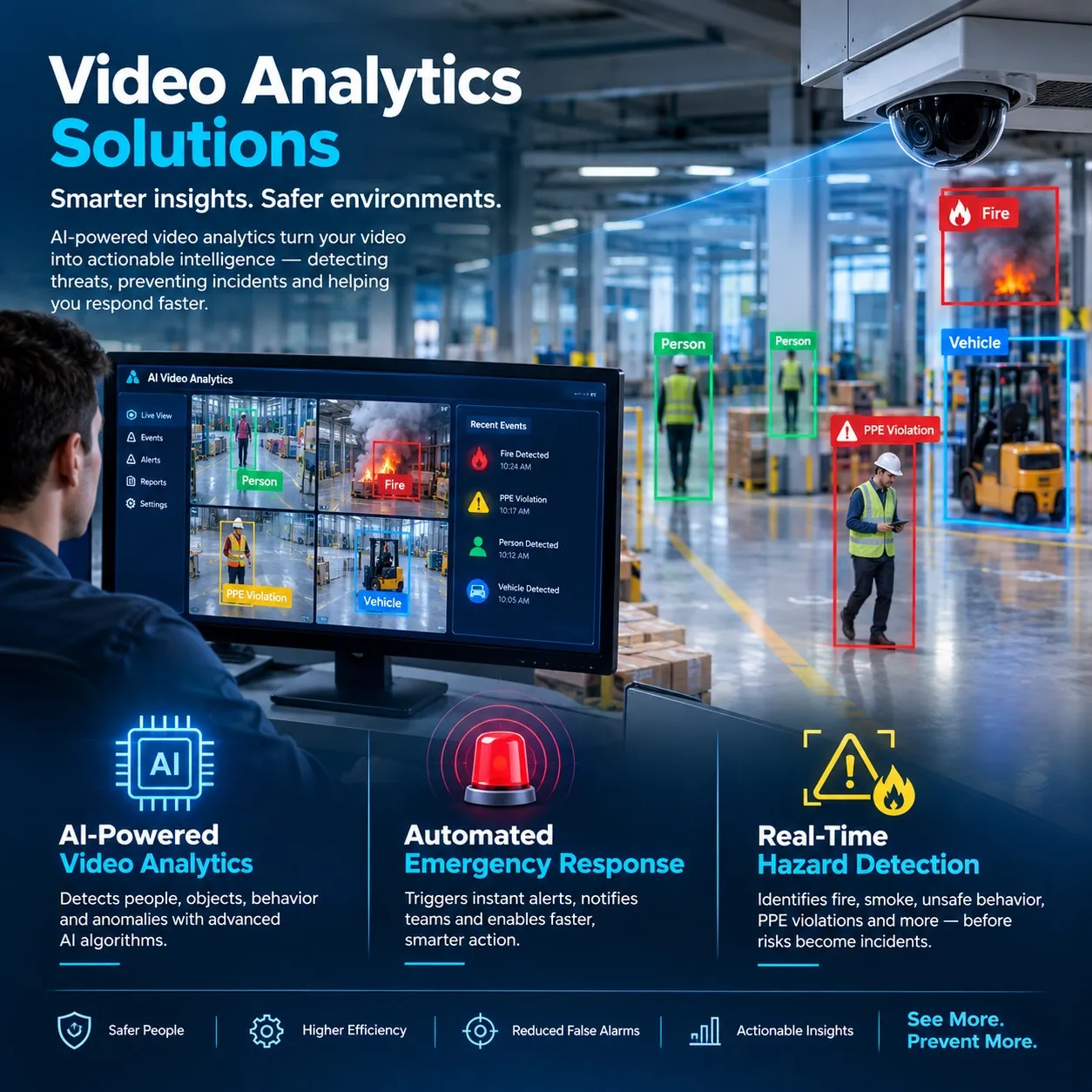
AI-Powered Video Analytics applies machine learning models directly to a camera's live feed, allowing the system to distinguish between a person walking through frame, a vehicle passing by, and an object that has been placed down and left unattended. Earlier generations of motion-based analytics could only detect that something moved — they had no concept of what that something actually was, which led to a flood of alerts for anything from a shifting shadow to a plastic bag blowing across a parking lot.
Modern AI models are trained to recognize object categories, track them across frames, and understand context — a bag carried by a person is simply luggage in motion, but the same bag set down and left stationary while its owner walks away becomes a flagged event. This contextual understanding is what separates a genuinely useful analytics platform from a basic motion sensor with a camera attached.
Beyond left object use cases, the same underlying platform typically supports a broader library of detection rules — perimeter line-crossing, loitering, crowd density thresholds, and wrong-direction movement through a controlled corridor. Facilities investing in AI-powered analytics for left object detection usually find it makes sense to activate several of these complementary rule sets at the same time, since the camera infrastructure and processing capability are already in place regardless of how many rule types are switched on.
Real-Time Object Detection: The Technology Behind Left Object Alerts
Real-Time Object Detection continuously scans each frame of live video, identifying and classifying every object in view within milliseconds. For left object use cases, the system tracks each identified item's position over time, measuring how long it remains stationary and whether the person who set it down has moved a defined distance away from it.
Processing at this speed typically happens close to the camera or on a dedicated on-site analytics server, rather than relying entirely on a cloud round-trip for every frame. This keeps detection latency low and ensures the system continues functioning reliably even at sites with limited or intermittent internet connectivity, which matters for UAE facilities spread across large campuses or remote perimeter zones.
Multi-object tracking is a related capability worth understanding, since real environments rarely present a single clean scenario. A busy transit concourse might have dozens of bags, trolleys, and packages moving through frame simultaneously, and the detection engine needs to maintain an individual tracking record for each one — noting when it entered the scene, who was carrying it, and whether it has since been set down — without conflating one item with another as people cross paths.
Advanced AI Recognition for Complex UAE Environments
Advanced AI Recognition capability is what allows a single platform to operate reliably across the wide range of environments a typical UAE facility portfolio includes — a busy shopping mall atrium, a quiet corporate lobby overnight, an outdoor parking structure exposed to heat and glare, and a covered loading dock with poor lighting.
Recognition models trained on diverse real-world footage handle crowd density, variable lighting, and partial occlusion far better than earlier-generation systems, which often failed in exactly the conditions where reliable detection mattered most — a crowded transit hub during peak hours, for instance, where a stationary bag needs to be distinguished from dozens of moving people passing nearby every second.
Partial occlusion handling deserves particular mention because it is one of the more common real-world failure points for weaker analytics platforms. An object left behind a pillar, partly obscured by a passing trolley, or briefly blocked from view by a crowd should still be tracked continuously by a properly engineered system, rather than being treated as a new, unrelated object each time it re-enters clear view — a distinction that directly affects whether a genuinely left item is caught or missed entirely.
This is particularly relevant for retail and hospitality environments across Dubai and Abu Dhabi, where footfall can swing dramatically between a quiet weekday morning and a packed weekend evening. A platform that performs consistently across both extremes, without requiring manual reconfiguration between shifts, delivers far more reliable protection than one tuned narrowly for a single traffic condition.
Low-light and nighttime performance deserves specific attention in a region where many outdoor facilities — parking structures, loading areas, and perimeter zones — operate around the clock. Recognition accuracy that holds up under infrared or low-light camera conditions, not just in well-lit daytime footage, is one of the clearer signals that a platform has been properly engineered for continuous operation rather than optimized only for demo-friendly daylight conditions.
Prolonged Detection: Distinguishing Real Threats from Routine Activity
Prolonged Detection logic is the safeguard that prevents every dropped item from triggering an immediate alarm. Someone briefly setting a bag down to tie a shoelace is normal behaviour, not a security event, so the system applies a configurable dwell-time threshold — typically a set number of minutes — before an object is classified as genuinely left behind and worth flagging.
Threshold tuning is site-specific rather than a single default that works everywhere. An airport departure hall handling security-sensitive traffic might set a short threshold of just a minute or two, while a corporate office lobby with lower risk exposure might allow five or ten minutes before an alert fire, avoiding unnecessary notifications for a courier bag briefly set down at reception.
False Alarm Reduction: Making Alerts Worth Acting On
False Alarm Reduction is arguably the single biggest factor in whether a video analytics deployment actually gets used day to day. Security teams that receive dozens of meaningless alerts every shift quickly learn to ignore the system entirely, which defeats the purpose of deploying it in the first place — a well-tuned platform is judged as much by what it does not flag as by what it does.
Modern platforms reduce false positives through a combination of accurate object classification, environmental awareness — accounting for wind, shadows, and reflections rather than reacting to them — and the prolonged detection thresholds described above. Facilities that invest properly in initial tuning during commissioning consistently report far fewer nuisance alerts than sites where the system is deployed with default settings and left unadjusted for local conditions.
There is a quantifiable operational cost to poor tuning that facility budgets often underestimate. A security team fielding fifty false alerts a day for the first month of a new deployment will, understandably, start treating the fifty-first alert with the same scepticism — even if it happens to be the one genuine incident of the month. Getting false alarm rates down early is not a cosmetic improvement; it directly determines whether the system delivers real security value or simply becomes background noise the team learns to tune out.
Instant Alerts and Notifications: Closing the Response Gap
Instant Alerts and Notifications deliver a flagged event directly to a security operations center, a mobile app, or an on-duty guard's radio the moment a left object is confirmed, along with a snapshot or short clip showing exactly what triggered the alert and precisely where in the facility it occurred.
This immediacy is what allows a facility to move from a reactive review process — discovering an unattended item only when someone happens to notice it or reviews footage afterward — to a proactive response, where security staff are directed to the exact camera and location within seconds of the object being left. For high-footfall UAE venues such as malls and transit hubs, that speed difference can be the deciding factor in how quickly a genuine incident is contained.
- Push notifications to mobile devices for roaming security staff
- Automatic snapshot and short clip attached to every alert
- Escalation rules routing unresolved alerts to a supervisor after a set time
- Integration with access control and public address systems for coordinated response
Coordinated Response Beyond the Alert
The most effective deployments treat the alert as the start of a workflow rather than the end point. An instant notification that also triggers a nearby public address announcement, locks down an adjacent access-controlled door, or automatically pulls up the relevant camera feed on a supervisor's screen turns a passive notification into an active part of the facility's incident response, shortening the time between detection and a coordinated staff action on the ground.
Video Analytics UAE: Trusted Deployment Across Dubai and Abu Dhabi
Tektronix LLC designs and integrates Video Analytics UAE platforms for malls, corporate campuses, transit facilities, and critical infrastructure sites across the Emirates. Our team has delivered left object and perimeter analytics for commercial venues in Business Bay and Dubai Silicon Oasis, supported technology rollouts referencing infrastructure standards used by G42-affiliated smart-building programs, and aligned public-space monitoring with RTA Dubai guidance for high-footfall transit and parking areas. Detection accuracy and response workflows refined during major public deployments around EXPO 2020 Dubai — where crowd density and camera coverage reached a scale few venues match — continue to inform how Tektronix configures analytics platforms for everyday commercial and government facilities today.
Every deployment includes site survey, camera placement planning, threshold tuning, and staff training. You can review the full solution scope on our Tektronix video analytics solutions page or request a site assessment for your facility.
Beyond initial deployment, Tektronix supports ongoing tuning as a facility's operating patterns evolve — a new wing added to a mall, a changed traffic pattern following a renovation, or an expanded perimeter as a campus grows. Treating video analytics as a system that is periodically reviewed and adjusted, rather than configured once and left untouched for years, is what keeps detection accuracy and alert relevance high over the long term.
Planning a Reliable Left Object Detection Deployment
A camera placement survey should precede any hardware order, mapping viewing angles, lighting conditions, and typical foot traffic patterns at each proposed detection zone. Left object analytics depend on a clear, mostly unobstructed view of the floor or ground area — cameras mounted too high or at too oblique an angle struggle to reliably track when an object is set down versus simply passing through frame carried by someone.
Threshold and rule configuration should happen on-site during commissioning rather than being left at factory defaults. Walking the facility with security staff to agree on dwell-time thresholds per zone, confirm which areas need the most sensitive detection, and test the system against real foot traffic during both quiet and busy periods produces a far more reliable deployment than a generic configuration applied uniformly across every camera.
Integration planning with the facility's existing camera infrastructure is another decision point worth resolving early. Many UAE sites already operate a substantial CCTV network, and a video analytics platform that can run on top of existing camera hardware — rather than requiring a full replacement — significantly changes both the project budget and the rollout timeline. Confirming which existing cameras meet the resolution and positioning requirements for reliable analytics, and which need to be upgraded or repositioned, should happen during the initial site survey rather than after equipment has already been ordered.
Common Rollout Pitfalls to Avoid
The most frequent issue is leaving default sensitivity settings unchanged after installation, which generates enough false alarms in the first weeks that security staff begin dismissing every notification without checking it. The second common pitfall is placing cameras purely for general surveillance coverage rather than specifically for left object detection, resulting in angles that technically show the area but perform poorly for tracking stationary objects on the ground.
A third pitfall is skipping staff training on how to act once an alert arrives. A perfectly tuned detection system still fails operationally if the guard receiving the notification does not know the facility's standard response procedure — whether that means a visual check from a distance, a controlled evacuation of the immediate area, or an immediate call to local authorities depending on the nature and location of the flagged item.
Measuring Success After Go-Live
Facility and security teams typically track three numbers in the first 90 days after deployment: the ratio of confirmed genuine alerts to total alerts generated, average response time from alert to security staff arrival at the location, and the number of manually reported incidents that the system also caught automatically. A rising confirmed-alert ratio alongside falling response times is the clearest sign the platform has been tuned correctly for the site.
Longer-term, many facilities also track how detection performance holds up across seasonal changes — the shift in lighting conditions between summer and winter, or the sharp rise in footfall during major UAE events and holiday periods. A platform that maintains consistent accuracy through these swings, without needing a full recalibration every few months, delivers materially lower ongoing management overhead than one that requires frequent manual adjustment to stay reliable.
For a tailored deployment plan covering camera placement, threshold configuration, and alert routing, reach out through our video analytics solutions team.
Conclusion
Video Analytics gives UAE facilities the ability to catch unattended items the moment they appear rather than after the fact. Built on AI-Powered Video Analytics and Real-Time Object Detection, supported by Advanced AI Recognition and Prolonged Detection thresholds, alerts arrive with confidence thanks to False Alarm Reduction tuning and reach staff instantly through Instant Alerts and Notifications. For facilities seeking a proven Video Analytics UAE partner, Tektronix combines site-specific tuning with hands-on local deployment experience.
FAQs
1. How does left object detection tell the difference between luggage and litter?
The system classifies object type and tracks whether the person who set it down has moved away and stayed away, applying Prolonged Detection thresholds so a passing item on the ground does not trigger an alert on its own.
2. Will the system flag every bag someone briefly sets down?
No. A configurable dwell-time threshold means brief, normal actions like setting a bag down to tie a shoelace do not trigger a notification — only objects left stationary beyond the site's configured time limit are flagged.
3. How does the platform avoid constant false alarms from shadows or blowing debris?
Environmental awareness built into the detection models accounts for wind, shadows, and lighting changes rather than reacting to them, and proper on-site tuning during commissioning further reduces nuisance alerts specific to each camera's conditions.
4. How quickly does security staff get notified after an object is flagged?
Alerts are delivered within seconds through Instant Alerts and Notifications, including a snapshot or short clip and the exact camera location, so staff can respond immediately rather than reviewing footage later.
5. Can the system work reliably in busy, high-traffic UAE venues like malls?
Yes. Recognition models trained on diverse real-world footage handle crowd density and variable lighting, allowing the platform to distinguish a stationary object from dozens of moving people even during peak footfall.
For more information contact us on:
Tektronix Technology Systems Dubai-Head Office
+971 50 814 4086
+971 55 232 2390
Office No.1E1 | Hamarain Center 132 Abu Baker Al Siddique Rd – Deira – Dubai P.O. Box 85955




























Sign in to leave a comment.