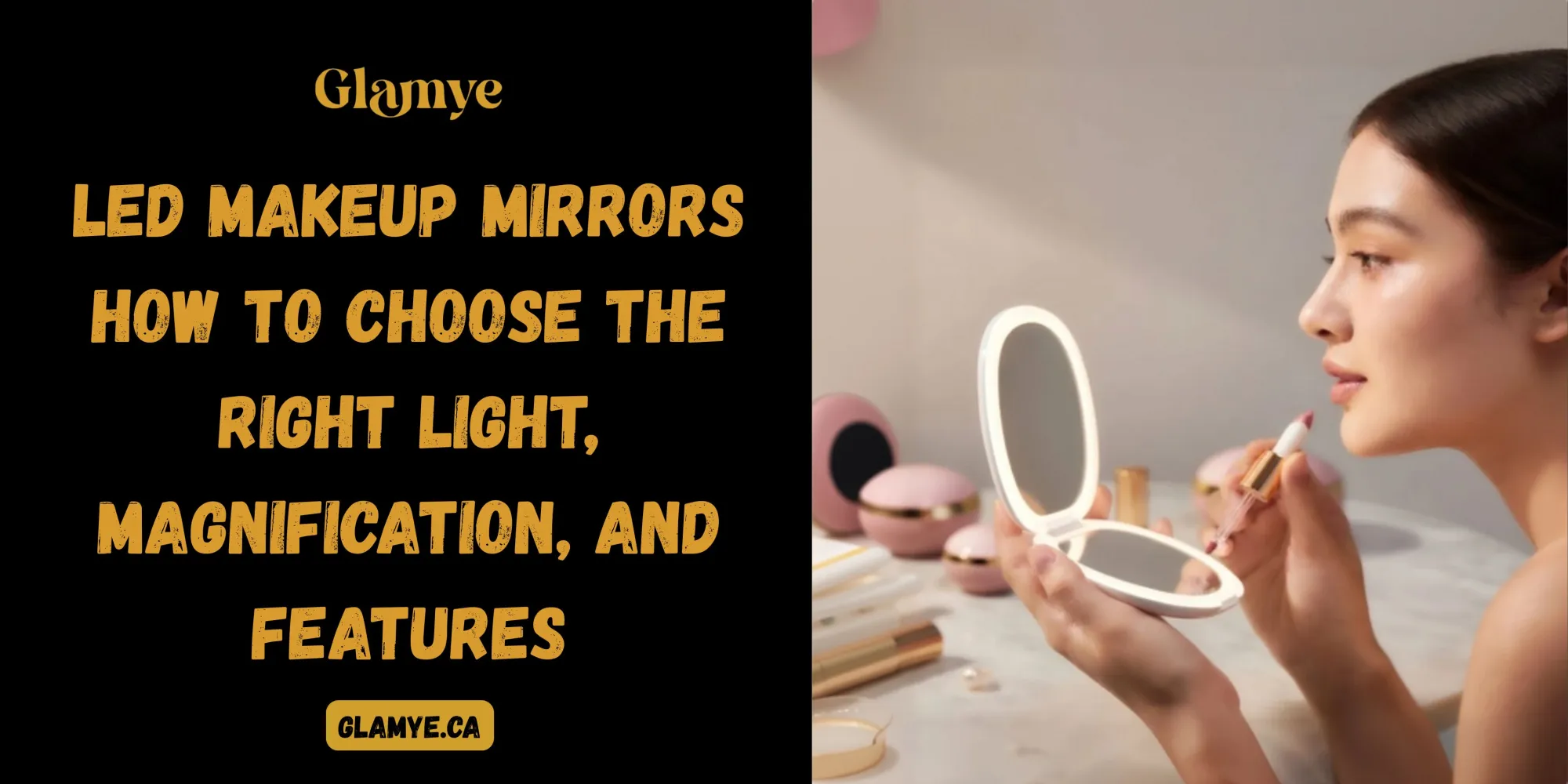

If you've ever tried to apply eyeliner in a dim bathroom or caught your foundation looking two shades off once you stepped outside, you already know why lighting matters just as much as the products in your makeup bag. The right LED makeup mirror doesn't just make your routine easier — it changes the accuracy of everything you do in front of it, from blending to brow shaping to skincare checks.
With so many mirrors on the market claiming to be "professional grade" or "salon quality," it can be hard to know what actually makes a difference. This guide walks through the features that matter most — dimmable lighting, magnification, touch controls, and portability — and highlights specific mirrors built around each of these needs.
Why LED Lighting Changed the Way We Do Makeup
Before LED mirrors became mainstream, most people relied on whatever lighting happened to be available — overhead bulbs, bathroom fixtures, or natural window light that changes throughout the day. The problem is that none of these sources are consistent, and inconsistent lighting leads to inconsistent makeup application. A foundation shade that looks perfectly blended under yellow-toned bathroom light can suddenly look orange or gray under office fluorescents or outdoor daylight.
An LED makeup mirror solves this by building consistent, adjustable light directly into the mirror itself. Instead of hoping your bathroom lighting is flattering and accurate, you control the light source, which means your makeup looks the way you intended no matter where you go afterward. This is the same principle professional makeup artists have relied on for years with studio lighting setups — just scaled down for home use.
Beyond color accuracy, built-in LED lighting also reduces the shadows that ordinary mirrors create. Overhead lighting tends to cast shadows under the eyes, nose, and chin, making it harder to judge how concealer, contour, or blush actually look. A well-designed LED mirror distributes light evenly across the face, giving you a much more realistic preview of your finished look.
The Case for a Dimmable Mirror
One of the most requested features in modern cosmetic mirrors is dimming control — and for good reason. Different tasks and times of day call for different brightness levels. A bright, high-intensity light might be ideal for detailed daytime makeup application, but that same brightness can feel harsh for a quick evening touch-up or a relaxed skincare routine before bed.
A true dimmable mirror allows you to adjust brightness gradually rather than flipping between a handful of fixed settings. This kind of fine control matters more than it might seem:
- Lower brightness is gentler on the eyes for nighttime routines or sensitive skin inspection
- Mid-range brightness works well for everyday, natural-looking makeup application
- Higher brightness helps with detailed work like precise eyeliner, brow shaping, or full glam looks that need to hold up under bright event lighting
Dimming isn't just about comfort — it's also about accuracy. Being able to match your mirror's brightness to the environment you're heading into (a dim restaurant versus a brightly lit office) means fewer surprises once you leave the house. Many dimmable mirrors also pair brightness control with adjustable color temperature, letting you shift between warm and cool tones depending on the look you're going for.
Compact Magnifying Mirrors: Precision in a Small Package
Magnification is one of the most underrated features in a good cosmetic mirror. While a standard mirror shows your whole face at a glance, fine detail work think tweezing brows, applying false lashes, or checking for stray hairs often requires a much closer view than your natural reflection can offer.
That's where a compact magnifying mirror with light becomes an essential tool rather than a nice-to-have. Combining magnification with built-in LED lighting solves two problems at once: you get a closer, more detailed view of your skin or makeup application, and you get the bright, even light needed to actually see fine details clearly, rather than squinting under weak ambient light.
Compact magnifying mirrors are especially useful for:
- Precise brow tweezing and shaping, where visibility of individual hairs matters
- False lash or lash extension application, which requires a steady, close-up view
- Spotting skincare concerns early, such as fine lines, texture changes, or blemishes
- Contact lens application, where accuracy and lighting both matter
Because these mirrors are compact by design, they're easy to store on a bathroom shelf, tuck into a drawer, or bring along when traveling giving you salon-level detail work wherever you are.
Magnifying Mirrors With Light: A Closer Look at the Basics
Beyond compact designs, many people are simply looking for a reliable magnifying mirror with light that offers a closer, brighter view without unnecessary bulk or complicated features. These mirrors are popular precisely because they keep things simple: a magnified reflective surface paired with even LED illumination, in a lightweight and easy-to-use format.
This style of mirror tends to appeal to a wide range of users, including:
- People applying makeup without the benefit of natural daylight, such as early mornings or evenings
- Anyone who wears glasses or contacts and needs extra clarity for close-up tasks
- Those who want a secondary, detail-focused mirror to pair with a larger vanity mirror
- Travelers who want magnification and lighting without carrying a full-sized mirror
A magnifying mirror with light works especially well as a complement to a larger, non-magnified mirror. You get the big-picture view for overall application from one mirror, and precise, well-lit detail work from the other covering every part of your routine without compromise.
Why Touch Sensor Controls Matter More Than You'd Think
It's easy to overlook control design when comparing mirrors, but how you actually adjust the lighting matters for everyday usability. Mechanical switches and multi-button interfaces can be clunky, especially with makeup-covered fingers or in a rush before heading out the door.
An LED mirror with touch sensor controls simplifies this with a single, intuitive touch panel — usually a light tap to turn the mirror on or off, and a swipe or press-and-hold to adjust brightness. This kind of interface offers a few real advantages:
- Faster adjustments during a routine, without fumbling for tiny buttons
- Cleaner design, since touch panels typically sit flush with the mirror's frame rather than protruding
- Easier cleaning, as smooth touch surfaces don't trap product residue the way textured buttons can
- A more premium feel, similar to the touch controls found on modern smartphones and appliances
Touch sensor mirrors are particularly popular for vanity setups where the mirror stays in one place and gets used multiple times a day. The convenience of a quick tap versus digging for a switch adds up over weeks and months of daily use.
Building the Ideal Mirror Setup for Your Routine
Rather than looking for a single "perfect" mirror, many people find that combining a couple of purpose-built mirrors covers their routine more completely. Here's how these features tend to pair well together:
For everyday full-face application: A larger LED makeup mirror with dimmable, touch-sensor controls offers the flexibility to adjust brightness throughout the day and handle general application tasks with ease.
For detail work: A compact magnifying mirror with light kept nearby on the same counter or in a drawer handles brows, lashes, and skincare checks that require a closer view.
For travel: A smaller magnifying mirror with light, lightweight and battery-powered, ensures you don't have to sacrifice good lighting just because you're away from your usual setup.
For nighttime routines: A dimmable mirror set to a lower brightness is gentler on the eyes during evening skincare or a quick touch-up before bed, without the harshness of a fully bright LED ring.
Layering mirrors this way a primary mirror for general use and a magnifying mirror for detail mirrors (no pun intended) the setup many professional makeup artists use, just scaled for home counters and travel bags.
What to Look for When Comparing LED Mirrors
With so many similar-looking products available, a few key specs make the biggest difference in day-to-day usability:
- Brightness range — Look for mirrors with a wide dimming range rather than just a couple of fixed settings.
- Color temperature options — Warm, cool, and neutral daylight settings offer the most flexibility for different makeup looks and lighting environments.
- Magnification level — Common options range from 3x to 10x; higher magnification is better for fine detail work, while lower magnification keeps more of your face in view.
- Control type — Touch sensors tend to offer a cleaner, more convenient experience than physical buttons or dials.
- Power source — Rechargeable, battery-powered mirrors offer more flexibility than mirrors that require a constant outlet connection.
- Size and portability — Consider where the mirror will live: a stationary vanity mirror can be larger, while a travel or detail mirror should stay compact.
Frequently Asked Questions
What's the benefit of a dimmable LED mirror over a fixed-brightness one?
A dimmable mirror lets you match lighting to the task and time of day — brighter for detailed daytime application, softer for nighttime routines — rather than being stuck with a single brightness level that may not suit every situation.
How much magnification do I actually need?
For general use and everyday touch-ups, lower magnification (around 3x–5x) is usually sufficient. For detailed tasks like brow tweezing or lash application, higher magnification (7x–10x) offers a much closer, more precise view.
Are touch sensor mirrors reliable, or do they malfunction easily?
Touch sensor controls on quality LED mirrors are generally reliable and respond to a light tap or swipe, similar to smartphone touch controls. They also tend to be easier to keep clean than traditional buttons.
Can I use a magnifying mirror with light as my only mirror?
It depends on your routine. Many people prefer pairing a magnifying mirror with a standard, non-magnified mirror so they can see their whole face for general application and switch to magnification only for detail work.
Final Thoughts
Choosing the right mirror comes down to understanding your own routine — how much detail work you do, how often you travel, and how much control you want over your lighting. A dimmable mirror offers flexibility across different times of day, a compact magnifying mirror handles precision tasks, and touch-sensor controls make daily use that much smoother.
Whether you're upgrading your main vanity setup or adding a detail-focused mirror to your collection, investing in the right combination of lighting, magnification, and controls pays off every time you sit down to get ready.
Looking for more tips on building the perfect vanity setup? Check back for our upcoming guides on lighting for content creators and skincare-focused mirror routines.





















Sign in to leave a comment.