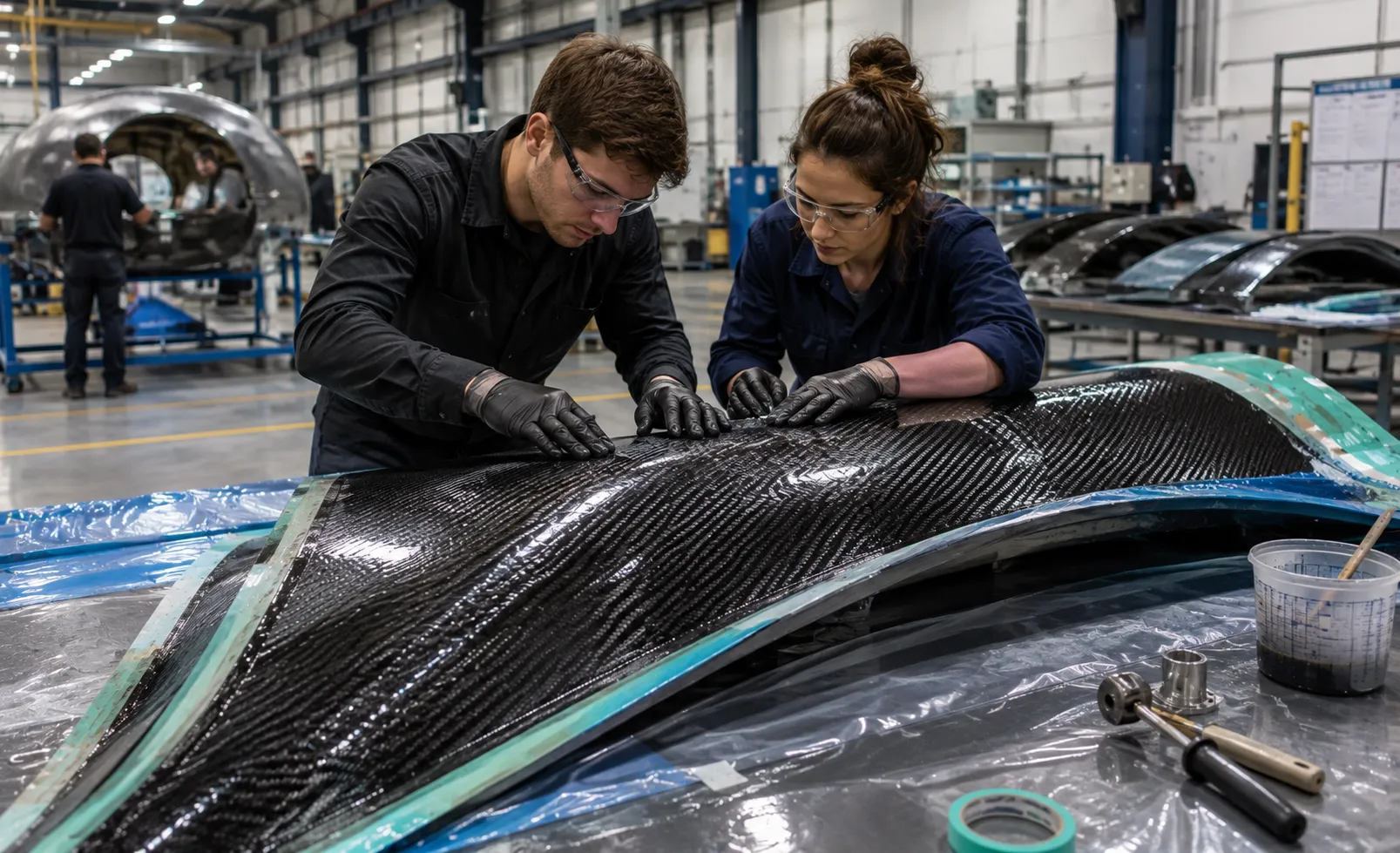

Manufacturing is quietly shifting its center of gravity. For decades, metal fabrication defined how vehicles, aircraft, and industrial equipment were built. Today, composite materials such as carbon fiber and fiberglass are taking on structural roles once reserved for steel and aluminum, and the shift is changing what employers look for on a shop floor.
Why Weight Reduction Drives the Shift
Weight reduction directly affects fuel efficiency, payload capacity, and emissions targets across aerospace and automotive sectors. A composite panel can match the strength of a metal counterpart at a fraction of the weight, which is why manufacturers increasingly design components around resin systems, laminates, and honeycomb cores rather than sheet metal alone. This is not a niche trend confined to research labs. It is now a standard consideration in production planning, procurement, and even facility layout, since composite work requires curing ovens, vacuum bagging stations, and controlled environments that differ from a traditional welding bay.
The Skills Gap Behind the Trend
The challenge for manufacturers is not demand; it is talent. Composite fabrication requires a different skill set than metal forming. Technicians need to understand resin infusion, mold making, non-destructive testing, and cure verification, along with the chemistry behind polymer matrix composites. Many facilities report that experienced metal fabricators, however skilled, still need dedicated retraining before they can safely and consistently produce aerospace-grade composite parts. This gap has pushed hiring managers to look beyond general trade experience toward candidates with hands-on exposure to lamination, bonding, and repair techniques specific to composite structures.
Educational programs have started to respond to this exact need. The Fab School Composites Manufacturing Program is one example of training built specifically around composite production rather than treating it as an add-on to a broader metalworking curriculum, reflecting how the industry now separates these two disciplines in practice.
Operational Risk and Quality Control
Composite parts carry different failure risks than metal ones. A defect in a laminate layer or improperly cured resin can compromise structural integrity in ways that aren't always visible without tap testing or other inspection methods. This raises the stakes for quality control on the production floor. Facilities working with aerospace or automotive clients often build in redundant inspection steps, including visual checks, bond testing, and documentation trails, to reduce the chance that a flawed part reaches final assembly. For operations managers, this means quality assurance protocols need to account for composite-specific defects such as delamination, voids, and improper cure cycles, which behave differently from cracks or warping in metal components.
What This Means for the Workforce
As more sectors adopt lightweight materials, the demand for technicians who understand both metal fabrication and composite processing will likely keep growing. Facilities that invest in cross-trained staff, or that recruit from programs focused specifically on composite manufacturing, are better positioned to handle mixed-material projects without slowing down production timelines. The broader lesson for manufacturing leadership is straightforward: material science is advancing faster than most training pipelines, and closing that gap now is less costly than scrambling to fill it once composite work becomes the industry default rather than the exception.

























Sign in to leave a comment.