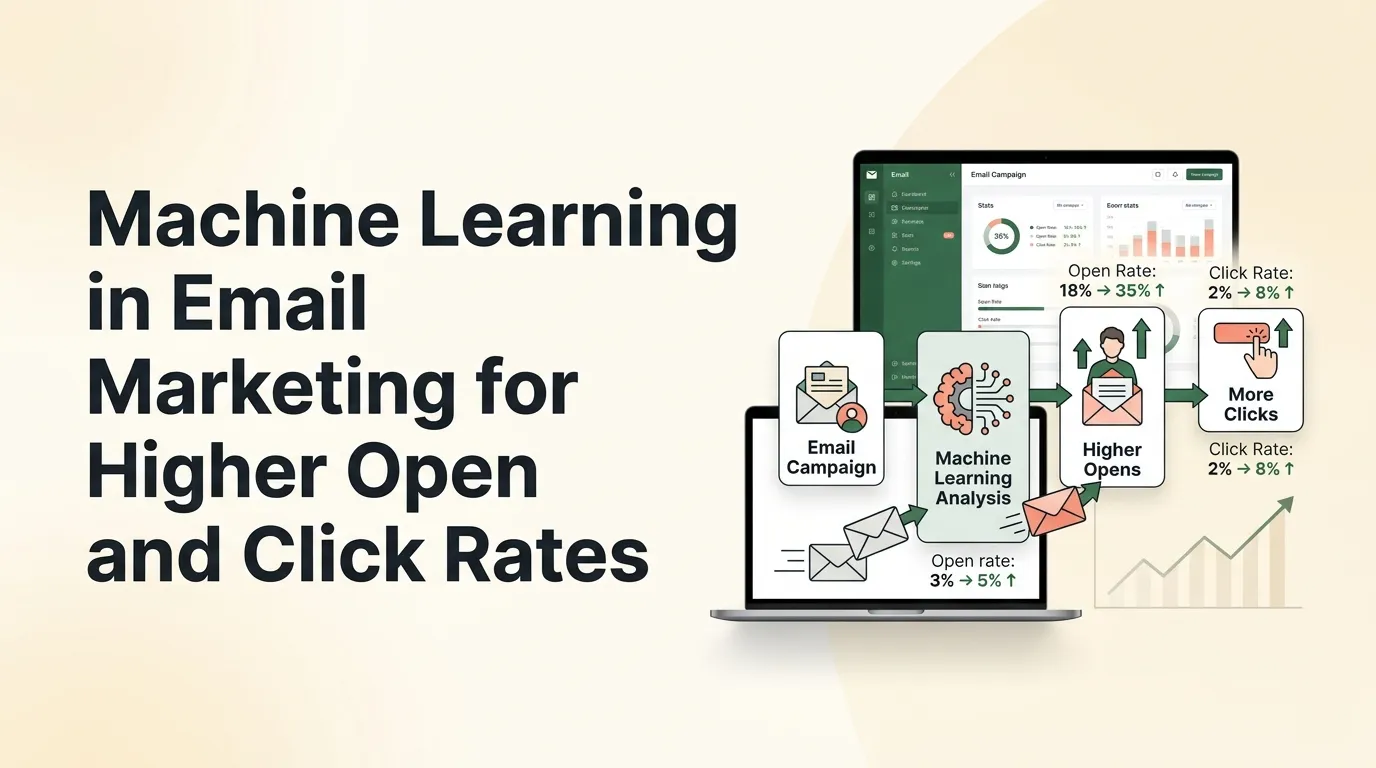

Machine learning email marketing uses predictive algorithms to calculate the ideal send time, message frequency, and content type for each subscriber based on their individual behavior. Brands still relying on fixed schedules across their full database are not just underperforming; they are actively training their audience to ignore them. This guide explains how predictive send-time models work, how frequency capping reduces churn, which platforms to consider, and how a structured rollout builds toward full predictive deployment.
How Machine Learning Calculates the Optimal Send Time
Batch scheduling applies one decision to every subscriber. Machine learning applies a separate decision to each one, driven entirely by that contact's own behavioral record.
Individual Behavioral Profiles Power the Model
The algorithm examines a rolling 90-day window of each subscriber's activity. It tracks when they open emails, when they click, and when they purchase. From those data points, it builds a profile unique to that contact. When the profile shows consistent Tuesday evening engagement, the system holds the email until Tuesday evening and overrides whatever time the campaign was originally set to deploy.
Profiles update on an ongoing basis. Behavioral shifts trigger automatic recalibration without any manual input from the team.
Where Rule-Based Automation Falls Short
Rule-based flows apply fixed conditions across the entire list: send at 9 AM, segment by timezone, delay by 48 hours. Those conditions stop working the moment a subscriber changes their daily habits. Machine learning detects behavioral drift within a few interactions and adjusts the optimal send window automatically. For teams investing in marketing automation for B2B businesses, this self-correcting capability removes the ongoing maintenance burden that rigid rule-based systems create.
Predictive Frequency Capping: Protecting Subscriber Relationships at Scale
Getting the timing right means nothing if the volume destroys trust. Predictive frequency capping manages send volume at the individual contact level rather than applying a single rule across the whole database.
Calculating Each Subscriber's Personal Threshold
A blanket frequency cap treats every subscriber identically regardless of how engaged they actually are. Predictive capping calculates how many messages each contact can receive before their unsubscribe likelihood rises and adjusts volume accordingly:
- Highly engaged VIP contacts receive frequent, personalized messaging
- Mid-tier actives receive consistent, well-targeted communication at moderate volume
- Passive or at-risk contacts receive minimal outreach with a single focused offer
McKinsey research confirms personalized algorithmic marketing produces 10 to 15% revenue lift while reducing acquisition costs. Sephora applied predictive frequency management to reduce generic blast volume and strengthen cross-channel engagement at the same time. Smarter volume control also directly reduces cart abandonment, which remains one of the most damaging omnichannel retailing mistakes brands make when email frequency overwhelms the purchase journey instead of supporting it.
Why Static Email Scheduling Damages Enterprise Performance
Fixed deployment times do not just limit results. They actively work against engagement, domain reputation, and revenue across the majority of any large subscriber database.
The Best Send Time Is Not a Single Moment
Static scheduling calculates one average across millions of different behavioral patterns and optimizes for that average. The average does not reflect most of your subscribers. A list split between early morning readers and late-night browsers gets nothing useful from a fixed midday send. Gartner research shows 84% of marketing leaders report that static generic emails fail to generate meaningful engagement. That failure is structural, not creative.
How List Fatigue Builds and Compounds
List fatigue does not announce itself. It develops quietly and creates damage that accumulates over time:
- Engagement rates drop and domain reputation weakens
- Weakened domain reputation reduces primary inbox placement rates
- Lower visibility accelerates disengagement and drives permanent churn
The Krish Predictive Engagement Matrix maps each subscriber's tolerance threshold against their lifetime value, turning the financial cost of over-sending into a visible and measurable risk.
Choosing the Right Platform for Machine Learning Email Marketing
Platform selection determines how quickly predictive capabilities go live and how well they integrate with your existing data infrastructure.
Native ESP Tools vs. Composable AI Architecture
Native ESP machine learning features offer faster deployment and simpler integration for teams already committed to a specific platform. Composable AI layers built on MACH principles offer greater flexibility for brands managing complex or custom data models. Most enterprise growth solutions built on Google Cloud and marketing platform infrastructure combine both, applying native tools where they perform well and composable layers where deeper customization is required.
Three platforms worth evaluating:
- Salesforce Marketing Cloud with Einstein STO: Analyzes 90 days of email engagement data to predict the optimal send hour per contact. Connects directly with Salesforce data extensions. Best for large enterprises with high data volumes already operating within the Salesforce ecosystem.
- Klaviyo Predictive Analytics: Generates next purchase date estimates, churn risk scores, and lifetime value predictions natively. Best for high-growth D2C brands running fast-moving product catalogs.
- AWS Personalize: Lets data engineering teams build custom algorithmic scoring layers entirely outside the ESP and feed parameters into delivery engines via API. Best for brands whose data complexity exceeds what native ESP tools can support.
Data Quality, Compliance, and the Conditions That Break Predictive Models
Predictive systems produce accurate outputs only when the data feeding them meets two basic standards: sufficient volume and current accuracy.
When Data Volume or Freshness Fails the Model
Enterprise B2B brands with long sales cycles and infrequent transactions give the algorithm too little behavioral data to learn from reliably. A subscriber who purchases once every several years does not generate enough signal for the model to build an accurate predictive profile. That data scarcity makes predictive deployment unsuitable until transaction frequency improves.
Outdated data creates a different failure. When a data warehouse syncs stale segment lists to the ESP, the algorithm deploys with confidence based on incorrect assumptions. Completing a thorough eCommerce audit before activating any predictive system is the step that separates accurate model outputs from confidently wrong ones.
Privacy Compliance Requirements
GDPR and CCPA both require users to opt out of automated profiling on request. Every data pipeline that feeds a third-party composable AI layer must remove personally identifiable information before that data enters the system. The model trains exclusively on behavioral signals, never on personal identity data.
The Krish 90-Day Rollout Framework
Predictive accuracy develops over time. Rushing past the training phase produces unreliable early results and undermines team confidence before the model has an opportunity to demonstrate its value.
The rollout follows three structured phases:
- Phase 1, Days 1 to 30: Data hygiene and pipeline integration. Audit the existing ESP, resolve tracking pixel gaps, and verify that behavioral events and purchase timestamps flow accurately and completely into the system.
- Phase 2, Days 31 to 60: Model training and shadow deployment. The algorithm builds predictive profiles in the background without altering any live send times. Validate predictions against real subscriber behavior before applying them to active campaigns.
- Phase 3, Days 61 to 90: Controlled A/B rollout. Divide the database evenly. One half receives standard batch delivery, the other receives algorithmic send times. Measure engagement lift, churn reduction, and revenue impact before expanding the model to the full list.
Conclusion
Machine learning email marketing replaces list-wide assumptions with contact-level precision. Predictive send-time optimization and individual frequency capping improve engagement rates, strengthen deliverability, and slow the subscriber churn that static scheduling accelerates over time.
Krish helps enterprise teams make this transition through how ML improves email send time and frequency, data-driven marketing automation, and modern MarTech architecture built for scale. A clean data foundation and a disciplined phased rollout are where every successful implementation begins.




























Sign in to leave a comment.