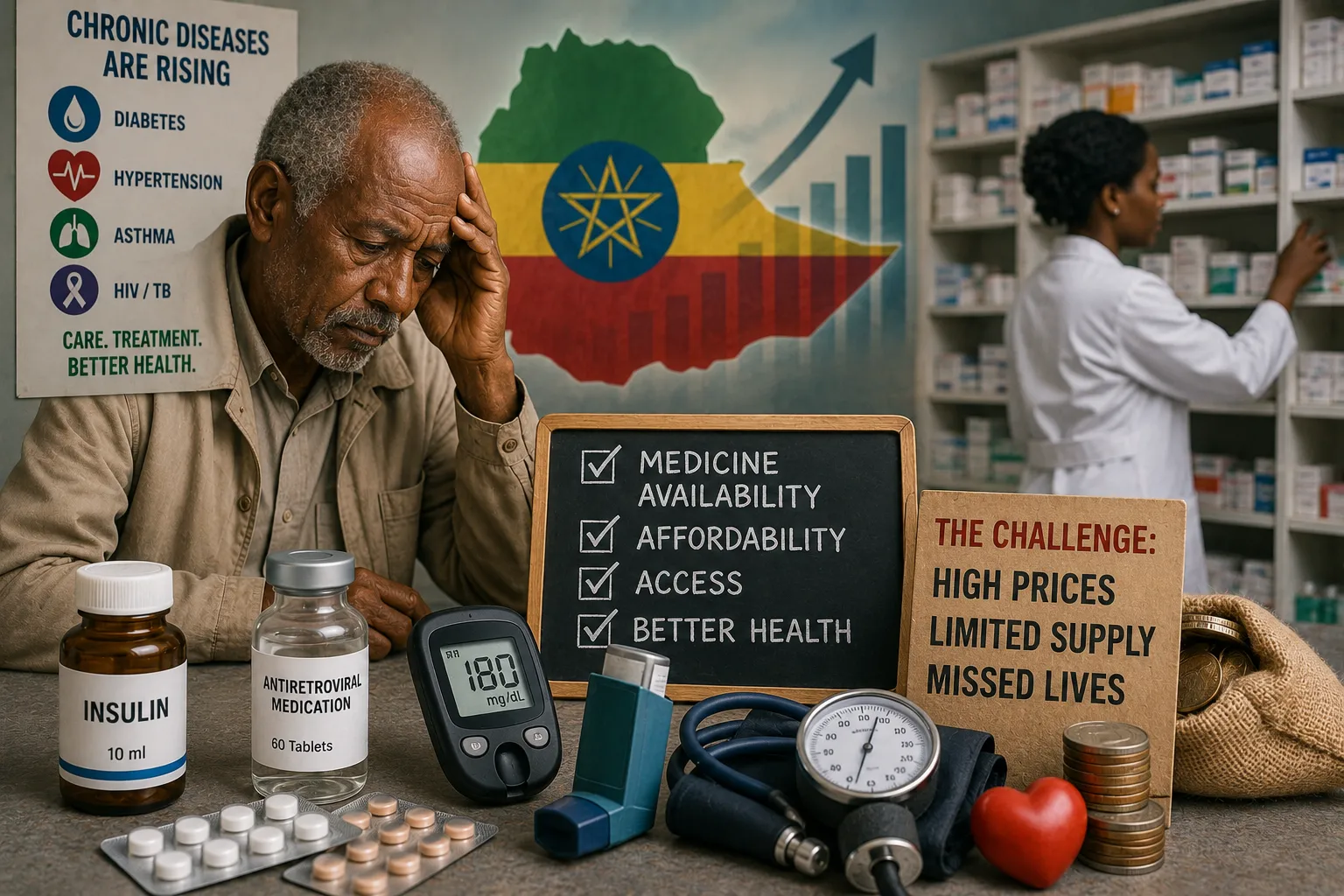

A patient walks into a health center in Addis Ababa with diabetes she was diagnosed with three months ago. She needs insulin. The health center doesn't have it today. The provider tells her to come back next week. She goes to a private pharmacy. Insulin is available but costs 800 birr per vial — roughly two days of her income if she's a daily laborer. She buys two vials instead of the one-month supply she actually needs. She's rationing it, stretching it, taking less than she should.
This happens thousands of times every week across Ethiopia. Chronic diseases are becoming increasingly common — diabetes, hypertension, heart disease, respiratory conditions — but the pharmaceutical supply system wasn't built to handle chronic disease management. It was built for acute care and infectious disease treatment.
The result is a quiet crisis. Patients who could live reasonably healthy lives with proper medicine access are instead managing their conditions poorly, having complications that could have been prevented, sometimes dying from conditions that should have been manageable.
The Chronic Disease Burden That's Changing Ethiopia
For decades, Ethiopia's health narrative was dominated by infectious diseases — malaria, TB, infectious diarrhea. Those are still major issues. But something has shifted.
As the population ages and as living conditions improve in urban areas, chronic diseases are becoming a larger proportion of the disease burden. Diabetes is increasingly common. Hypertension is widespread. Heart disease, cancer, chronic respiratory disease — these are becoming more prevalent.
The problem is that the healthcare and pharmaceutical systems haven't adapted to manage chronic disease effectively. Chronic disease requires long-term medication adherence. It requires consistent supply of specific medicines. It requires patient education and behavior change. It's fundamentally different from acute care.
The pharmaceutical supply system in Ethiopia is still oriented toward acute care. Hospitals and clinics order for immediate needs. Importers bring in medicines based on short-term demand signals. Nobody's systematically forecasting chronic disease medicine needs for the next year. Nobody's building supply chains specifically designed for chronic disease management.
The Availability Problem
The first major challenge is simple: chronic disease medicines aren't always available where patients need them.
Government health facilities often lack chronic disease medications. A government health center or hospital might have basic acute care medicines but no insulin, no antihypertensives, no anticoagulants. The government procurement system is slow and bureaucratic. By the time medicines are approved for purchase and actually delivered, months can pass. Patients show up expecting to get their regular medicines and find they're not in stock.
Private pharmacies have availability but at unaffordable prices. Private pharmacies in Addis and regional cities usually have chronic disease medicines. You can get insulin, you can get metformin, you can get lisinopril. But you pay for the convenience. Medicines in private pharmacies cost 2-3 times what they'd cost elsewhere, sometimes more.
Regional health facilities are particularly challenged. Outside Addis, accessing chronic disease medicines is genuinely difficult. A patient in Adama or Hawassa with diabetes might have to travel to Addis to get insulin or do without. Regional health centers don't have the resources to maintain inventory of specialized medicines that serve small populations.
Supply chain visibility is limited. Nobody really tracks how much insulin is being used nationally, what the total demand is, where demand is growing. This makes forecasting impossible. Importers guess. The guesses are often wrong. Sometimes there's oversupply of certain medicines. Sometimes there's shortage. It's reactive, not planned.
The Affordability Crisis
Even when medicines are available, affordability is the bigger barrier for most Ethiopians.
A patient earning 100 birr a day isn't spending 40-50 birr daily on medicine to manage a condition they feel fine with most of the time. They're eating. They're paying rent. They're choosing between medicine and other necessities.
This creates patterns that harm health:
Non-adherence. Patients don't take medicines as prescribed because they can't afford to buy them regularly. They take medicines inconsistently. They skip doses to stretch supply. They stop taking medicines entirely when money runs out.
Disease progression. Non-adherence to diabetes medication leads to complications — vision loss, kidney disease, neuropathy. What could have been managed with consistent medicine becomes a serious disability. Uncontrolled hypertension leads to stroke or heart attack. What's preventable becomes catastrophic.
Delayed diagnosis. Many Ethiopians don't see healthcare providers until conditions are severe because they know they won't be able to afford ongoing treatment. They'd rather not know they have diabetes if they can't afford insulin anyway. So diagnosis happens late, when complications have already developed.
Financial catastrophe. When chronic diseases progress to severe complications, families face massive healthcare costs. A preventable stroke leads to hospitalization, rehabilitation, loss of work capacity. A preventable amputation from uncontrolled diabetes is a lifetime disability. The financial and human costs are enormous.
Why The Supply System Can't Handle This
From a supply chain perspective, chronic disease management requires different approaches than what currently exists in Ethiopia.
Predictable, large-volume demand. Chronic disease medicine supply needs to be more predictable than acute care. A hospital doesn't know how many malaria cases it'll see next month. But it should know how many diabetic patients are registered in its catchment area and roughly how much insulin they need. This requires better forecasting and planning.
Long-term relationships with suppliers. Instead of buying one month's worth of insulin at a time, a health facility should have contracts with suppliers for consistent monthly delivery of specific medicines at specific prices. This requires planning and relationship-building that most Ethiopian health facilities don't currently do.
Quality and consistency. For acute care, having variety is sometimes okay. For chronic disease, consistency matters. A patient on a specific insulin formulation shouldn't have that changed every month. Blood pressure medicines shouldn't vary. This requires reliable supply chains and supplier relationships, not opportunistic buying.
Regional distribution infrastructure. To reach patients outside Addis, you need distribution networks that actually deliver medicines to regional health facilities and pharmacies on a regular schedule. Most current distribution is reactive — medicines show up when they show up. Chronic disease management needs reliability.
What Would Actually Help
Real improvements would require changes at multiple levels.
Government procurement needs to be more proactive. Instead of waiting for facilities to request medicines, the government should forecast chronic disease medicine needs based on epidemiology and population projections. Procurement should happen systematically, not reactively.
Health facilities need to register chronic disease patients and forecast. A clinic should know how many diabetic patients it serves and how much insulin is needed. This seems basic but most facilities don't do it. With registration and forecasting, they could approach importers and suppliers with real numbers instead of guesses.
Insurance and subsidies are essential. If chronic disease medicines were subsidized or covered by insurance, affordability would improve dramatically. A patient paying 20 percent of the cost instead of 100 percent would have much better adherence.
Suppliers need to think about chronic disease as a market segment. Right now, most pharmaceutical suppliers in Ethiopia think about immediate acute care demand. What if importers and wholesalers actually focused on chronic disease medicine supply? Building reliable distribution specifically for chronic diseases?
When healthcare facilities and suppliers are thinking strategically about chronic disease medicine supply, working with exporters who understand the Ethiopian market and can provide consistent, reliable supply of chronic disease medications becomes crucial. Finding importers and suppliers who specialize in building chronic disease medicine supply chains, rather than just opportunistically sourcing whatever medicines are requested, makes a real difference. Resources highlighting reliable pharmaceutical exporters with Ethiopia market expertise and supply chain consistency can help facilities and distributors identify suppliers committed to systematic supply rather than ad-hoc importing.
The Patient Reality
Behind all the supply chain discussion is a simple human reality.
A 45-year-old woman with diabetes in a small town has no consistent access to insulin. She manages her condition poorly. At 55, she has vision loss from diabetic retinopathy. At 58, she has kidney disease. She becomes unable to work. Her family faces financial strain from her disability and her healthcare costs.
If she'd had reliable access to insulin at an affordable price from age 45 onward, none of this would have happened. She'd be healthy and working and contributing.
The same story repeats for hypertension patients who have strokes. For asthma patients who have severe attacks that could have been prevented. For patients with heart disease who don't take their medication consistently.
These aren't rare stories. They're common. The difference between health and disability, between work capacity and dependency, often comes down to medicine availability and affordability.
Moving Forward
Chronic disease management in Ethiopia isn't going to improve by accident. It requires intentional focus from government, from healthcare providers, from pharmaceutical suppliers.
For suppliers and importers, there's actually an opportunity here. Chronic disease is a growing market in Ethiopia. If someone positioned their business around reliable chronic disease medicine supply — consistent products, predictable volumes, supportive pricing — they could serve a real need and build a sustainable business.
For healthcare facilities, it requires stepping up and taking chronic disease seriously. Register your patients. Forecast your needs. Build relationships with suppliers who can deliver consistently.
For patients, it requires access to affordable medicines as a priority. That's ultimately a policy decision, not a supply chain issue.
But until something changes systematically, the quiet crisis continues. Ethiopians suffering from preventable complications of chronic diseases, not because good medicines don't exist, but because getting those medicines is too difficult or too expensive.
That's a problem worth solving.





























Sign in to leave a comment.