

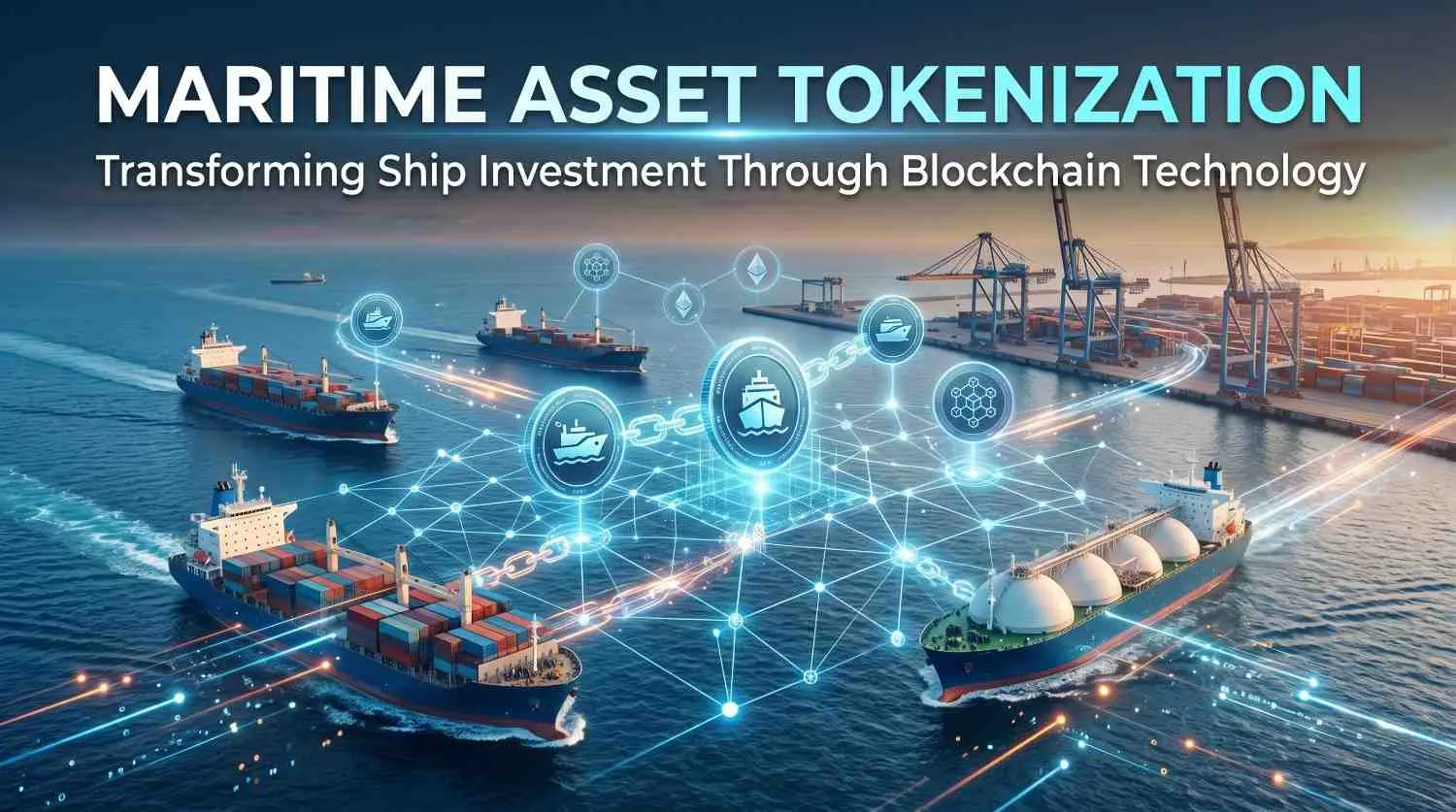
The global maritime industry moves over 80% of world trade and represents a $3 trillion economy. Yet for decades, direct participation in this essential sector has remained out of reach for most participants. The barriers? Multi-million dollar capital requirements, extreme illiquidity, and opaque deal structures that favor only institutional players.
Maritime asset tokenization is changing this reality. By converting economic exposure to physical vessels into VARA-regulated virtual assets, this innovation is opening access to one of the world's most fundamental, yet historically gated, asset classes.
This guide explores how maritime asset tokenization works, why it matters, and what prospective MAT holders need to understand before participating in the digital maritime economy.
What is Maritime Asset Tokenization?
Maritime asset tokenization is the process of converting the economic rights associated with a commercial vessel into digital tokens—Maritime Asset Tokens (MATs)—issued on a secure blockchain infrastructure.
Unlike speculative utility tokens that derive value solely from market sentiment, MATs represent economic exposure to vessel-owning Special Purpose Vehicles (SPVs). Each SPV owns a single, verified physical maritime asset: a container ship, bulk carrier, tanker, or other commercial vessel with intrinsic underlying value.
The Structure Behind the Token
Here's how the process works:
1. Asset Selection & Due Diligence
A commercial vessel undergoes rigorous technical screening, independent market appraisal, and legal verification. Only vessels that meet strict performance, age, and compliance criteria are considered.
2. SPV Formation
The vessel is held within a dedicated Special Purpose Vehicle—a ring-fenced legal entity designed to isolate the asset from other liabilities. This structure protects both the asset and token holders.
3. Token Issuance
Digital tokens are minted on-chain, each representing a fractional economic interest in the SPV. These are not equity shares, but virtual assets regulated by the Virtual Assets Regulatory Authority (VARA) in Dubai.
4. Transparent Distribution Mechanism
Where distributions are declared by the SPV board (based on vessel performance, charter status, and operating costs), payments are made transparently and on-chain to MAT holders.
This structure combines the tangible value of physical maritime assets with the transparency and accessibility of blockchain infrastructure.
Why Maritime Assets Were Previously Inaccessible
To understand the innovation, we must first understand the problem.
The Traditional Barriers
Capital Requirements
A modern container ship costs between $100 million and $200 million. Even secondhand vessels typically require capital outlays in the tens of millions. For individual participants—and many smaller institutions—direct ownership has been financially impossible.
Extreme Illiquidity
Unlike publicly traded securities, maritime assets cannot be sold with a click. Exiting a vessel investment traditionally involves complex negotiations, months of due diligence, and significant transaction costs. Capital committed to a ship has historically been locked in for years.
Opacity
Traditional maritime deals often lack real-time transparency. Valuations, charter performance, and operational expenses are frequently known only to insiders. This information asymmetry creates an environment where only those "in the room" can make informed decisions.
Geographic & Regulatory Complexity
Ship ownership involves multiple jurisdictions, flag states, port authorities, and maritime law frameworks. Navigating these complexities requires specialized expertise and institutional infrastructure.
These barriers have kept the vast majority of potential participants on the sidelines—unable to access an asset class that underpins global commerce.
How Tokenization Solves These Problems
Maritime asset tokenization addresses each of these pain points directly.
1. Fractional Access to High-Value Assets
By dividing economic exposure into digital tokens, tokenization lowers the capital threshold dramatically. Instead of needing $100 million to participate in a vessel, prospective MAT holders can gain exposure with significantly smaller amounts—making maritime investment accessible to a global audience.
2. Enhanced Liquidity Potential
While MATs are not as liquid as publicly traded equities (and prospective holders should understand that secondary market liquidity is limited and early exit may not be possible), tokenization creates the infrastructure for peer-to-peer trading on secondary markets. This represents a material improvement over traditional ship ownership, where exiting a position could take months or years.
3. Blockchain-Based Transparency
Every MAT transaction, ownership change, and distribution payment is recorded on an immutable blockchain ledger. This provides verifiable, real-time visibility into ownership structure and payment history—eliminating the opacity that has historically characterized maritime deals.
4. Simplified Cross-Border Participation
Blockchain infrastructure removes many geographic barriers. Prospective MAT holders from different jurisdictions can participate in the same vessel SPV without navigating complex cross-border ownership structures.
The Real-World Asset (RWA) Difference
It's critical to understand that Maritime Asset Tokens are fundamentally different from speculative virtual assets.
MATs Are Backed by Physical Assets
Each MAT represents economic exposure to an SPV that owns a specific, verifiable vessel. That vessel has:
- Intrinsic underlying value: The ship can be appraised, insured, and (if necessary) sold
- Residual scrap and salvage value: Even in extreme scenarios such as vessel total loss, physical maritime assets retain residual value
- Income-generating potential: Vessels under charter generate operational revenue, which (after costs and SPV board declaration) may be distributed to MAT holders
What This Means for Risk Language
Because MATs are backed by real-world assets with intrinsic value, the risk profile is different from purely speculative tokens. While MAT values may decline materially below the price at which they were purchased (and prospective holders may receive less than their invested amount, including after accounting for income received), the "total loss of capital" or "may become worthless" language used for speculative virtual assets is inaccurate for RWA tokens.
This is not to suggest MATs are risk-free—far from it. Vessel casualty, off-hire periods, charter market downturns, regulatory changes, and SPV insolvency are all real risks. But the risk must be described accurately: material capital impairment is possible; total loss of intrinsic value is structurally different given the physical asset backing.
How Shipfinex Enables Maritime Asset Tokenization
Shipfinex operates under VARA In-Principle Approval (IPA/26/01/002), providing the regulated infrastructure necessary to bridge traditional maritime finance and on-chain virtual asset markets.
Our Approach
Rigorous Asset Screening
Every vessel listed on the Shipfinex platform undergoes independent technical inspection, market appraisal, and legal verification before tokenization.
Transparent SPV Structure
Each vessel is held in a dedicated, ring-fenced SPV. Token holders receive clear documentation outlining the SPV's governance, distribution policy, and operational structure.
On-Chain Distribution
Where distributions are declared by the SPV board, payments are made transparently and verifiably on-chain—ensuring token holders can track every transaction.
Regulatory Compliance by Design
As a VARA In-Principle Approval holder, Shipfinex adheres to stringent virtual asset regulatory standards, including KYC/AML procedures, anti-money laundering controls, and investor protection requirements.
Benefits of Maritime Asset Tokenization
For prospective MAT holders, tokenization offers several compelling advantages:
Accessible Entry Point
Fractional tokenization lowers capital requirements, making maritime assets accessible to participants who could never afford direct vessel ownership.
Portfolio Diversification
Maritime assets have historically shown low correlation with traditional equity and bond markets. For participants seeking to diversify beyond conventional asset classes, vessels offer exposure to global trade flows and commodity shipping cycles.
Transparent Ownership & Payment Records
Blockchain infrastructure provides an immutable record of token ownership and distribution history—eliminating information asymmetry.
Potential for Charter Revenue Distribution
Where vessels are under charter and the SPV board declares distributions, token holders may receive proportional payments based on their holdings. (Distributions depend on vessel performance, charter status, operating costs, and SPV board declaration and are not guaranteed.)
Global Accessibility
Tokenized maritime assets can be accessed from anywhere in the world (subject to local regulatory restrictions), removing geographic barriers that have traditionally limited participation.
Understanding the Risks
Maritime asset tokenization is not without risk. Prospective MAT holders must understand the following:
Market Risk
Vessel values fluctuate based on global shipping demand, commodity prices, geopolitical factors, and regulatory changes. MAT values may decline materially below purchase price.
Operational Risk
Vessels may experience off-hire periods, mechanical failures, or casualty events. In extreme scenarios such as vessel total loss, while residual scrap and salvage value provides a floor, material capital impairment is possible.
Distribution Risk
Charter revenue distributions are not guaranteed. They depend on vessel performance, charter contract terms, operating costs, and SPV board declaration.
Liquidity Risk
Secondary market liquidity for MATs is limited. Early exit may not be possible. Prospective holders should be prepared to hold tokens for the medium to long term.
Regulatory Risk
Virtual asset regulations are evolving. Changes in regulatory frameworks could impact token transferability, distribution mechanisms, or platform operations.
SPV Insolvency Risk
In the event of SPV insolvency, token holders may lose part or all of their invested amount.
Do not invest amounts you cannot afford to lose.
The Future of Maritime Finance
The tokenization of real-world assets is not a speculative trend—it represents a fundamental shift in how physical assets are financed, owned, and traded.
Analysts project that the tokenized asset market could reach $16 trillion by 2030. As global trade continues to rely on efficient maritime logistics, the role of on-chain infrastructure in maritime finance will only expand.
Maritime asset tokenization offers a glimpse of this future: one where access to essential global infrastructure is no longer reserved for a privileged few, but available to a global community of participants who understand both the opportunity and the risk.
Final Thoughts
Maritime asset tokenization is transforming the $3 trillion shipping industry from an exclusive, opaque market into a transparent, accessible asset class. By combining the intrinsic value of physical vessels with the efficiency of blockchain infrastructure, platforms like Shipfinex are opening doors that have remained closed for generations.
But accessibility does not mean simplicity. Prospective MAT holders must understand the structure, the risks, and the regulatory framework before participating. This is not speculative trading—it is economic exposure to real-world maritime assets, with all the complexity and responsibility that entails.
For those who do their due diligence, maritime asset tokenization offers a unique opportunity to participate in the global shipping economy—and to be part of the future of real-world asset finance.
Ready to explore maritime asset tokenization?
Learn more about how Shipfinex is building the infrastructure for the digital maritime economy.
Disclaimer
This communication is issued by Shipfinex FZCO, operating under VARA In-Principle Approval (IPA/26/01/002). An IPA is not a full operational licence and is subject to completion of final regulatory requirements. Maritime Asset Tokens (MATs) are VARA-regulated virtual assets representing economic exposure to vessel-owning Special Purpose Vehicles. MATs are backed by real-world maritime assets (vessels) with intrinsic underlying value, including residual scrap and salvage value; however, MAT values may decline materially below the price at which they were purchased, and you may receive less than your invested amount including after accounting for income received. Distributions depend on vessel performance, charter status, operating costs, and SPV board declaration and are not guaranteed. Do not invest amounts you cannot afford to lose. This communication does not constitute financial, investment, or legal advice. Prospective MAT holders should review the full offering documentation and seek independent professional advice before making any purchase decision.























Sign in to leave a comment.