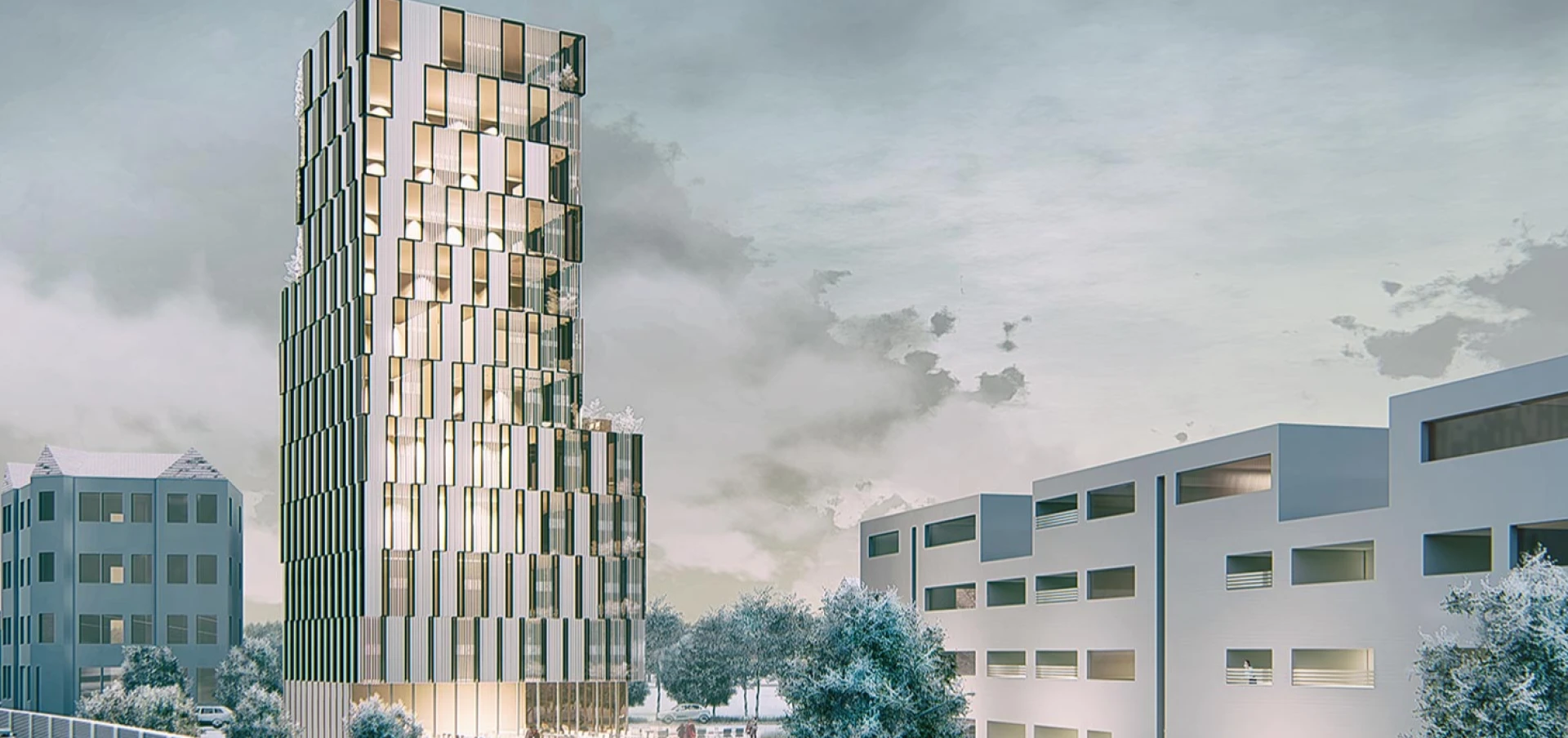
The Rome Competition entry by Studio Symbiosis represents an ambitious architectural proposal for a multifunctional development adjacent to the MAXXI Museum (Museo nazionale delle arti del XXI secolo) in Rome, Italy. Rather than a conventional building, this project is conceived as an integrated architectural and urban strategy that seamlessly connects cultural program, public space, and sustainability — proposing a new landmark for the Flaminio district of the city.
Reimagining Urban Connectivity
Central to Studio Symbiosis’s entry is the idea of architectural and social integration. The proposal responds to the complex urban fabric of the Flaminio neighbourhood by emphasizing connectivity between the MAXXI Museum, surrounding streets, and public spaces. The project comprises two interlinked components: Building A, a multifunctional facility, and System B, a landscape reconfiguration along Via Masaccio that reinvigorates the public realm.
Building A is designed as a compact, layered volume that engages both pedestrian and cultural flows. Its physical form and spatial organization are informed by contemporary computational design methodologies, yet they draw on vernacular architectural elements for a respectful dialogue with Rome’s contextual character. The building’s massing works with the urban constraints of its site while establishing a sense of continuity with its surroundings.
The architectural program is diverse, blending art storage, advanced technical laboratories, café spaces, and a landscaped rooftop terrace that serves as a public amenity. The rooftop garden, with panoramic views of the MAXXI Museum and surrounding city, becomes not only a social destination but also a place for reflection, interaction, and cultural exchange.
Landscape and Urban Integration
System B, the landscape component, extends the architectural narrative outdoors. It reimagines the stretch of Via Masaccio as a vibrant urban corridor — one that dissolves the boundary between museum precinct and local neighbourhood. Curvilinear pathways and green spaces create a cohesive urban experience, encouraging leisure, interaction, and connectivity between cultural, civic, and everyday life. This approach enables the project to serve as a bridge between architectural form and urban space.
Sustainability and Material Strategies
Sustainability is embedded in both concept and construction. The design integrates circular economy principles, including recycled materials from on-site demolition and low-carbon emission construction techniques. Structural resilience is achieved through a robust steel framework, complemented by renewable X-Lam laminated wood and innovative energy systems like geothermal heat pumps and integrated solar panels to minimize embodied carbon and operational energy requirements.
A Cultural and Urban Milestone
In essence, the Rome Competition project by Studio Symbiosis transcends traditional architectural competition submissions. It imagines a multifunctional building that is culturally responsive, environmentally responsible, and deeply embedded in the urban context of one of Italy’s most historically rich districts. By weaving program, landscape, and sustainability into a coherent whole, the design proposes more than infrastructure — it proposes a public space that resonates with Rome’s legacy and future promise.



























Sign in to leave a comment.