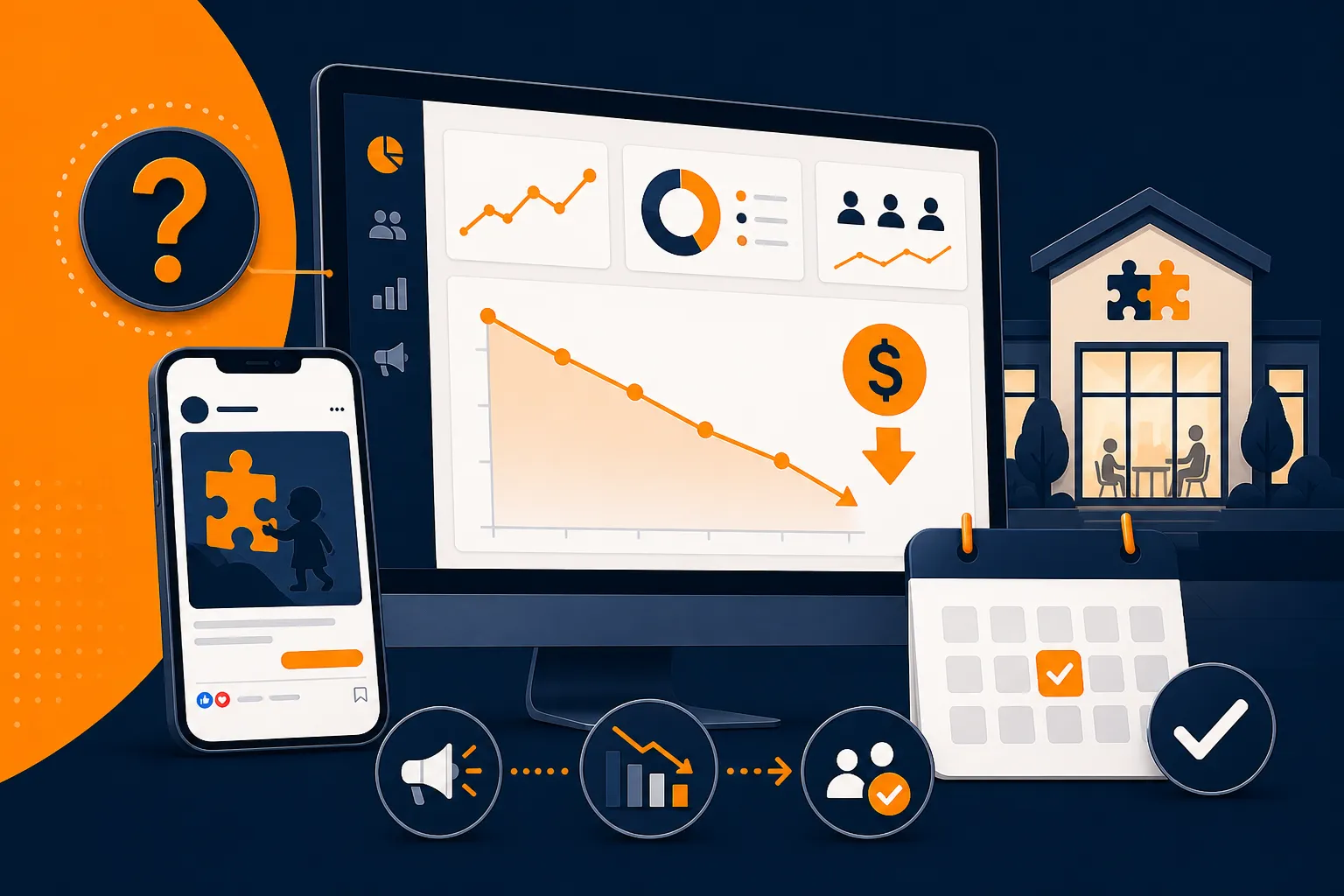

Cost per appointment is one of the most important numbers in any paid social campaign for an ABA practice. It is not just a marketing metric. It determines whether your acquisition costs are sustainable relative to the lifetime value of a client. Reducing that number is not about spending less. It is about spending more efficiently.
Start With the Funnel, Not the Ad
A common mistake is assuming that a high cost per appointment is caused by weak ad creative. In many cases, the real issue is somewhere else in the funnel.
If your ads are generating clicks at a reasonable cost but those clicks are not converting into booked appointments, the problem may be your landing page, your intake form, or your follow-up process. A parent who clicks your ad and lands on a cluttered, slow-loading page with a buried contact form will not fill it out. A parent who submits a form and does not receive a call within a few hours may move on to the next provider.
Before adjusting your creative or your budget, audit the full path from ad click to booked appointment. Where are people dropping off? That is where the fix needs to happen first. Agencies that document this kind of analysis, as seen with aba practice meta ads results, often find the biggest efficiency gains in the post-click experience rather than in the ad itself.
Audience Refinement as a Cost Reduction Tool
Once you have addressed funnel gaps, audience targeting is the next place to look. Meta's algorithm is powerful, but it works best when you give it quality data to learn from.
If your campaign has been running for a while, look at the demographic and placement breakdowns of your conversions. Which age groups are converting at the highest rate? Which placements, feed versus Stories versus Reels, are delivering the most cost-efficient appointments? Use this information to exclude low-performing segments and let your budget concentrate on the audiences that are working.
Custom audiences built from your existing client list can also help. Uploading a list of current or past clients allows Meta to model a lookalike audience of people who share similar characteristics. Because these users are more likely to be in-market and a good match for your practice, they typically convert at a lower cost than cold audiences.
Creative Testing Without Overcomplicating It
Creative fatigue is real. When the same audience sees the same ad too many times, performance drops and cost per result rises. Testing new creative regularly prevents this.
The key is to test systematically rather than randomly. Change one element at a time: swap the image or video while keeping the copy the same, or change the headline while keeping the visual. This gives you actionable data rather than noise.
Video consistently outperforms static images in Meta Ads for service-based businesses. A 15 to 30 second video that explains what the intake process looks like, what families can expect in the first session, or what makes your practice different can significantly improve both click-through rate and lead quality. Higher quality leads mean fewer wasted intake conversations, which ultimately brings cost per appointment down.
Reducing cost per appointment is not a one-time project. It is an ongoing discipline of monitoring, testing, and adjusting. The practices that stay consistent with this process see cumulative improvements in efficiency over time.




























Sign in to leave a comment.