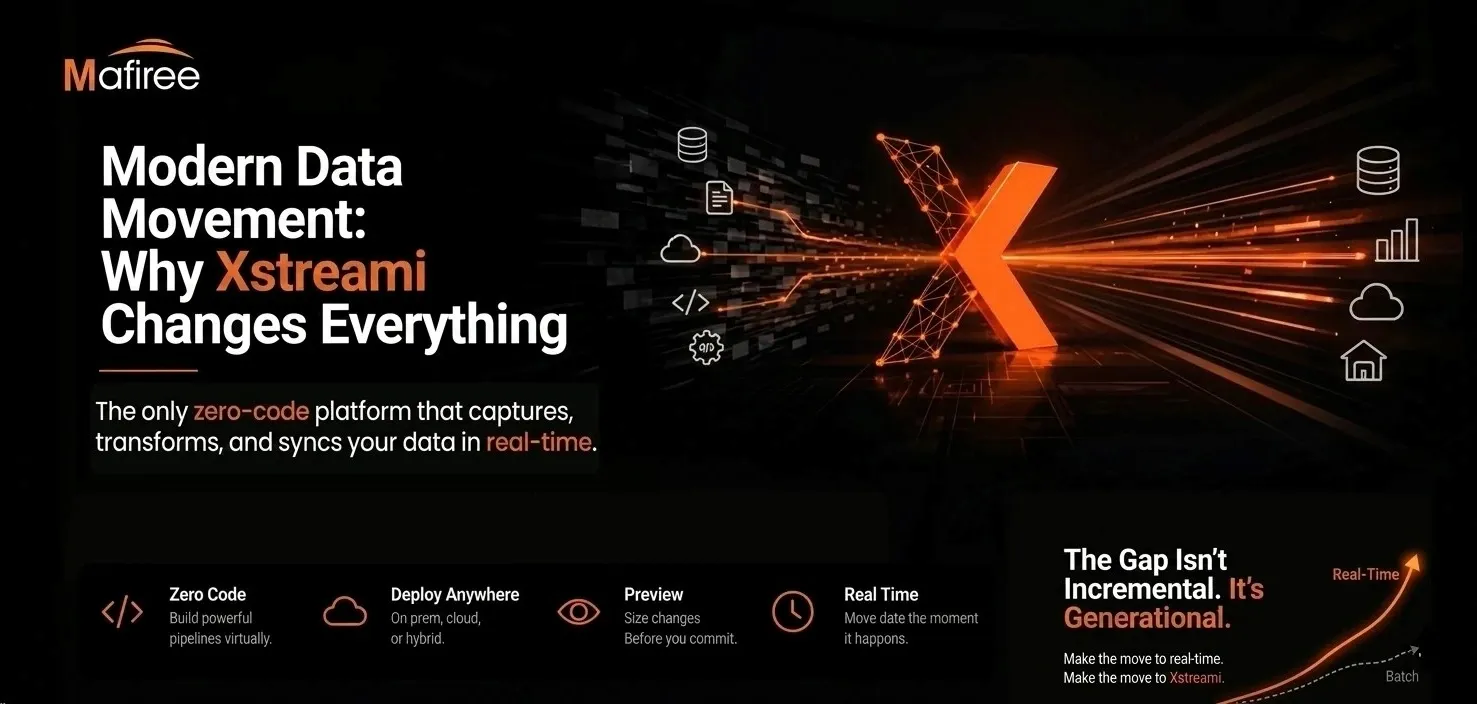

From Storing Data to Real-Time Data Movement
For years, data companies competed on storage - the biggest warehouse, the deepest lake, whoever held the most data. That race is over. The real advantage today isn't how much data you hold, but how fast you can move it from where it's generated to where it actually creates value. Every second data stays idle is a second a real-time competitor gets to act while you're still waiting. By 2026, real-time data streaming isn't a nice-to-have for enterprises - it's the baseline, and it's what separates companies that respond in seconds from those still working in hours.
Built for the Speed of Thought
Xstreami isn't framed as another CDC or ETL tool — it's called a real-time data execution engine. It works as an always-on bridge sitting between production systems and every place that data needs to go. As soon as something changes anywhere in the stack, Xstreami picks it up, applies transformation logic, and delivers it — with no polling, no batch windows, and no scheduled jobs, since it's built on a genuinely event-driven model. It links sources such as PostgreSQL, MySQL, MongoDB, Kafka Streams, and REST APIs to destinations like BI tools, AI/ML models, warehouses, microservices, and applications. Its three defining numbers: sub-millisecond latency, one unified dashboard, and zero-downtime streaming around the clock.
Why "Batch" Is a Liability in the Real-Time Era
Batch made sense years ago, when systems moved slower and nobody expected instant personalization. That expectation has shifted, but batch processing hasn't kept up — it's now just friction. Every hour of delay is an hour a real-time competitor can use against you, and every outdated dashboard risks driving a bad call. Standard batch pipelines can run close to 24 hours behind. The blog likens this to a postal service delivering mail once a day: fine for routine letters, but useless for fraud detection, dynamic pricing, or live recommendations, where information that's eight hours old is worthless. Four failure modes of batch are highlighted: latency (acting on stale data), inconsistency (systems drifting apart between runs), blocked teams (everyone stuck waiting on the pipeline), and missed signals (fraud, churn, or demand spikes noticed only after they've already happened).
This leads into Xstreami's four pillars, each built to fix one of these specific failure points:
1. Zero-Code Dashboard - A single screen displays every pipeline's status, throughput, latency, and errors - no SSH, no terminal commands, no digging through scattered logs. Streams can be paused, restarted, or edited with one click, letting teams focus on what the data should do instead of managing infrastructure.
2. From Code-Deploy to Click-Deploy - Instead of routing every pipeline change through code review, CI/CD, and a scheduled release window (often a multi-day process with downtime risk), Xstreami offers a visual Smart Rule UI for building joins, filters, enrichment, and routing logic that goes live in under 30 seconds. A change that once took a two-day engineering ticket becomes something anyone with dashboard access can do themselves in half a minute.
3. Nightmare-Free Error Handling - Traditional CDC failures are often discovered only when a downstream team complains, followed by hours of log-searching and tracking down whoever built the pipeline. Xstreami instead sends an immediate dashboard alert with the exact cause, lets you edit the rule right in the UI, and restarts the stream with one click - with every change logged in an immutable audit trail. A multi-hour incident becomes a five-minute fix.
4. Live Preview: Confidence Before Commitment - Because staging environments rarely match production data, every pipeline change used to carry real risk. Live Preview runs new transformation logic against actual production data in read-only mode, so you see the real output - including edge cases - before anything goes live. The outcome is deployments with no surprises, and confidence that takes seconds rather than days of staging tests.
What This Means for Every Team
Engineers spend less time firefighting and more time building real architecture. Data teams can test and validate transformations quickly using Live Preview and make rule changes themselves, without filing engineering tickets. Business leaders get to act on current data rather than yesterday's numbers, with fewer bottlenecks between teams and tighter real-time alignment across the company.
Want to Understand the Concepts Behind Xstreami?
The blog wraps up by describing the shift from batch to real-time as a generational change, not an incremental one. Where other tools ask businesses to work around the limits of batch pipelines, Xstreami is positioned as matching the pace of the business itself - combining sub-millisecond latency, one unified dashboard, and 24/7 zero-downtime operation into a single real-time data movement platform.























Sign in to leave a comment.