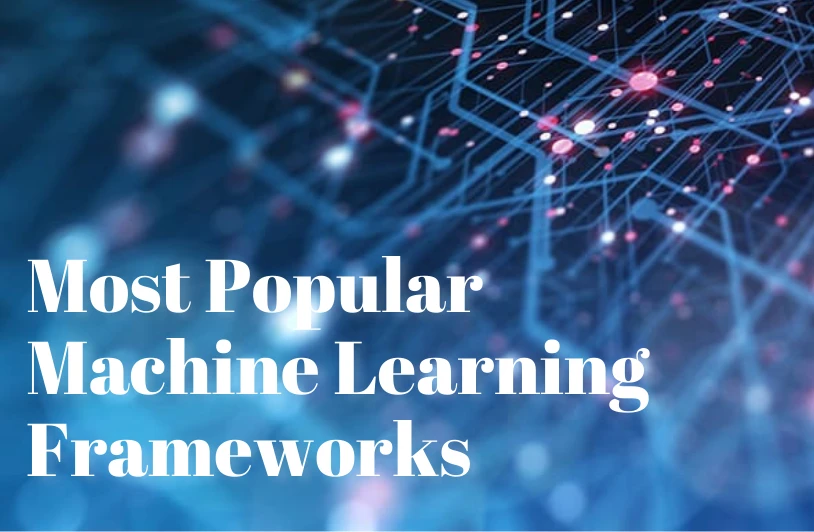

Technology has transformed everything. From doing critical tasks to interacting with machines, technologies, and data. All these have been possible with machine learning.
Machine learning has grown into a billion-dollar market and continues to grow with the rise in demand by almost every industry.
You might not know but somehow every other person has availed of the benefits of machine learning through the modern technologies they use. One such example is a mobile device, where 97% of users are using AI-powered voice assistants.
Also as per the numbers and insights, 80% of people state that the integration and use of AI into their businesses has helped them increase their revenue. With this simple statistic, it is clear that ML has been holding strong in the market which is why everyone is embracing it for the integration of Machine Learning into their businesses.
In this article, we will be filling you up with the details on machine learning and some of the best frameworks for the same.
An Overview of Machine Learning (ML)
It is a branch of Artificial Intelligence, designed to teach machines to perform explicit tasks without having to program them.
Additionally, it also helps in the identification of the patterns and makes data-driven decisions based on these patterns. Also, machine learning can make predictions, classify objects and patterns, and find similarities or differences between them.
One common use case of Machine Learning is a recommendation engine, fraud detection, spam filtering, and many more.
Importance of Machine Learning
Leading corporate giants like Facebook, Google, and Uber, have made machine learning a central part of their operations and have made them exceptionally popular and stand out in the market.
Below we have mentioned some of the benefits and importance of machine learning, so here we go.
It helps in providing organizations and businesses with a view of the latest trends and demands in customer behavior.The trends and patterns collected help in the development of new products that aid both consumers and businesses.Additionally, it has also boosted business operations along with increased productivity.It also helps in providing targeted suggestions to boost a business.Also improvises the automation process, saving a lot of time and money.It eliminates almost all the defects and possible human errors.It also offloads all the possible threats to a business, like data breaches, identity theft, etc, and also complements existing security.Adding more to it, Machine Learning also helps in performing complex tasks such as algorithmic trading and fraud detection.Now that we have a basic understanding of what machine learning is and its importance, we will be moving forward with the most popular machine learning frameworks.
Most Popular Machine Learning Frameworks
Numerous frameworks are widely used in machine learning. Below we have mentioned some of the popular frameworks for your reference.
TheanoApache SparkAccord.NETTensorFlowScikit-learnPyTorchKerasTheano
It is an open-source and one of the fastest python libraries used in the development of machine learning models quickly. It is used to deal with mathematical expressions involving multi-dimensional arrays and was initially released in 2007 by the Montreal Institute for Learning Algorithms (MILA). Additionally, Theano computations are expressed using a NumPy-Esque syntax which is compiled to run seamlessly on the different ML architectures.
Pros:
It provides dynamic C code generation to evaluate expressions faster.It uses GPUs to perform efficient symbolic differentiation.Cons:
It can be complex on Amazon Web Service (AWS).It requires a large compilation time for extensive and complex models.Apache Spark
It is an open-source cluster computing framework with a unified analytics engine used in the processing of large-scale data. It was launched in 2014 at the University of California, Berkeley's AMPLab and focuses on working with Resilient Distributed Dataset (RDD) data structure. It also provides an interface to program clusters with implicit data parallelism and is maintained in a fault-tolerant way. The workflow here is managed as a directed acyclic graph (DAG). Additionally, it also comes with multilingual and advanced analytics features.
Pros:
It enables the implementation of both iterative algorithms.It is easy to use, adaptable, and fast.Cons:
It doesn’t have a file management system, which makes it dependent on other platforms.It is expensive since it requires additional memory.Accord.NET
It is a .NET machine learning framework used in scientific computing, with audio and image processing libraries written in C#. It was released in May 2010 and was created by César Roberto de Souza. It covers various ML topics with multiple algorithms like Numerical Linear Algebra, Classification, Regression, Clustering, Hypothesis Tests, and support libraries like graph plotting and visualization. Additionally, it is used in the development of production-grade computer vision, and signal processing, and also for commercial use.
Pros:
It is well-documented and has vast development partners. Its libraries are available as source code that are executable installers as well as NuGet packages (An open-source package created for the Microsoft development platform).Cons:
It is slower as compared to TensorFlow.It lacks troubleshooting resources.TensorFlow
It is one of the widely used and versatile Machine Learning frameworks, initially released in November 2015, developed for data-based programming. It also has a comprehensive library of extensive and flexible functions which allows you to build different types of ML models that work well with CPUs and GPUs. Additionally, it is used for both research and production at Google.
Pros:
It helps in handling a wide range of data.It is portable and can run on every device.Cons:
It is quite a complex framework, which requires extra effort.It releases updates every 2-3 months which makes it time-consuming to bind it with the existing system.Scikit-learn
Formerly known as scikits.learn, is one of the finest and most widely used ML frameworks developed by the Python community. It was originally released in June 2007 by David Cournapeau, as a Google Summer of Code project.
Additionally, it is highly recommended for data mining problems and has a clean API. It also supports vector machines, random forests, gradient boosting, k-means, DBSCAN, and other scientific libraries like NumPy and SciPy.
Pros:
It is capable of working on multiple tasks without compromising speed.It allows the developers to change the algorithm's predetermined parameters to make it easy to tune and troubleshoot models.Cons:
It is not very good at string processing.Scikit-learn is not optimized for graph algorithms.PyTorch
Also known as Torch, it is an open-source and lightweight framework developed by Meta (formerly known as Facebook) with high-end flexibility and efficiency. The corporate giants that use PyTorch include Yandex, IBM, Idiap Research Institute, and many more. It also has a scripting language like Lua programming UI and has a widespread application in the fields like computer vision, research, and Natural Language Processing (NLP).
Pros:
It is capable of performing difficult operations in less time along with a huge ecosystem of driven packages. It is beginner-friendly, with multi-GPU support, and also allows smooth integration with Python.Cons:
It lacks monitoring and visualization tools.It has a smaller developer community as compared to other ML frameworks.Keras
It is a neural network library and acts as a bridge between the machine and deep learning. It was released in March 2015, by François Chollet, a Google engineer. It is built on top of TensorFlow to make Machine Learning modeling straightforward. Also, Keras isn’t just limited to TensorFlow, it can be also used with Microsoft Cognitive Toolkit (CNTK), Theano, and many other ML frameworks. Additionally, it comes with an understanding of translation, tagging, and understanding of various languages, and also has a collection of pre-trained models.
Pros:
It is one of the most simple machine learning frameworks.It is user-friendly, well-documented, and has large community support.Cons:
It has a low-level API, which makes it unable to handle low-level computations.It does not support the features of dynamic chart creation.Conclusion
Above we have listed a few of the popular machine learning frameworks, but there are a few more frameworks that have contributed to the Machine Learning industry. The frameworks include MXNet, Caffe, H2O, Shogun, Amazon Machine Learning, and many more.
Now that you have an idea of which frameworks are suitable per your requirements you can move ahead and work on your ML model and deliver and avail of the best services that machine learning has to offer, for each framework has its unique set of features and functionalities to cater to all your requirements.


























Sign in to leave a comment.