
When selecting film capacitors for industrial or power electronic applications, engineers often compare MPP (Metallized Polypropylene) and MPET (Metallized Polyester) capacitors.
While both are metallized film capacitors, their electrical performance, thermal stability, and application suitability differ significantly.
This guide explains the technical difference between MPP and MPET capacitors to help engineers choose the right one.
1️- What is an MPP Capacitor?
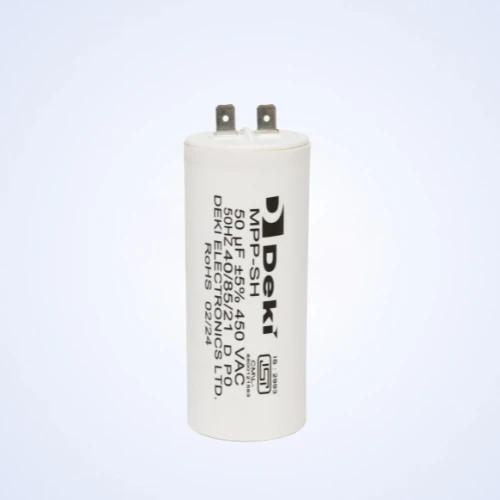
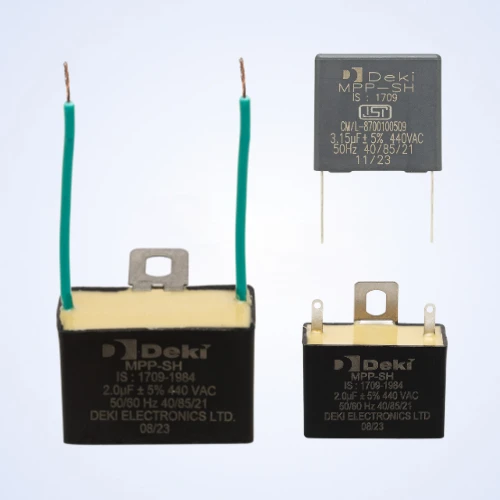
MPP stands for Metallized Polypropylene capacitor.
It uses:
- Polypropylene dielectric film
- Vacuum metallized electrode layer
- Self-healing construction
Key Characteristics:
- Low ESR
- Low dielectric loss
- High ripple current capability
- Excellent frequency stability
- Better temperature performance
- Long lifespan
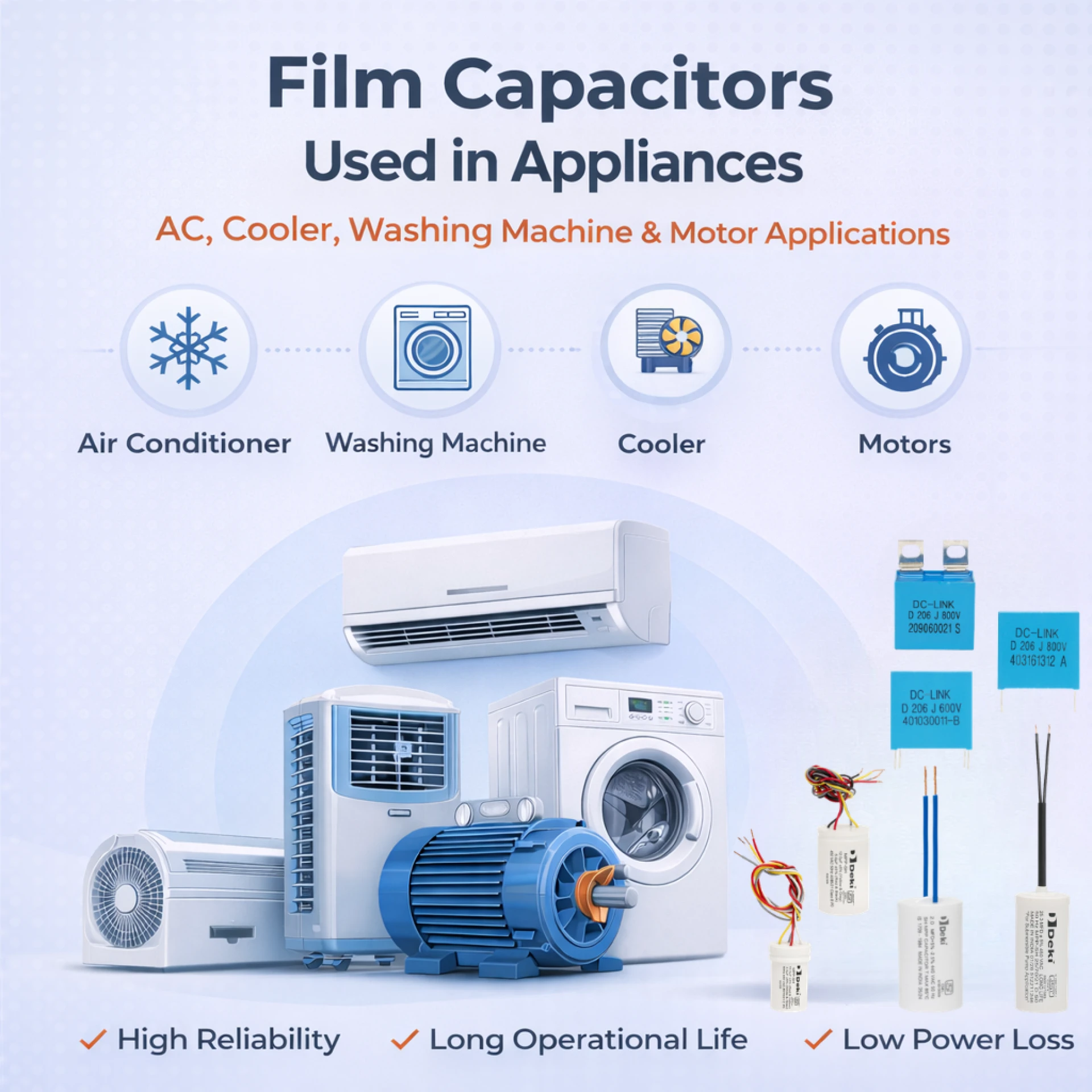
MPP capacitors are widely used in:
- DC link circuits
- IGBT modules
- Snubber circuits
- High-frequency inverters
- EV power electronics
2️- What is an MPET Capacitor?
MPET stands for Metallized Polyester (PET) capacitor.
It uses:
- Polyester dielectric film
- Metallized electrode layer
Key Characteristics:
- Higher dielectric constant
- Compact size for same capacitance
- Higher ESR than MPP
- Moderate ripple capability
- Lower cost
MPET capacitors are commonly used in:
- Fan regulators
- Motor run circuits
- Lighting circuits
- Consumer electronics
- EMI suppression
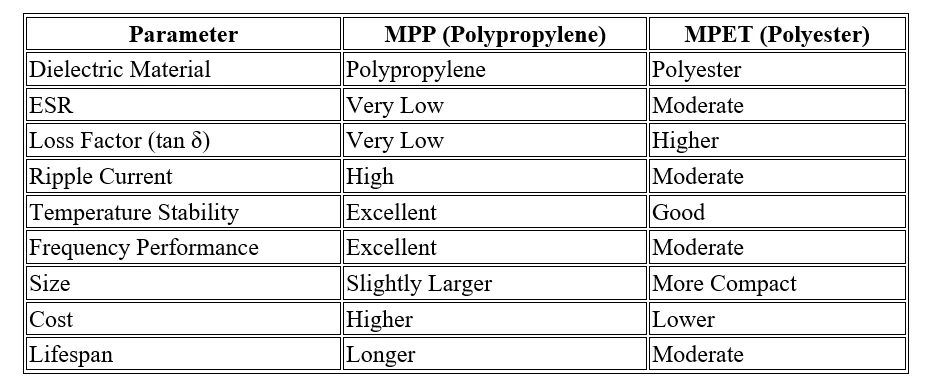
3️- MPP vs MPET – Technical Comparison
| Parameter | MPP (Polypropylene) | MPET (Polyester) |
|---|---|---|
| Dielectric Material | Polypropylene | Polyester |
| ESR | Very Low | Moderate |
| Loss Factor (tan δ) | Very Low | Higher |
| Ripple Current | High | Moderate |
| Temperature Stability | Excellent | Good |
| Frequency Performance | Excellent | Moderate |
| Size | Slightly Larger | More Compact |
| Cost | Higher | Lower |
| Lifespan | Longer | Moderate |
4️- Why MPP Has Lower ESR than MPET?
Polypropylene has:
- Lower dielectric loss factor
- Higher insulation resistance
- Better thermal dissipation
This results in:
✔ Lower self-heating
✔ Higher ripple current capability
✔ Better performance in high-frequency circuits
This is why MPP capacitors are preferred for DC link and IGBT applications.
5️- Application-Based Selection Guide
Choose MPP When:
- High ripple current is required
- Low ESR is critical
- Application involves EV / inverters
- Long life is required
- Operating temperature is high
Choose MPET When:
- Cost optimization is required
- Compact size is important
- Application is low-frequency
- Moderate performance is acceptable
6️- Reliability & Lifespan Comparison
MPP capacitors generally provide:
- Better thermal endurance
- Lower capacitance drop over time
- Reduced internal heating
MPET capacitors, while cost-effective, may have:
- Slightly higher dielectric losses
- Higher self-heating under load
For mission-critical applications, MPP is preferred.
7️- Frequently Asked Questions
1. Is MPP better than MPET?
For high-performance power electronics, yes.
For cost-sensitive consumer applications, MPET may be sufficient.
2. Which capacitor is better for DC link?
MPP capacitor.
3. Which capacitor is used in fan motor?
Typically MPET or motor-run polypropylene depending on rating.
8️- Final Conclusion
Both MPP and MPET capacitors have specific advantages.
MPP capacitors are ideal for:
- High ripple
- High frequency
- EV and inverter systems
MPET capacitors are suitable for:
- Consumer appliances
- Cost-sensitive applications
- Moderate electrical stress
Selecting the correct dielectric directly impacts system reliability and performance.
























Sign in to leave a comment.